In Chávez’s Absence, the Government Seeks to Dissipate Opposition with Fear
Courtesy of: Agence France Presse
As is well documented, the Venezuelan government’s record on human rights has been substandard at best. For years, human rights watchdogs have criticized the government for consolidating power in the executive branch and using that power to intimidate, censor and prosecute those who criticize the president or his regime. During Hugo Chávez’s prolonged absence, these problems have only gotten worse.
Fears that Chávez’s declining health will force a new presidential election in the coming months has the United Socialist Party of Venezuela (PSUV) party concerned. Both of Chávez’s likeliest successors lack the charisma and deep popular support the president enjoys, prompting many within the government to wonder whether the movement will survive without its strong leader. A slumping economy has further exposed the government’s failures, and the PSUV has continually sought to change the subject.
Knowing of this – and of the PSUV’s penchant for strongman tactics – it is hardly surprising that there has been significant harassment of Venezuela’s opposition in the past month.
For example, the government has stepped up accusations that three opposition lawmakers were involved in corruption, in a clear attempt to demoralize, fracture and damage the reputation of the opposition. Leaders of the ruling PSUV have threatened to jail those involved and have pledged to pursue further investigations into the alleged financial irregularities.
The attacks weren’t limited to these lesser known lawmakers. Just this week, Chávez’s chosen successor, Vice President Nicolás Maduro, launched a scathing assault on the opposition’s charismatic leader, Henrique Capriles. Capriles was in the United States visiting his sister and her family, who live in New York. Maduro alleged – without any evidence – that Capriles himself owns a lavish high-rise in New York City, and accused Capriles of engaging with Venezuelan expatriates in a plot to destabilize the country. He boasted to a friendly audience that he was “tracking the movements” of Capriles. Capriles called the accusations false, and suggested that Maduro was trying to distract Venezuelans from the damage wrought by a currency devaluation, rampant violence and escalating shortages – not to mention the continuing secrecy surrounding Chávez’s battle with cancer.
“It seems ridiculous to me, with all the problems that there are in Venezuela, that this is what the government is talking about,” Capriles told the New York Times.
Last week, Venezuelan prosecutors brought influence peddling charges against Leopoldo López, a prominent opposition leader, economist and former mayor of the Chacao Municipality of Caracas. He is accused of accepting donations from Venezuela’s state-run oil company in 1998, donations that were purportedly authorized by his mother, Antonietta Mendoza de Lopez, who was a PDVSA administrative employee at the time. Government officials allege the funds were used to form the now popular First Justice Party. Arguing the charges are politically motivated, López denies any wrongdoing.
Of course, if it’s corruption they are after, the PSUV need look no further than itself: under their rule, Venezuela is considered the most corrupt nation in Latin America by Transparency International.
According to Luis Vicente León, analyst and head of the renowned Datanálisis polling firm, the point of these measures is to make the country believe there is a strong government in place despite Chávez’s absence. He expects a series of symbolic actions against key players of the opposition, to instill fear in society and dissuade others from speaking out against Chavismo.
Attacks against the media have become a clear example of this intimidation strategy. Globovisión, the last television network in Venezuela openly critical of the government, was not among the list of stations to be included when the country transitions to a new digital TV signal. The decision will likely drive the station off the air at that time. The government has refused to offer an explanation for the exclusion. Similarly, the website analisis24.com and its Twitter account have been blocked in Venezuela after publishing a series of pictures of Chávez and his daughters in Cuba.
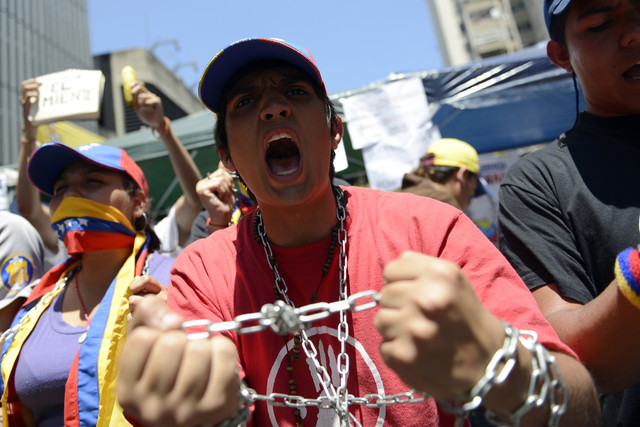
Most troubling thus far, however, were the attacks against students during a peaceful demonstration. Frustrated after not hearing from President Chávez for 80 days, about 120 students gathered in front of the Executive Directorate of the Judiciary to demand answers from the government about the true health of their president. They were received instead by members of the military, who wielded batons and fired pellets, injuring four of them. Once again, the government has offered no justification for these attacks on its own citizens.
Though there has been no word on whether Chávez will ever return to power, it is clear that the regime fears the uncertainty that would follow if he passes. After 14 years under the strong leadership of Hugo Chávez, PSUV faces the difficult task of convincing Venezuela it is capable of governing without him. The dire economic situation in the country shows that they have much to prove on that front. Yet thus far, fear, intimidation and the suppression of free speech appear to be their only solutions.