Jan
31
2012
Posted by
admin
Comments

Meet the Cadidates: María Corina Machado

800px Mariacorinamachado2 Meet the Cadidates: María Corina Machado

Source: World Economic Forum
(photo by Bel Pedrosa)

Today, as part of What’s Next Venezuela’s “Meet the Candidates” series, we introduce Venezuelan opposition candidate María Corina Machado.

María Corina Machado is running as an independent candidate in the February primaries, with the hope of facing President Hugo Chávez in the October general elections and becoming the first woman president of Venezuela.

Early on in her career, Machado focused on Venezuela’s youth, successfully co-founding ATENEA, an organization that assists orphaned and abandoned children. She also served as chair of a similar organization called Oportunitas Foundation, which focuses on helping Venezuela’s youth.

Years later, her focus shifted to keeping a close watch on the government. In fact, Machado co-founded in 2002 the political watchdog organization known as Súmate. The organization’s main goal is to promote and defend the political rights of every Venezuelan. Under her leadership, Súmate gained around 30,000 supporters and received international praise.

Two years later, Machado and fellow Súmate members played an active role in collecting signatures from nearly a quarter of the Venezuelan electorate in support of a referendum to recall President Chávez. The National Endowment for Democracy provided financial support for the group’s efforts, which followed constitutional guidelines. Mr. Chávez responded by charging Machado with conspiracy and treason. He also banned her from leaving the country for a period of three years.

After resigning from Súmate in 2010, Machado was elected to represent the state of Miranda in the Venezuelan National Assembly, winning her seat with more votes than any other candidate during the elections.

Machado has remained a vocal opponent of Chávez’s human rights violations and abuses of power, particularly as they relate to expropriations. Her most defiant criticism of Chávez’s expropriation policies came during the President’s nine-and-a-half hour State of the Union address earlier this month, when Machado interrupted Chávez to accuse him of lying to the Venezuelan people about food sovereignty and expropriations. She compared expropriation to theft and demanded that Chávez, “tell the truth to Venezuela.”

As Machado heads into the February primary elections, she has established a platform focused on:

- Reducing the power of the “oficialismo” and ridding the government of corruption;
- Enacting “popular capitalism,” aimed at providing Venezuelans equal opportunity, justice and truth;
- Decentralizing power and reestablishing the power of  local governments, which have been weakened under Chávez;
- Re-instating the “juntas parroquiales,” an initiative that encourages private industry and religious organizations to be responsible for providing social services to the Venezuelan people;
- Increasing accountability and transparency of the government, particularly with regard to national resources and exports;
- Halting attacks on human rights by ending censorship of the national media and the unlawful takeovers of private property by the Chávez regime.

Click here to learn more about María Corina Machado on her website.
 
Jan
30
2012
Posted by
admin
Comments

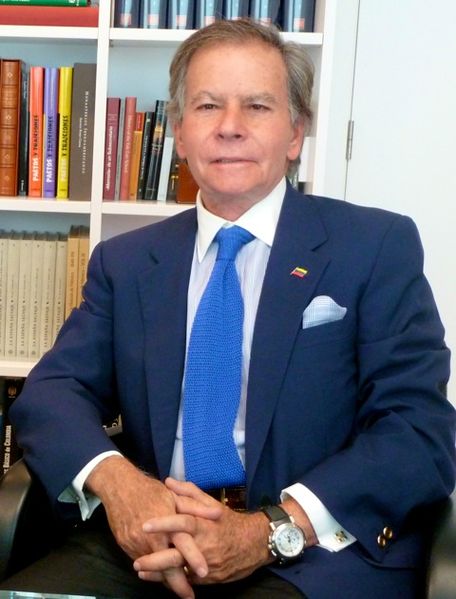
Meet the Candidates: Diego Arria

 Meet the Candidates: Diego Arria

Source:
Wikimedia commons

This week, What’s Next Venezuela presents our “Meet the Candidates” series. Over the next five days, we will share with you the backgrounds of five Venezuelans battling to become the presidential candidate for the Mesa de la Unidad Democrática (MUD) in the February 12 primary. The winner will face President Hugo Chávez in the October 7 presidential elections. Today, we introduce Diego Arria.

Diego Arria, known for his work in international diplomacy, is running as an independent candidate in the 2012 Venezuelan primary elections.

For much of his political career, Arria held several positions within the United Nations (UN). He served as the Venezuelan permanent representative to the UN, rising to chair the UN Security Council, the organization’s most important committee. Later, he served as special advisor to Kofi Annan, then Secretary General of the UN. During his time leading the Security Council, Arria directed several conflict resolution missions in Sarajevo, Bosnia, the Balkans and Rwanda, becoming recognized as a champion of human rights. He actively endorsed the creation of an international tribunal to try human rights violators and served as a witness during the trial against Slobodan Milosevic. He also established himself as an approachable leader through the creation of “Arria Formula,” a program that allowed individuals and organizations to engage in informal dialogue with the Security Council.

Prior to his involvement in the UN, Arria was a prominent politician in Venezuela. Arria was appointed in 1974 as the Governor of the Federal District (Caracas) during the presidency of Carlos Andrés Peréz. Later, in 1978, after a brief stint as Minister of Information and Tourism, Arria ran as an independent candidate in the Venezuelan presidential election of 1978, in which he garnered only 1.7 percent of the vote.

In the present campaign, Arria has emphasized the need for a Constitutional Assembly that would amend changes to the current Venezuelan Constitution that was adopted in 1999. Arria has also been a sharp, vocal critic of Chávez’s expropriation policies. Following Arria’s participation in the Oslo Freedom Forum, where he accused Chávez of crimes against his people, the Venezuelan government seized his ranch, known as “La Carolina,” in the State of Yaracuy.

Since announcing his candidacy, Arria has filed a complaint against President Chávez, accusing him of crimes against humanity before the International Criminal Court (ICC) at The Hague. The complaint alleges that President Chávez and several of his top advisors violated human rights through murder, forced displacement and violation of property.

Leading up to the February elections, Arria has established a platform focused on:

  • Decentralizing power and distributing it among governors and mayors;
  • Convening a Constitutional Assembly to limit presidential terms to 3 years with no possibility of reelection;
  • Strengthening Venezuela’s relationship with the United States.
  • Improving Venezuela’s education system by focusing on equal access to education, freeing the classroom of political ideologies, and providing teachers with greater influence;
  • Working to improve the daily lives of ordinary citizens by protecting human rights, including the right to private property;
  • Quelling violence related to drug trafficking that crosses into Venezuela;
  • Reestablishing the Armed forces without corruption;

Click here to learn more about Diego Arria on his website.

 
Jan
30
2012
Posted by
admin
Comments

ICYMI: Venezuela’s New Chance

Venezuela’s New Chance
The Washington Post
January 29, 2012
By Editorial Board

IN 13 YEARS of ruling Venezuela, Hugo Chavez has often benefited from his opposition. His first election victory reflected disgust with a complacent and corrupt political order; in his early years, the remnants of that elite played into his hands by boycotting elections while trying to oust him through non-democratic means. In the last presidential election, in 2006, Mr. Chavez faced a respectable but uncharismatic opponent with a history in the old order. He won handily, then forced challenger Manuel Rosales into exile.

Six years later Mr. Chavez’s Venezuela is a wretched mess of inflation, food shortages, rampant drug trafficking and one of the world’s highest murder rates. Yet in the opposition, a promising new political generation has emerged whose leaders look a lot like their counterparts in Brazil, Chile or Mexico. They are populist but pragmatic; internationally schooled yet focused on the problems of the poor; and committed to peaceful change. With another presidential election less than nine months away, they are offering Venezuela a path toward rejoining the democratic world.

More evidence that Mr. Chavez at last faces a serious domestic challenge came Tuesday, when one of the new leaders, 40-year-old Leopoldo Lopez, stepped out of an opposition competition to choose a presidential candidate in favor of 39-year-old Henrique Capriles Radonski – making the latter the overwhelming favorite in a Feb.?12 primary. Mr. Capriles, who upset one of Mr. Chavez’s closest allies in 2008 to become the governor of the key state of Miranda, styles himself as a Venezuelan version of Luiz Inacio Lula da Silva, the immensely popular former Brazilian president who created a new regional model of center-left government. Both Mr. Capriles and Mr. Lopez have worked their way up in Venezuelan politics over the past decade despite constant persecution by Mr. Chavez, while never abandoning the democratic system.

Polls show Mr. Capriles in a dead heat with Mr. Chavez, even though the president has benefited from a wave of public sympathy since revealing seven months ago that he had been treated in Cuba for cancer. Any doubt that the strongman is worried about his political future was erased this month when Mr. Chavez shook up his government by appointing two longtime military allies to key posts – most notably, Gen. Henry Rangel Silva as defense minister. Gen. Rangel has been designated by the U.S. Treasury as an international narcotics kingpin for his well-documented involvement in cocaine trafficking in tandem with Colombia’s FARC terrorist group. In Venezuela, he is notorious for declaring that the military would not tolerate an opposition election victory.

It’s possible that Mr. Capriles will never get his chance to challenge Mr. Chavez at the ballot box. Though the president claims that he is cured of cancer, he has not revealed the details of his illness, and more than one foreign report has said that he suffers from an incurable malignancy. But no one should wish for Mr. Chavez’s untimely death. Instead, the democratic world should be hoping, and campaigning, for a free and fair presidential vote in October – and a democratic victory by Venezuela’s new opposition.