Aug
26
2013
Posted by
admin
Comments

ICYMI: Chavez’s Inflation Bites His Successor

Wall Street Journal
August 25, 2013
By Mary O’Grady

OB YQ920 amcol0 G 20130825120857 e1377534741885 ICYMI: Chavez’s Inflation Bites His Successor

Courtesy of: European Pressphoto Agency

Hyperinflation and political witch hunts seem to go together. Just ask the Venezuelan opposition.

With the bolivar collapsing and prices spiraling higher, the government alleged this month that its No. 1 adversary, former presidential candidate Henrique Capriles, is linked to a prostitution ring that was using minors in the state of Miranda, where he is governor.

Lest that not be enough to turn Venezuela’s socially conservative working-classes against the popular Mr. Capriles, a leading congressman from the ruling United Socialist Party of Venezuela (PSUV) used gutter talk on the floor of the national assembly to accuse the governor of homosexuality.

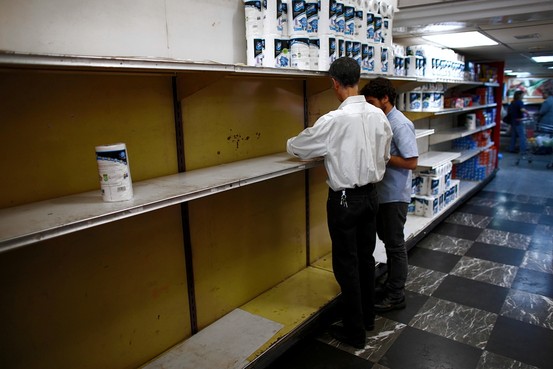
Don’t suppose for a minute that this mudslinging is merely about destroying Mr. Capriles. The ruling chavistas, led by President Nicolás Maduro, need a circus because there is no bread—and that’s not a metaphor. At times in Venezuela, there really is no bread. Earlier this year there was, for a time, no toilet paper. Mr. Maduro knows he is in trouble.

The “proof” of the allegations against Mr. Capriles’s chief of staff, who is accused of running the sex ring, cannot be shown to the public, according to Mr. Maduro. He says that the “videos and photos” that the government confiscated in a raid are of “un-publishable orgies.” Venezuelans will have to use their imaginations while trusting the courts—now controlled by the military government—and the government itself to get to the bottom of it all. Developments will be reported on television, which is almost exclusively state-controlled and where most Venezuelans get their news.

Mr. Capriles has said that the allegations are an attempt to distract the population from the real problems in the country. The charges are certainly well timed. An official 46% devaluation in April took the bolivar-to-dollar exchange rate to 6.3 from 4.3. Those who actually need dollars are unlikely to get them at that rate. Instead they have to go to the black market, where one greenback costs as much as 38 bolivars, up from 22 in March.

The government forecasts that inflation will hit 40% this year. But Johns Hopkins University economist Steve Hanke, director of the Cato Institute’s Troubled Currency Project, says that the soaring cost for the bolivar in the market translates into an implied annual inflation rate of more than 250%.

Earlier this month Caracas-based economist José Manuel Puente described the perfect storm to the Los Angeles Times this way: “The slowdown in economic growth, high and persistent inflation and high levels of scarcities [of basic foodstuffs] will combine to make Venezuela’s the worst-performing economy on the continent, despite the extraordinary oil boom that the country is still benefiting from.”

A mid-July survey by the Venezuelan polling company IVAD, posted on the website lapatilla.com, suggests Mr. Maduro is having no luck dodging the blame like his predecessor Hugo Chávez did so deftly. Asked what are the principal problems facing the country, almost 82% of respondents named crime. More than 53% also pointed to shortages. The scarcity is caused by the price controls that the government is using to try to hold down inflation. Those controls could explain why only 31% named “the high cost of living.”

But more than 65% said the economic situation was worse or much worse than one year ago, and more than half blamed either the national government or Mr. Maduro for the country’s problems.

Because the allegations against Mr. Capriles by the PSUV included a pejorative term for a homosexual, gay-rights groups took offense. But Venezuela’s homosexuals needn’t feel special. Hate speech as a political tool has been common practice in Venezuela’s military government for more than a decade. Catholics, Jews, entrepreneurs and the bourgeoisie have all been on the receiving end.

Mr. Maduro, coached as he is by Fidel Castro, immediately recognized that gay rights are a priority for many members of the international left. So in the aftermath of the impolitic comments by his colleague in Congress, he quickly seized a gay-pride flag to wave while he continued his verbal assaults against Mr. Capriles.

Political nonconformists regularly singled out by chavista politicians for ridicule and acrimony won’t get off so easily. This week Mr. Maduro is expected to try again to force through congress an “enabling law” that will allow him to rule by decree.

Opposition Congressman Richard Mardo has already been stripped of his congressional immunity and is slated for trial on corruption charges. Other opponents are being investigated. The Venezuelan daily El Nacional reported this month that more than one third of congressional sessions in the first half of the year were spent “harassing the opposition,” including with physical violence.

The goal is to drum up mass hysteria against opponents. Apparently Mr. Maduro has decided that if inflation cannot be contained, Mr. Capriles and his allies will be.

To read this article at Wall Street Journal, please click here.
 
Jun
21
2013
Posted by
admin
Comments

In Case You Missed It… Articles Roundup Week of 6/21/13

UNI VenezuelaHunger wg e1371848667693 In Case You Missed It… Articles Roundup Week of 6/21/13

Courtesy of: La Prensa

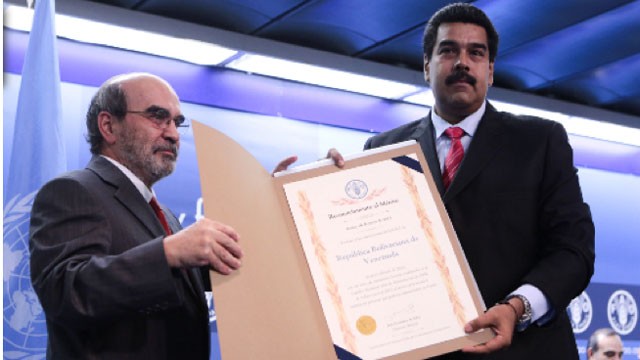
This Week: The Venezuelan constitutional court is expected to rule on Henrique Capriles’ lawsuits challenging the April 14 elections; in an attempt to improve his international image, President Maduro tours Europe, meeting with Pope Francis to discuss poverty, the fight against organized crime and regional disputes; ahead of his meeting with the Maduro, Capriles warns the Pope of basic democratic and human rights violations in Venezuela; in a survey of presidents, Venezuela’s Maduro receives worst ratings of all national leaders; and attackers torch buses and damage the rectory building at a leading Venezuelan university. Venezuela experiences soaring inflation, reporting a 6.1 percent spike last month alone; S&P expects “next to no growth” in the Venezuelan economy this year and downgrades its sovereign debt rating from “B+” to “B”; amid severe food shortages, the United Nations ironically congratulates Venezuela for reducing hunger; and Capriles maintains that Venezuela has not beaten hunger or poverty, questioning the FAO award.  In an attempt to alleviate goods shortages, Venezuela will supply more U.S. dollars to importers; in response to rationing rumors, Venezuela will allegedly import 760.000 tons of food; Venezuela’s non-oil exports hit the lowest level since 2009; and Venezuela’s Congress will discuss legislation that would prohibit baby bottles.

Top Constitutional Court to take up actions contesting April 14 election, El Universal

The Constitutional Court of the Supreme Tribunal of Justice (TSJ) is to hear and rule on all the seven laswsuits filed by former opposition presidential candidate Henrique Capriles and the opposition alliance Unified Democratic Panel (MUD) challenging the April 14 presidential vote.

Pope Francis meets Venezuelan President Maduro, Reuters

Maduro meets Pope Francis in the Vatican City and discussed poverty, the fight against organized crime and drug trafficking, and regional issues including a dispute between Venezuela and Colombia.

Capriles warns pope of rights violations in Venezuela, Global Post

Venezuela’s opposition leader told Pope Francis on Saturday that the government was violating basic democratic and human rights, just two days before President Nicolas Maduro visits the Vatican.

Venezuelan president pulls off the lowest score in Spanish survey, El Universal

Polls conducted by Spanish firm Real Instituto Elcano, after the controversial results of the presidential election held on April 14 in Venezuela, show Venezuelan President Nicolás Maduro’s ratings are the lowest, scoring 2.5 out of 10 points, behind his Argentinean counterpart rated with 2.7 points.

Attackers torch buses at Venezuela university, Miami Herald

A group of masked assailants has attacked a leading university in the Venezuelan capital, torching two buses and seriously damaging its rectory building.

Soaring inflation adds even more stress to the Venezuelan economic model, El Universal

Venezuelan economy reported a 6.1% spike in May which led to an accumulated inflation of 19.4%, thus crushing any possibility of meeting the 14% to 16% target set by the government for 2012.

Citing Governability, S&P Cuts Venezuela’s Debt. Bondholders, Look Out Below, Wall Street Journal

Standard & Poor’s cut its sovereign rating on Venezuela from “B+” to “B” another step deeper into junk territory, reflecting the government’s diminishing ability to implement measures to reverse declining GDP growth, rising inflation, and weakening external liquidity in the context of growing political disagreements within the administration.

UN Congratulates Venezuela for Reducing Hunger, ABC News

The FAO, the UN organization that specializes in nutrition, included Venezuela in a group of 18 nations that that have cut their number of hungry people by half over the past 20 years.

Capriles: hunger is addressed with investment and production, El Universal

Following the recent award given to the Venezuelan Government by the FAO, Capriles claimed on Tuesday that the country has not overcome hunger and poverty and stressed that the award was not in line with both the true food shortage Venezuela was going through and the more than 3,000 households living under severe poverty.

Venezuela Plans Expanded Dollar Auctions to Fight Shortages, Bloomberg Businessweek

Venezuela will boost supplies of dollars, through auctions that will begin early in the second half of the year,  to importers as it seeks to alleviate a shortage of goods that is fueling the fastest inflation in the region.

To silence rationing rumours, Venezuela announces 760.000 tons of imported food is on the way, MercoPress

A 760.000 tons of different food items were imported into several cities in Venezuela that were suffering serious shortages, including  staples and other items such as coffee, sugar, cooking oil, butter, milk, flour and most recently toilet paper, but the situation instead of improving has worsened.

Venezuela’s non-oil exports hit lowest level since 2009, Reuters
Venezuela’s non-oil exports fell in March to their lowest level since early 2009 in another sign of the economic problems accruing for President Nicolas Maduro’s fledgling government.

Venezuela considers taking bottles from babies’ mouths, Reuters

Venezuela’s Congress will discuss legislation next week that would prohibit bottle feeding of infants to try to encourage breast feeding and reduce the use of baby formula, said a lawmaker of the ruling Socialist Party.

 
Jun
14
2013
Posted by
admin
Comments

As Venezuelans Struggle to Find Food, Maduro to Receive UN Award for Food Production

WO AN794 VENEZU G 20130516180502 e1371227734904 As Venezuelans Struggle to Find Food, Maduro to Receive UN Award for Food Production

Courtesy of: Reuters

For months, What’s Next Venezuela and other major news outlets have been reporting on the rampant shortages plaguing Venezuela. In light of this reality, we and many others were stunned to learn this week that President Nicolás Maduro is expected to receive an award from the Food and Agriculture Organization of the United Nations (FAO) for the “progress” Venezuela has made in food-related matters. The irony is palpable; shortages in Venezuela are now so severe that Venezuelans have turned to a mobile app that helps them locate basic goods like milk and toilet paper.

Maduro’s troubling two months in office and record shortages have caused many, including Congresswoman Ileana Ros-Lehtinen, to wonder aloud whether the award is indeed justified. While the FAO argues advances have been made with regards to food development and consumption in Venezuela, the facts and figures beg to differ.

The Venezuelan Central Bank reported that shortages in May rose to 21.3 percent, its highest level in 64 months. In other words, two out of 10 products were not in stock in grocery stores and supermarkets. Furthermore, that same month Venezuelan consumer prices increased at a record pace after a devaluation of the currency pushed up the cost of imports. Prices climbed 6.1 percent from April, accelerating the annual inflation rate to a record-high 35.2 percent.

Price controls and foreign exchange restrictions in the import-dependent nation have triggered shortages in every sector of the Venezuelan economy. Basic food products such as chicken, milk, sugar and toilet paper have become an ordeal to find. Not even the Catholic Church has been exempt of the country’s growing scarcities. Wheat flour used for the sacramental wafers is scarce, while the supply of altar wine used for Holy Communion is threatened, likely forcing the Church to ration supplies.

Maduro’s only solution to the problem has been to blame Venezuelans for “overconsumption.” Such a charge stands in utter contrast to the scenes of hungry Venezuelans swarming a grocery truck when it finally arrived with the food they needed. Maduro, meanwhile, has responded by telling Venezuelans not to “panic” and to “regularize consumption,” accusing the public for the government’s failed policies.

Thus far, the free mobile application – which uses crowdsourcing to pinpoint areas that actually have basic necessities – has been the most successful solution for everyday Venezuelans.  After struggling to find milk, an enterprising 21-year-old Venezuelan student decided to develop the app, which has been downloaded over 12,000 times. In a country where citizens are forced to rely on their smart phones to find basic food products, the rationale behind this award is difficult to understand.