Jun
14
2013
Posted by
admin
Comments

As Venezuelans Struggle to Find Food, Maduro to Receive UN Award for Food Production

WO AN794 VENEZU G 20130516180502 e1371227734904 As Venezuelans Struggle to Find Food, Maduro to Receive UN Award for Food Production

Courtesy of: Reuters

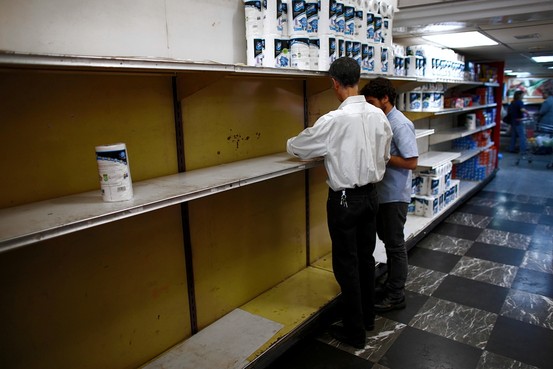
For months, What’s Next Venezuela and other major news outlets have been reporting on the rampant shortages plaguing Venezuela. In light of this reality, we and many others were stunned to learn this week that President Nicolás Maduro is expected to receive an award from the Food and Agriculture Organization of the United Nations (FAO) for the “progress” Venezuela has made in food-related matters. The irony is palpable; shortages in Venezuela are now so severe that Venezuelans have turned to a mobile app that helps them locate basic goods like milk and toilet paper.

Maduro’s troubling two months in office and record shortages have caused many, including Congresswoman Ileana Ros-Lehtinen, to wonder aloud whether the award is indeed justified. While the FAO argues advances have been made with regards to food development and consumption in Venezuela, the facts and figures beg to differ.

The Venezuelan Central Bank reported that shortages in May rose to 21.3 percent, its highest level in 64 months. In other words, two out of 10 products were not in stock in grocery stores and supermarkets. Furthermore, that same month Venezuelan consumer prices increased at a record pace after a devaluation of the currency pushed up the cost of imports. Prices climbed 6.1 percent from April, accelerating the annual inflation rate to a record-high 35.2 percent.

Price controls and foreign exchange restrictions in the import-dependent nation have triggered shortages in every sector of the Venezuelan economy. Basic food products such as chicken, milk, sugar and toilet paper have become an ordeal to find. Not even the Catholic Church has been exempt of the country’s growing scarcities. Wheat flour used for the sacramental wafers is scarce, while the supply of altar wine used for Holy Communion is threatened, likely forcing the Church to ration supplies.

Maduro’s only solution to the problem has been to blame Venezuelans for “overconsumption.” Such a charge stands in utter contrast to the scenes of hungry Venezuelans swarming a grocery truck when it finally arrived with the food they needed. Maduro, meanwhile, has responded by telling Venezuelans not to “panic” and to “regularize consumption,” accusing the public for the government’s failed policies.

Thus far, the free mobile application – which uses crowdsourcing to pinpoint areas that actually have basic necessities – has been the most successful solution for everyday Venezuelans.  After struggling to find milk, an enterprising 21-year-old Venezuelan student decided to develop the app, which has been downloaded over 12,000 times. In a country where citizens are forced to rely on their smart phones to find basic food products, the rationale behind this award is difficult to understand.

 
Jun
11
2013
Posted by
admin
Comments

ICYMI: Looking for toilet paper in Venezuela? There’s an app for that

Financial Times
June 10, 2013
By Benedict Mander

venezuela toilet paper reuters 1200 ICYMI: Looking for toilet paper in Venezuela? There’s an app for that

Courtesy of: Reuters

It turns out that President Nicolas Maduro thinks that the plan to introduce food rationing in Zulia, Venezuela’s most populous state, is “crazy”.

Regardless of whether he always thought that, or whether, perhaps, the increasingly unpopular president was responding to widespread rejection of the plan, he’s right – it is not the way to put an end to the problem of shortages that has become so acute that someone has even invented an app to help Venezuelans locate specific goods they are having difficulty finding.

Maduro was also right when he said that “the answer to our problems is to produce more”.

Let’s just forget for the moment that in saying this he was rather undermining the Zulia governor, Francisco Arias Cardenas, who had denied that the scheme even amounted to rationing in the first place, and that in fact it was aimed at preventing smuggling (if you wanted to do something about that, you probably wouldn’t produce more, but instead perhaps try and do something about the irresistible arbitrage opportunities in Colombia thanks to Venezuela’s price controls, or at the very least introduce stronger controls on the border).

Let’s also ignore the fact that the government has already put in place another rationing scheme in Zulia, for petrol, which by Maduro’s logic ought probably be pretty “crazy” too. Again, officials insist the idea is to prevent gasoline contraband, which is indeed rife in Zulia since it is magnificently profitable – some suggest it is an even bigger business in Venezuela than the cocaine trade.

In any case, increased production would certainly go a long way to solving Venezuela’s shortages problem. Ideally it would be an increase in the production of the goods that are scarce, especially food, but increased oil production might do too, as crude exports could provide the dollars needed to import more. This would probably be more practical in the shorter term, given the problems Venezuela has producing just about anything that is not oil (although that is not to say state oil company PDVSA does not have serious challenges of its own).

The problem is that, in the current conditions, Venezuelan businesses are unlikely to start producing much more. In order for this to happen, a lot needs to change: for starters, the business climate must improve, and that includes doing something about price and currency controls, something which Maduro has shown no signs of doing. And don’t expect state companies to pick up the slack – the government is even said to have seriously considered the offer of Venezuela’s largest private company, Polar, to help run underperforming state-owned food processing plants.

The app that aims to help Venezuela’s long-suffering shoppers, known as Abasteceme (or Supply Me) and which uses Google Maps and “crowdsourcing” to enable users to notify one another where a certain product is for sale, has so far only been downloaded 12,000 times. It is a scheme that promises to be infinitely more successful than Zulia’s still-born rationing plans.

To read this article at Financial Times, please click here.