Oct
3
2013
Posted by
admin
Comments

ICYMI: To Venezuelans, Heir of Chavez Is a Poor Copy

The New York Times
October 2, 2013
By William Neuman

VENEZUELA articleLarge e1380753017255 ICYMI: To Venezuelans, Heir of Chavez Is a Poor Copy

Courtesy of: The New York Times

CARACAS, Venezuela — The start of the season for two premier teams in this baseball-loving nation was thrown into doubt after thieves stripped vast amounts of copper wire from the lights in this city’s main stadium. Basic items are often so hard to find that when a truck driver slumped dead at the wheel after a highway accident last week, motorcycle-riding looters swarmed in to grab the cargo: tons of red meat.

Prices are soaring, the country is plagued by electrical blackouts, some neighborhoods go days without water, and protests tangle the already stifling traffic. To top it all off, the cheap beer that helps people let off steam at many a weekend party has suddenly become scarce, too.

Nearly seven months after the death of Hugo Chávez, the country’s longtime leftist president and father figure, there is a growing sense that things are falling apart.

The new president, Nicolás Maduro, has revived a longtime scapegoat for the country’s woes, accusing Washington of conspiring with other enemies of the government in waging an “economic war” that has subjected the populace to blackouts, chronic shortages and other ills. Borrowing from Mr. Chávez’s script, Mr. Maduro on Monday expelled the top American diplomat here and two other embassy officials, contending that they were plotting to destabilize the country.

But while Mr. Chávez skillfully portrayed the United States as an imperialist bully and cast himself in the role of underdog hero, many Chávez supporters are finding Mr. Maduro’s attempts to imitate his mentor unconvincing.

“This is the biggest mistake Chávez ever made,” said Axel Ortiz, 20, a student, referring to Mr. Chávez’s choice of Mr. Maduro as his successor. Mr. Ortiz still defines himself as a Chavista — a loyal Chávez supporter — but he questioned Mr. Maduro’s ability to solve the nation’s problems. “Chávez was the only one who was qualified, the only one who could keep things here under control.”

The country’s economic problems have become acute. Inflation in the first eight months of this year was more than triple the rate in the same period last year. When measured over the 12 months that ended in August, it exceeded 45 percent. A government indicator that measures the scarcity of basic goods is close to its highest level in more than five years.

Many stores allow customers to buy only a limited number of scarce items like corn flour and cooking oil. People complain of having to stand in line for hours, often in vain, and many are losing patience with the government’s explanation that unsavory conspirators are to blame for the nation’s problems.

“The government is resorting to more and more outrageous and extravagant actions and statements to control the agenda,” said Andrés Cañizalez, a communications professor at Andrés Bello Catholic University.

All of this would be a lot to handle for any neophyte president, but the gaffe-prone Mr. Maduro has come under withering criticism for regularly tripping over his words, eliciting cringes from supporters and jeers from opponents. When he fell off his bicycle on live television recently, the event threatened to become a metaphor for a struggling presidency.

“People laugh at him,” said María López, 32, a mother of two on a recent morning in the Terrazas del Alba slum in the center of Caracas. She voted for Mr. Maduro, and said she still supported him. But she fought back a smirk when asked about Mr. Maduro’s bicycle accident, which occurred during a ride to promote his party’s youth movement. “We don’t want a president who’s a joke,” she said.

The blunders have piled up, much like the entourage of politicians and bodyguards who screeched to a halt in a tangle behind the president’s fallen bicycle.

In one of his most infamous verbal flubs, in August, Mr. Maduro sought to make a reference to the biblical story of Jesus’ multiplying the loaves and fishes — only to have it come out of his mouth as “the multiplication of the penises.” Mr. Maduro apparently conflated “peces” (fish) and “panes” (loaves) to produce “penes” (penises). He quickly apologized and corrected himself, but the damage was done.

“A person who doesn’t know how to speak will never know how to run a country,” said Jorge Flores, 30, a messenger at a government-run hospital, who voted for Mr. Maduro but now bitterly regrets doing so.

“This is the worst government I’ve ever seen,” Mr. Flores said. “The best government we’ve ever had here was with Chávez.”

Mr. Maduro calls his critics elitists and once said he had misspoken on purpose to bait his detractors.

Mr. Chávez, a fiery socialist, had a connection with ordinary Venezuelans that was so strong they often refused to blame him for many of the same problems that continue to bedevil the country. Mr. Maduro does not have the same charisma, and at least some of Mr. Chávez’s followers seem to be tuning him out.

“The government does these things to distract us from our real problems,” said Cristian Nivela, 24, a Chávez loyalist who voted for Mr. Maduro, referring to the expulsion of the American diplomats.

On Tuesday, Mr. Maduro used a special national television broadcast to present what he said was evidence that the diplomats had been conspiring with the extreme right in Venezuela to destabilize the country.

He showed a video, accompanied by ominous music, contending that the top diplomat at the United States Embassy, Kelly Keiderling, and the other two expelled diplomats had met in recent weeks with elected officials — including a state governor and a mayor — who belong to the Venezuelan opposition. The video also showed them leaving a meeting at the office of a pro-democracy group.

“These officials are meeting, well, in a shameless manner, and talking about strikes, sabotage, talking about the internal affairs of Venezuela, offering money,” Mr. Maduro said.

Such accusations resonate here because of the United States’ history of intervention in Latin America, including its tacit support of a 2002 coup that briefly ousted Mr. Chávez.

But a State Department official called the accusations absurd.

“Our diplomats were doing what they do all over the world,” said the official, Roberta S. Jacobson, assistant secretary of state for Western Hemisphere affairs. “They were visiting parts of the country and talking to all kinds of different people. They were doing nothing covert or out of the ordinary for diplomats.”

She said that in response, the United States was expelling the top Venezuelan diplomat in Washington and two other Venezuelan Embassy officials. The United States and Venezuela do not maintain an ambassador in each other’s capital.

On Tuesday night the State Department identified the Venenezuelan diplomats, who were given 48 hours to leave the country, as the charge d’affaires, Calixto Ortega Rios, and Second Secretary Monica Alejandra Sanchez Morales, both of whom are assigned to the country’s embassy in Washington, and Marisol Gutierrez de Almeida, the consul in Houston,

“It is regrettable that the Venezuelan government has again decided to expel U.S. diplomatic officials based on groundless allegations, which require reciprocal action. the State Department said in a statement. “It is counterproductive to the interests of both our countries.”

With the diplomatic tussle in the background, officials said the burglarized stadium — home to the Caracas Lions and the La Guaira Sharks, roughly equivalent to the Yankees and Mets in Venezuelan baseball — would be ready for the start of the season on Oct. 10.

They said workers had finally finished repairs to the lighting system after thieves stripped out much of the wiring, in a very public example of the crime, corruption and disarray in this country.

But the looting of the meat truck on Friday was shocking even to many who have become inured to the high levels of violence here. The truck became stuck under a barrier meant to block oversize vehicles. Part of the cargo crushed the top of the cab.

Denny Medina, 44, the owner of a fleet of trucks, said that he had tried to rescue the driver, but that he could not open the door. Instead of helping, he said, looters clambered over the vehicle.

“What made me feel powerless was to see the people carrying off the boxes of meat, and no one was showing any concern for the driver right below them,” Mr. Medina said. “It was terrible. I hope that we don’t get used to this.”

To read this article at The New York Times, please click here.
 
Oct
1
2013
Posted by
admin
Comments

ICYMI: With Accusations of Sabotage, Venezuela Expels 3 US Embassy Officials

The New York Times
September 30, 2013
By William Neuman

VENEZ articleLarge e1380645570814 ICYMI: With Accusations of Sabotage, Venezuela Expels 3 US Embassy Officials

Courtesy of: Agence France Presse

CARACAS, Venezuela — Stepping up hostilities with the United States, President Nicolás Maduro of Venezuela expelled the top American diplomat and two other embassy officials from the country on Monday, accusing them of supporting plots to sabotage the country’s electrical grid and the economy.

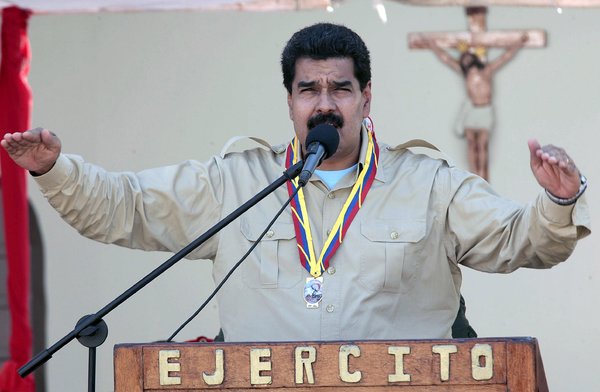
“Get out of Venezuela! Yankee go home!” Mr. Maduro shouted as he announced the expulsions at a military event to commemorate the bicentennial of a battle in Venezuela’s war of independence.

“We have detected a group of officials of the United States Embassy in Caracas, in Venezuela, and we have been tracking them for several months,” Mr. Maduro said during a live television broadcast. “These officials spend their time meeting with the Venezuelan extreme right wing, financing them and encouraging them to take actions to sabotage the electrical system, to sabotage the Venezuelan economy.”

The expulsions were the latest diplomatic swipe at Washington by Mr. Maduro since he took over for the country’s longtime president, Hugo Chávez, who died in March. Late last year, as Mr. Chávez grew increasingly ill, the two nations held informal talks aimed at improving the long-strained relations between them, and there was some optimism on the American side that Mr. Maduro, a former foreign minister sometimes described as pragmatic, would be amenable to a thaw.

But it quickly became clear that Mr. Maduro intended to stick closely to Mr. Chávez’s example, painting the United States as an imperialist aggressor out to undermine his government. Early on, he accused the Obama administration of plotting against him, and hours before he announced the death of Mr. Chávez on March 5, he kicked out two American military attachés, saying they had tried to recruit Venezuelan military personnel to conspire against the government.

The diplomats expelled on Monday included Kelly Keiderling, the chargé d’affaires, who runs the embassy in the absence of an ambassador here. The United States has not had an ambassador in Caracas since 2010, when Mr. Chávez refused to accept the new one proposed by Washington because of remarks that Mr. Chávez said were disrespectful.

Mr. Chávez had already expelled the American ambassador, Patrick Duddy, in 2008, saying that his government had discovered an American-supported plot by military officers to topple him. Mr. Duddy was later allowed to return to Caracas.

Another one of the diplomats expelled on Monday was Elizabeth Hoffman, an official in the embassy’s political section, whom Mr. Maduro had publicly accused at least as early as April of meeting with opposition figures to plot sabotage of the electrical system. He said at the time that he had proof but took no action until Monday. The third official being expelled is David Moo, the vice consul.

Foreign Minister Elías Jaua later said on television that the evidence against the American diplomats included meetings held in recent weeks with democracy advocates, union members and elected officials belonging to the political opposition, whom he accused of planning to destabilize the country.

Mr. Maduro said the officials had 48 hours to leave the country.

“We completely reject the Venezuelan government’s allegations of U.S. government involvement in any type of conspiracy to destabilize the Venezuelan government,” the American Embassy said in a statement. It called the meetings held by the officials “normal diplomatic engagements,” adding, “We maintain regular contacts across the Venezuelan political spectrum.”

Ever since he was elected by a narrow margin in April in a special election to replace Mr. Chávez, Mr. Maduro has struggled with intense economic woes and a deeply divided populace. He has often accused plotters and saboteurs of being responsible for a variety of the nation’s ills, including electrical blackouts and the deadly explosion at the national oil company’s enormous Amuay refinery.

“He needs diversions and distractions,” said Michael Shifter, president of the Inter-American Dialogue, a policy group in Washington. “The situation is so dire in Venezuela that he needs to find a scapegoat, and it’s convenient and politically so tempting to kick out U.S. diplomats.”

But Mr. Shifter said that describing the United States as the source of the country’s problems might not have the same effect it did for Mr. Chávez, who was beloved by many of his supporters. Mr. Maduro does not inspire nearly the same devotion, and the country’s economic woes are getting worse, with inflation over 45 percent a year and shortages of many basic foods and goods, including toilet paper.

“I doubt that it has the resonance it used to have,” Mr. Shifter said of the diplomatic expulsions.

To read this article at The New York Times, please click here.
 
Sep
20
2013
Posted by
admin
Comments

ICYMI: Venezuela keeps rooting for Syrian dictator

Miami Herald

September 18, 2013

By Andres Oppenheimer

venezuela syria 2012 12 06 e1379694480735 ICYMI: Venezuela keeps rooting for Syrian dictator

Courtesy of: AFP

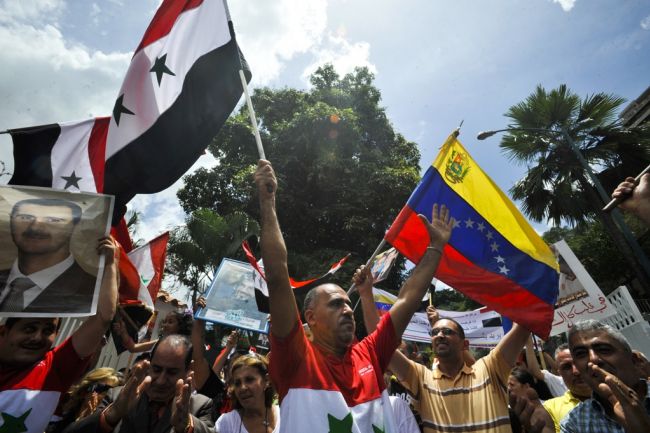
Much of the world is demanding greater pressure on Syria following a United Nations inspectors’ report hinting that Syrian strongman Bashar al-Assad used chemical weapons in his country’s civil war, but — amazingly — Venezuela and some of its Latin American allies are still passionately defending Syria’s dictator.

Earlier this week, after U.N. Secretary General Ban Ki-moon presented the U.N. inspectors’ report concluding that there is “clear and convincing” evidence that chemical weapons were used in an Aug. 21 incident on the outskirts of Damascus, Venezuelan President Nicolás Maduro lashed out against the U.N. chief for allegedly siding with the enemies of the Syrian people.

“Why is the U.N. secretary general lending himself (to plans to attack Syria,) as if he were a prosecutor and judge of the world’s people, putting himself at the service of the strategy of war, instead of being at the service of peace?” Maduro asked in a speech Monday in the state of Miranda.

In a speech last month more than a week after the Aug. 21 attack with chemical weapons, Maduro said, “Venezuela is with Syria, and with President Bashar al-Assad, and with the Syrian people.”

A day later, on Aug. 31, Maduro issued an official statement stating that Venezuela stands by “the Syrian people” in their fight against “unjustified war-mongering aggressions.”

Venezuela’s government-run media, meantime, has turned Assad into a hero and is blaming the United States and Israel for allegedly trying to invade Syria.

A cartoon in Venezuela’s state-run daily Correo del Orinoco this week shows a plane dropping hearts over Syria with the legend “to the Syrian people from the people of ALBA.” ALBA, which stands for the Bolivarian Alliance for the Peoples of Our Americas, is an organization formed by Venezuela that is it made up of nine Latin American and Caribbean countries.

Venezuela’s daily Vea, which like other government-backed newspapers often publishes anti-Semitic cartoons, ran a cartoon on May 9 showing a black-robed skeleton representing death, with a star of David and this legend: “Since we got tired of killing Palestinians, we are now going to finish with the Syrians.”

What’s most amazing about the pro-Assad statements in Venezuela’s official media is that they are still appearing after the U.N. inspectors’ report — which clearly suggests, without saying so explicitly, that Assad’s forces were responsible for the Aug. 21 chemical gas attack.

While it doesn’t officially take sides, because that wasn’t within the inspectors’ scope, the U.N. report shows that the rockets that carried Sarin gas are weapons that are not in the hands of Syria’s rebels, and that they were launched from several government-controlled points.

Although less strenuously, Venezuelan allies such as Cuba and Bolivia also have come out in support of Assad even after the U.N. findings. Most other Latin American countries have supported the Geneva agreement between the United States and Russia to demand that Syria destroy its chemical weapons.

But U.S. officials say major Latin American countries such as Mexico and Brazil have been late in joining the international community’s demands that Syria comply with the Geneva agreement.

Roberta Jacobson, the top U.S. State Department official in charge of Latin American affairs, told me Wednesday that “there is disappointment that more countries (in the region) would not have put out stronger statements condemning the Assad government’s use of Sarin gas, and supporting the Geneva U.S.-Russia agreements.”

Jacobson added that “countries in the Western Hemisphere want to be, and increasingly are, global actors. (But) If countries want to be global players, they should step up and confront challenges to the international community.”

My opinion: It’s entirely legitimate for Latin American countries to oppose a unilateral U.S. intervention in Syria, or even a U.S. intervention with dozens of allied countries but without the blessing of the United Nations. I myself have serious doubts about the wisdom of an intervention to stop Syria’s war crimes without some sort of U.N. cover.

But defending a dictator who has massacred a sizable part of the 100,000 people who have died in Syria’s civil war, and who according to all available evidence is responsible for the Aug. 21 attack with chemical weapons, is outrageous.

Maduro may be over-reacting on Syria because he needs to keep his Chavista radical base behind him after his dubious and narrow election victory April 14. His almost daily blunders, alongside Venezuela’s steep economic decline, are seriously weakening his government. And his adoration for dictators may explain his natural sympathy for Assad.

Still, Venezuela’s enthusiastic support for the Syrian regime after the Aug. 21 attack with chemical weapons should be denounced by everybody for what it is: an open defense of crimes against humanity.

To read this article at the Miami Herald, please click here.