Sep
20
2013
Posted by
admin
Comments

ICYMI: Venezuela keeps rooting for Syrian dictator

Miami Herald

September 18, 2013

By Andres Oppenheimer
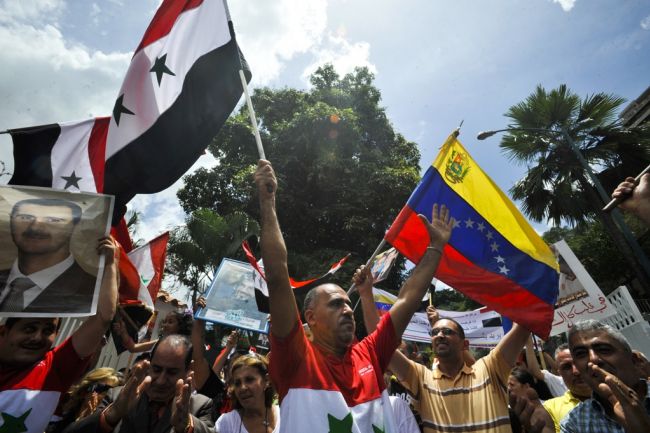
venezuela syria 2012 12 06 e1379694480735 ICYMI: Venezuela keeps rooting for Syrian dictator

Courtesy of: AFP

Much of the world is demanding greater pressure on Syria following a United Nations inspectors’ report hinting that Syrian strongman Bashar al-Assad used chemical weapons in his country’s civil war, but — amazingly — Venezuela and some of its Latin American allies are still passionately defending Syria’s dictator.

Earlier this week, after U.N. Secretary General Ban Ki-moon presented the U.N. inspectors’ report concluding that there is “clear and convincing” evidence that chemical weapons were used in an Aug. 21 incident on the outskirts of Damascus, Venezuelan President Nicolás Maduro lashed out against the U.N. chief for allegedly siding with the enemies of the Syrian people.

“Why is the U.N. secretary general lending himself (to plans to attack Syria,) as if he were a prosecutor and judge of the world’s people, putting himself at the service of the strategy of war, instead of being at the service of peace?” Maduro asked in a speech Monday in the state of Miranda.

In a speech last month more than a week after the Aug. 21 attack with chemical weapons, Maduro said, “Venezuela is with Syria, and with President Bashar al-Assad, and with the Syrian people.”

A day later, on Aug. 31, Maduro issued an official statement stating that Venezuela stands by “the Syrian people” in their fight against “unjustified war-mongering aggressions.”

Venezuela’s government-run media, meantime, has turned Assad into a hero and is blaming the United States and Israel for allegedly trying to invade Syria.

A cartoon in Venezuela’s state-run daily Correo del Orinoco this week shows a plane dropping hearts over Syria with the legend “to the Syrian people from the people of ALBA.” ALBA, which stands for the Bolivarian Alliance for the Peoples of Our Americas, is an organization formed by Venezuela that is it made up of nine Latin American and Caribbean countries.

Venezuela’s daily Vea, which like other government-backed newspapers often publishes anti-Semitic cartoons, ran a cartoon on May 9 showing a black-robed skeleton representing death, with a star of David and this legend: “Since we got tired of killing Palestinians, we are now going to finish with the Syrians.”

What’s most amazing about the pro-Assad statements in Venezuela’s official media is that they are still appearing after the U.N. inspectors’ report — which clearly suggests, without saying so explicitly, that Assad’s forces were responsible for the Aug. 21 chemical gas attack.

While it doesn’t officially take sides, because that wasn’t within the inspectors’ scope, the U.N. report shows that the rockets that carried Sarin gas are weapons that are not in the hands of Syria’s rebels, and that they were launched from several government-controlled points.

Although less strenuously, Venezuelan allies such as Cuba and Bolivia also have come out in support of Assad even after the U.N. findings. Most other Latin American countries have supported the Geneva agreement between the United States and Russia to demand that Syria destroy its chemical weapons.

But U.S. officials say major Latin American countries such as Mexico and Brazil have been late in joining the international community’s demands that Syria comply with the Geneva agreement.

Roberta Jacobson, the top U.S. State Department official in charge of Latin American affairs, told me Wednesday that “there is disappointment that more countries (in the region) would not have put out stronger statements condemning the Assad government’s use of Sarin gas, and supporting the Geneva U.S.-Russia agreements.”

Jacobson added that “countries in the Western Hemisphere want to be, and increasingly are, global actors. (But) If countries want to be global players, they should step up and confront challenges to the international community.”

My opinion: It’s entirely legitimate for Latin American countries to oppose a unilateral U.S. intervention in Syria, or even a U.S. intervention with dozens of allied countries but without the blessing of the United Nations. I myself have serious doubts about the wisdom of an intervention to stop Syria’s war crimes without some sort of U.N. cover.

But defending a dictator who has massacred a sizable part of the 100,000 people who have died in Syria’s civil war, and who according to all available evidence is responsible for the Aug. 21 attack with chemical weapons, is outrageous.

Maduro may be over-reacting on Syria because he needs to keep his Chavista radical base behind him after his dubious and narrow election victory April 14. His almost daily blunders, alongside Venezuela’s steep economic decline, are seriously weakening his government. And his adoration for dictators may explain his natural sympathy for Assad.

Still, Venezuela’s enthusiastic support for the Syrian regime after the Aug. 21 attack with chemical weapons should be denounced by everybody for what it is: an open defense of crimes against humanity.

To read this article at the Miami Herald, please click here.

 
Apr
13
2012
Posted by
admin
Comments

In Case You Missed It… Articles Roundup Week of 4/13/12

In this week’s roundup…President Barack Obama offers his thoughts on the Venezuelan election, urging the country’s authorities to conduct “free and fair elections where the people’s will is respected;” Hugo Chávez, shuttling back and forth from Cuba for treatment, tells Venezuelans that he believes a “miracle” will save him from his cancer. Meanwhile, Chávez stands with his ally President Bashar al-Assad as the Syrian conflict continues; the kidnapping of a Costa Rican diplomat draws attention to skyrocketing crime; Venezuela appears on the Inter-American Commission on Human Rights “blacklist” for the 10th time; and experts say Chávez’s latest increase in the minimum wage will likely not blunt the pain caused by inflation.

US President Barack Obama takes a stance on Venezuelan election, El Universal
US President Barack Obama would like to witness in Venezuela “free and fair elections where the people’s will is respected.” His comments were made during an exclusive interview with Grupo Diarios de América (GDA), a cluster of 11 leading newspapers in the Western Hemisphere.

Venezuela’s Chavez Heads Home After Latest Cuba Cancer Treatment, The Wall Street Journal
Venezuela President Hugo Chávez arrived home late Wednesday following his latest round of cancer treatment in Cuba. Chávez, 57, was shown arriving at an airport in Caracas on state television.

Hugo Chavez heads back to Cuba for more cancer treatment, calling it battle for life, Associated Press
Venezuelan President Hugo Chavez flew back to Cuba late Saturday for another round of radiation therapy, telling his countrymen that he has faith a “miracle” will help him survive cancer.

Chávez Seeks to Attend Americas Summit, Wall Street Journal
Cancer-stricken Venezuela President Hugo Chávez intends to make a brief appearance at this weekend’s 33-nation Summit of the Americas, which will also include U.S. President Barack Obama, an official from the meeting’s host country, Colombia, said Tuesday.

Amidst the Carnage, Syria Finds a Loyal Ally in Hugo Chávez, Huffington Post
At a time when most nations are trying to figure out how to stop Syrian dictator Bashar al-Assad from killing his own people in a year-long struggle to stay in power, the Venezuelan government is helping to prop him up. The facts and figures coming out of Syria are grisly, with more than 9,000 dead since last spring.

Chávez orders mandatory simultaneous broadcast to talk about 2002 coup, El Universal
Venezuela’s President Hugo Chávez commemorated the 10th anniversary of the events of April 2002 that briefly ousted him from power. Chávez talked with a “group of friends” in a mandatory radio and TV simultaneous broadcast.

Kidnapped Costa Rican diplomat freed in Venezuela, Reuters
A Costa Rican diplomat kidnapped last weekend and held for ransom in the latest attack on foreign envoys in Venezuela was released on Tuesday and is in good health despite having suffered a blow to the head, authorities said.

Crime in Venezuela, The Economist
Foreign diplomats in Caracas have been briefing their capitals for years about the rise of violent crime in Venezuela. Now they are targets as well as observers. On April 8th Guillermo Cholele, a Costa Rican attaché, was kidnapped for ransom.

IACHR keeps Venezuela in human rights “blacklist” for the 10th time, El Universal
Venezuela was “blacklisted” again by the Inter-American Commission on Human Rights (IACHR) in its Chapter IV of the 2011 Annual Report to the Committee on Juridical and Political Affairs of the Organization of American States (OAS).

Chavez hikes Venezuela’s minimum wage before vote, Reuters
President Hugo Chavez hiked Venezuela’s minimum wage by almost a third on Saturday as the ailing socialist leader aimed to solidify his political base among the poor and win re-election in October.

Inflation erodes much of minimum wage increase, El Universal
Venezuelan workers who earn minimum wage will be paid 15% more from May 1 and they will have a second 15% hike in September.

 
Feb
23
2012
Posted by
admin
Comments

ICYMI: As Others Isolate Syria, Chávez Ships Fuel to It

As Others Isolate Syria, Chávez Ships Fuel to It
The New York Times
February 22, 2012
By William Neuman

CARACAS, Venezuela – A day before the United Nations General Assembly voted overwhelmingly to condemn President Bashar al-Assad of Syria this month for his bloody crackdown on the uprising in his country, President Hugo Chávez of Venezuela was conducting a very different kind of diplomacy on his own.

A ship owned by the Venezuelan state oil company sailed into the Syrian port of Baniyas, its location captured by a satellite system that tracks ship movements. The ship, making its second trip to Baniyas since December, appeared to be carrying fuel to help prop up the embattled Mr. Assad.

The Venezuelan shipment flies in the face of international efforts to isolate Mr. Assad and pressure him to step down, but Mr. Chávez is no stranger to such controversy. Last month, he played host to another Middle Eastern ally, President Mahmoud Ahmadinejad of Iran, ridiculing Western claims that Iran was seeking to be able to produce nuclear weapons.

Still, Mr. Chávez is at the start of what could prove to be a difficult re-election campaign overshadowed by his battle with cancer, and the political equation here may be shifting. While provocative moves like oil shipments to Syria play well among Mr. Chávez’s staunchest backers, they may prove to be a liability among voters who resent his oil tanker diplomacy.

The Venezuelan ship, the Negra Hipólita, arrived in the Syrian port on Feb. 15, according to John H. Paskin, the chief executive of Commodity Flow, a company based in London that compiles satellite data and other information to track the movement of ships.

He said the ship left a Venezuelan refinery complex at Puerto La Cruz on Jan. 25. The Puerto La Cruz complex produces gasoline, diesel, jet fuel and fuel components, according to the Web site of the state oil company, Petroleos de Venezuela, known as P.D.V.S.A.

Mr. Paskin said the tracking data showed that the ship made a previous trip to Syria last fall, leaving a Venezuelan refinery complex on the Paraguana Peninsula on Oct. 15 and arriving at Baniyas on Dec. 1.

Click here to read more