Sep
20
2013
Posted by
admin
Comments

ICYMI: Venezuela keeps rooting for Syrian dictator

Miami Herald

September 18, 2013

By Andres Oppenheimer
venezuela syria 2012 12 06 e1379694480735 ICYMI: Venezuela keeps rooting for Syrian dictator

Courtesy of: AFP

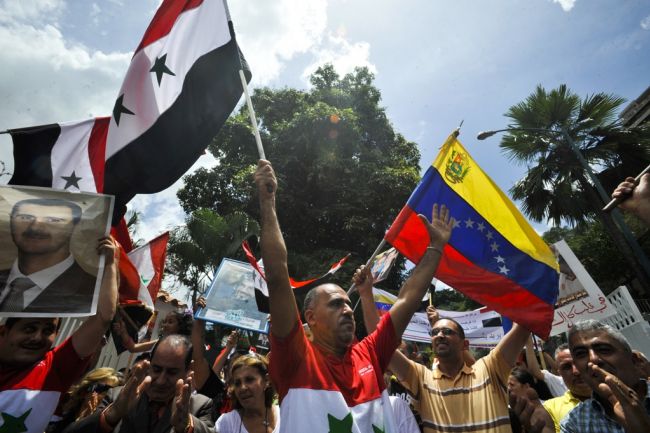
Much of the world is demanding greater pressure on Syria following a United Nations inspectors’ report hinting that Syrian strongman Bashar al-Assad used chemical weapons in his country’s civil war, but — amazingly — Venezuela and some of its Latin American allies are still passionately defending Syria’s dictator.

Earlier this week, after U.N. Secretary General Ban Ki-moon presented the U.N. inspectors’ report concluding that there is “clear and convincing” evidence that chemical weapons were used in an Aug. 21 incident on the outskirts of Damascus, Venezuelan President Nicolás Maduro lashed out against the U.N. chief for allegedly siding with the enemies of the Syrian people.

“Why is the U.N. secretary general lending himself (to plans to attack Syria,) as if he were a prosecutor and judge of the world’s people, putting himself at the service of the strategy of war, instead of being at the service of peace?” Maduro asked in a speech Monday in the state of Miranda.

In a speech last month more than a week after the Aug. 21 attack with chemical weapons, Maduro said, “Venezuela is with Syria, and with President Bashar al-Assad, and with the Syrian people.”

A day later, on Aug. 31, Maduro issued an official statement stating that Venezuela stands by “the Syrian people” in their fight against “unjustified war-mongering aggressions.”

Venezuela’s government-run media, meantime, has turned Assad into a hero and is blaming the United States and Israel for allegedly trying to invade Syria.

A cartoon in Venezuela’s state-run daily Correo del Orinoco this week shows a plane dropping hearts over Syria with the legend “to the Syrian people from the people of ALBA.” ALBA, which stands for the Bolivarian Alliance for the Peoples of Our Americas, is an organization formed by Venezuela that is it made up of nine Latin American and Caribbean countries.

Venezuela’s daily Vea, which like other government-backed newspapers often publishes anti-Semitic cartoons, ran a cartoon on May 9 showing a black-robed skeleton representing death, with a star of David and this legend: “Since we got tired of killing Palestinians, we are now going to finish with the Syrians.”

What’s most amazing about the pro-Assad statements in Venezuela’s official media is that they are still appearing after the U.N. inspectors’ report — which clearly suggests, without saying so explicitly, that Assad’s forces were responsible for the Aug. 21 chemical gas attack.

While it doesn’t officially take sides, because that wasn’t within the inspectors’ scope, the U.N. report shows that the rockets that carried Sarin gas are weapons that are not in the hands of Syria’s rebels, and that they were launched from several government-controlled points.

Although less strenuously, Venezuelan allies such as Cuba and Bolivia also have come out in support of Assad even after the U.N. findings. Most other Latin American countries have supported the Geneva agreement between the United States and Russia to demand that Syria destroy its chemical weapons.

But U.S. officials say major Latin American countries such as Mexico and Brazil have been late in joining the international community’s demands that Syria comply with the Geneva agreement.

Roberta Jacobson, the top U.S. State Department official in charge of Latin American affairs, told me Wednesday that “there is disappointment that more countries (in the region) would not have put out stronger statements condemning the Assad government’s use of Sarin gas, and supporting the Geneva U.S.-Russia agreements.”

Jacobson added that “countries in the Western Hemisphere want to be, and increasingly are, global actors. (But) If countries want to be global players, they should step up and confront challenges to the international community.”

My opinion: It’s entirely legitimate for Latin American countries to oppose a unilateral U.S. intervention in Syria, or even a U.S. intervention with dozens of allied countries but without the blessing of the United Nations. I myself have serious doubts about the wisdom of an intervention to stop Syria’s war crimes without some sort of U.N. cover.

But defending a dictator who has massacred a sizable part of the 100,000 people who have died in Syria’s civil war, and who according to all available evidence is responsible for the Aug. 21 attack with chemical weapons, is outrageous.

Maduro may be over-reacting on Syria because he needs to keep his Chavista radical base behind him after his dubious and narrow election victory April 14. His almost daily blunders, alongside Venezuela’s steep economic decline, are seriously weakening his government. And his adoration for dictators may explain his natural sympathy for Assad.

Still, Venezuela’s enthusiastic support for the Syrian regime after the Aug. 21 attack with chemical weapons should be denounced by everybody for what it is: an open defense of crimes against humanity.

To read this article at the Miami Herald, please click here.
 
Oct
12
2012
Posted by
admin
Comments

In Case You Missed It… Articles Roundup Week of 10/12/12

colgate 300x196 In Case You Missed It… Articles Roundup Week of 10/12/12

Stock Photo

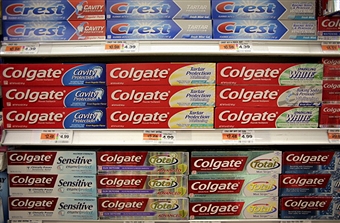
Sunday’s reelection of Chávez disappointed many Venezuelans, but, with gubernatorial elections in December, Henrique Capriles and the opposition still may pose a threat to Chávez’s political aims in the future. Meanwhile, Chávez hails his reelection as evidence of Venezuela’s “perfect” democracy, despite the unfair playing field. Chávez also criticizes U.S.-Syria policy in his first press conference after the election, while vowing to deepen his socialist revolution in Venezuela. Yet his victory spurs further emigration as Venezuelans predict more economic woes. On Wednesday, Chávez named Foreign Minister Nicolas Maduro as his new Vice President to replace Elias Jaua. And with the end of 2012 only three months away, the Venezuelan inflation rate is expected to rise to 21 percent by the end of the year. Meanwhile, Chávez’s reelection raises worries among manufacturers from Coca-Cola to Colgate, with the threat of currency devaluation looming.

Chavismo Wins, Venezuela Loses, The Wall Street Journal

It was around 9 p.m. in Caracas on Sunday when opposition presidential candidate Henrique Capriles Radonski tweeted his followers: “Calm, prudence, patience. Today was a great historic day. The people spoke.” Chávez also used his first press conference following his reelection to criticize U.S. Syria policy.

Venezuelan opposition candidate Capriles may still pose future threat to Chavez, The Washington Post

CARACAS, Venezuela — His loss in Sunday’s presidential election was resounding, but in conceding defeat before tearful followers, Henrique Capriles hinted at an active political future that may yet pose a challenge to President Hugo Chavez’s self-proclaimed socialist revolution.

Venezuela’s Hugo Chavez wins 3rd term, vows to deepen socialist revolution, NBC News

CARACAS, Venezuela — President Hugo Chavez scored a comfortable election victory that could extend his rule to 20 years and vowed to deepen his self-styled socialist revolution after a bitterly fought race against a youthful rival who has galvanized Venezuela’s opposition.

Venezuela’s Chavez hails “perfect” democracy, mocks tyrant image, Reuters

(Reuters) – An ebullient President Hugo Chavez on Tuesday hailed his comfortable re-election as evidence of Venezuela’s “perfect” democracy and mocked his foes’ depiction of him as a dictator.

Venezuela’s Chavez criticizes US over Syria policy, Kansas City Star

In his first press conference since winning reelection Sunday, President Hugo Chávez said he was willing to work with the opposition even as he doubles down on his socialist reforms.

Chavez Victory Spurs Exodus as Venezuelans Foresee Economic Woes, Bloomberg Businessweek

Juan Ibarra, a 35-year-old surgeon from Caracas, is preparing to emigrate after Venezuelan President Hugo Chavez won another six-year term on Oct. 7.

Venezuela’s Chavez names Maduro vice-president, Reuters

(Reuters) – Venezuelan President Hugo Chavez named Foreign Minister and former bus driver Nicolas Maduro as his new vice president on Wednesday in a Cabinet shake-up following his comfortable re-election.

Inflation rate estimated at 21% ending 2012, El Universal

On Tuesday, the Central Bank of Venezuela (BCV) published the results of the performance of the National Consumer Price Index (NCPI) in September, resulting in a monthly variation of 1.6% for an accrued amount of 11.5% and annualized inflation at 18%.

Colgate: not toasting Chavez’s return, Financial Times

How do you toast the victory of Hugo Chávez, Venezuela’s socialist president, who last Sunday won another six-year term, reconfirming him as one of Latin America’s most commanding political figures?

 
Sep
21
2012
Posted by
admin
Comments

The Venezuelan Election Deserves Our Attention

Forbes
September 21, 2012
By Doug Schoen

4b3f7cfa9709bddca3dcc2bb73a0c167 The Venezuelan Election Deserves Our Attention

Courtesy of: AP

There is a crucial election about to take place in Venezuela. Basic issues of freedom and economic liberty are at stake for the Venezuelan people. And with Venezuela being both our largest oil provider and a chief anti-American aggressor with alliances in Iran, Syria and Russia amongst others, this election is not only critical for us but much more so than policymakers in DC have acknowledged or realized.

Democratic challenger Henrique Capriles could surely change the direction of the Venezuela. He is poised to serve as a much-needed positive force in shaping Venezuela’s future as a cooperative member of the international community if he is elected on October 7th.

The head of Venezuela’s oil workers union, the United Federation of Oil Workers, said just yesterday that his members are not even entertaining the idea of a Chavez defeat. “It is impossible for Capriles to win this year…We the working class will not allow it.”

But while some in the state run oil industry look to Chavez as a savior of their industry, he has been involved in a number of dangerous and unsavory pursuits over the years that bring a black cloud over his administration and its business. Chavez has been linked to major narcoterrorists, including Walid Makled who was designated a major drug kingpin by the Obama administration in 2009 and is a financial stalwart of Chavez’s administration. In fact, dozens of top-level figures in the Chavez government including ministers, judges and generals were on Makled’s payroll.

Roger Noriega, former US Ambassador to the Organization of American States, delivered chilling testimony to the Congressional Subcommittee on Counterterrorism wherein he detailed Venezuela’s support of Hezbollah in Latin America. And it is well known that Chavez is actively working against American interests in Latin America while he bankrupts his country in pursuit of a radical socialist agenda.

In contrast, challenger Capriles is a true democrat. A successful governor of the state of Miranda, he is a capitalist who is focused on de-politicizing Venezuela, a much needed change.

He represents a new generation of the Venezuelan political class that supports America and wants to work in genuine partnership. As a practicing Roman Catholic and a child of the Holocaust, he is acutely aware of and concerned with issues of freedom and equity, both crucial areas for the future of Venezuela.

To be sure, Capriles faces an uphill battle. Chavez has proven he will do anything, say anything, or undermine the integrity and independence of any institution to stay in power. It is therefore imperative that there be international recognition that Chavez has cheated in past elections and that he very well may cheat again. The polls are currently showing a wide range of results from a two-point advantage for Capriles to as much as a 20-point advantage for Chavez. The reality is that the two candidates are probably very close.

Chavez is convinced that he will win the election. Two weeks ago he said, “Capriles will no longer be able to surmount [the lead], even if he gets on a missile, or two, or 10…it is impossible for them to win this election. It is absolutely impossible, mathematically impossible.”

I’ve written in the past about how Chavez cheated in the 2004 referendum, which has been verified by outside, independent auditors. And indeed, there have occasionally been times that he has stood down, acknowledged defeat and moved to change the constitution like the 2007 referendum.

But the instances of Chavez circumventing the democratic process for his own personal gain far outnumber the cases where he has accepted defeat. It follows that the world must focus on this election so he cannot cheat again, a reality that has been widely predicted.

One of the keys to ensuring a free and fair election in Venezuela next month is Ambassador Diego Arria. Ambassador Arria has long pursued a lonely mission of trying to make the case of Venezuela’s importance on the world stage.

As the Permanent Representative of Venezuela to the United Nations, he predicted the Bosnian genocide in Srebrenica before it happened. And he created the “Arria Formula”, an informal consultation process that affords members of the UN Security Council the opportunity to hear persons in a confidential, informal setting which has become integral to the Security Council process.

It is critically important that Ambassador Arria continues to do his work in order to prevent Chavez from stealing yet another election and, again, consigning the Venezuelan people to further years of deprivation and poverty.

Ambassador Arria is a towering intellect and a world-class figure, a true supporter of democracy. He is playing the role of key liaison to the US and other governments around the world for Capriles and the forces of democracy in Venezuela. He is one of those genuine heroes who has effectively worked to make peace in the world and has dedicated himself to this cause for decades.

An unapologetic democrat, Ambassador Arria is working to make sure the world knows what is at stake in Venezuela. To be sure, the stakes couldn’t be higher and it is high time that the international community took notice.

To read this article on Forbes, please click here.