Sep
4
2013
Posted by
admin
Comments

ICYMI: Blackouts Hit Nearly Half of Venezuela

Wall Street Journal
September 3, 2013
By Kejal Vyas
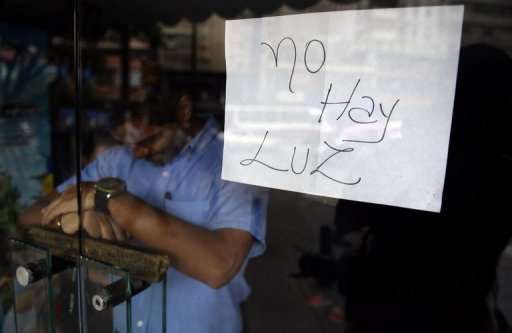
ALeqM5jqwUQc1j zylZx6VRZj8nU HvGvQ e1378316807289 ICYMI: Blackouts Hit Nearly Half of Venezuela

Courtesy of: AFP

CARACAS—A failure in a transmission line cut power across much of Venezuela on Tuesday, leading the government to blame unidentified saboteurs for the widespread disruption.

Electricity outages struck parts of at least 11 of Venezuela’s 23 states in the early afternoon, mostly in the central and western regions, as well as the capital city, Electricity Development Vice Minister Franco Silva said in comments carried on state television.

Information Minister Delcy Rodríguez said in an address about five hours after the initial outage that power had been restored to several states, adding electricity was in the process of coming back online in the oil-rich western states of Zulia and Táchira, and the greater Caracas area.

A shaky power grid remains a thorn in the side of energy-rich Venezuela, leading critics of the current government to point the finger at mismanagement at state-run utility companies. Authorities have periodically turned to power rationing and levied additional surcharges and penalties on heavy electricity users.

Ms. Rodríguez said “complete restoration of this important service will be done in a progressive manner” without specifying how long it would take.

Messages posted on the Twitter account of President Nicolás Maduro said that the power grid was attacked by unnamed enemies of the government.

“It’s evident that behind [the blackout] is the hand of those that want to weaken our country,” said one post. Mr. Maduro didn’t offer evidence to back up his allegations. Calls seeking further comment from officials weren’t immediately returned.

While the government’s detractors accuse authorities of misappropriating investments into the country’s electricity network and falling behind growing consumer demand, the late leader Hugo Chávez often blamed conspirators against his self-styled socialist “Bolivarian revolution.” Mr. Chávez died in March following a nearly two year battle with cancer. Mr. Chávez nationalized much of the electricity sector in 2007.

In recent weeks, his successor Mr. Maduro has disclosed details of various other alleged plots against Venezuela, including several alleged assassination attempts against his life supposedly masterminded by agents of the U.S. and Colombian governments. Critics accuse him of fabricating plots in a bid to boost support.

Venezuela opposition leader Henrique Capriles, who lost April elections to replace Mr. Chávez, said the power failure underscored mismanagement at state companies. “The blackout today demonstrates one more time the terrible incapacity of this government,” Mr. Capriles said in a post on his official Twitter account. “Now they’ll come up with another story to try to cover up the failure.”

In Caracas, the blackouts briefly hit some key government buildings, including the Energy Ministry, which is also the headquarters of state oil company Petróleos de Venezuela, or PdVSA.

In a statement, Oil Minister Rafael Ramírez said refining and production operations in Venezuela’s vital oil industry were unaffected.

The sprawling capital city was furthered tangled by knotted traffic, disrupted subway service and severed water supplies, as several treatment plants went down, authorities said. Power shortfalls and outages are more common in the interior of the country of 29 million residents, while more rarely reaching Caracas.

Between 2009 and 2010, a drought cut production at Venezuela’s hydroelectric facilities that accounted for some 70% of the country’s power. The country has since had to divert more of its crude oil production and imports gas from Colombia to fulfill its own domestic power needs.

To read this article at The Wall Street Journal, please click here.
 
May
16
2013
Posted by
admin
Comments

ICYMI: Venezuela is Running Out of Toilet Paper

Associated Press
May 16, 2013
By Fabiola Sanchez and Karl Ritter

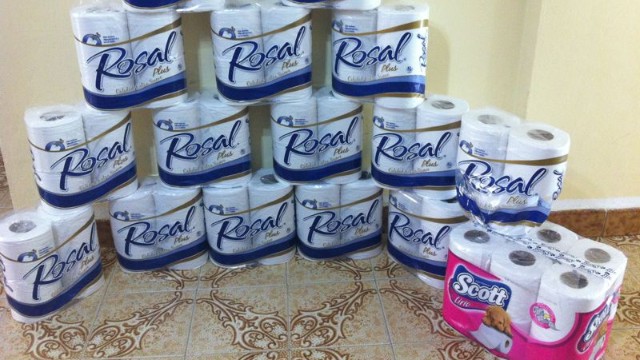
130515171546 toilet paper caracas story top e1368722217422 ICYMI: Venezuela is Running Out of Toilet Paper

Courtesy of: CNN

CARACAS, Venezuela (AP) — First milk, butter, coffee and cornmeal ran short. Now Venezuela is running out of the most basic of necessities — toilet paper.

Blaming political opponents for the shortfall, as it does for other shortages, the embattled socialist government says it will import 50 million rolls to boost supplies.

That was little comfort to consumers struggling to find toilet paper on Wednesday.

“This is the last straw,” said Manuel Fagundes, a shopper hunting for tissue in downtown Caracas. “I’m 71 years old and this is the first time I’ve seen this.”

One supermarket visited by The Associated Press in the capital on Wednesday was out of toilet paper. Another had just received a fresh batch, and it quickly filled up with shoppers as the word spread.

“I’ve been looking for it for two weeks,” said Cristina Ramos. “I was told that they had some here and now I’m in line.”

Economists say Venezuela’s shortages stem from price controls meant to make basic goods available to the poorest parts of society and the government’s controls on foreign currency.

“State-controlled prices — prices that are set below market-clearing price — always result in shortages. The shortage problem will only get worse, as it did over the years in the Soviet Union,” said Steve Hanke, professor of economics at Johns Hopkins University.

President Nicolas Maduro, who was selected by the dying Hugo Chavez to carry on his “Bolivarian revolution,” claims that anti-government forces, including the private sector, are causing the shortages in an effort to destabilize the country.

The government this week announced it would import 760,000 tons of food and 50 million rolls of toilet paper.

Commerce Minister Alejandro Fleming blamed the shortage of toilet tissue on “excessive demand” built up as a result of “a media campaign that has been generated to disrupt the country.”

“The revolution will bring the country the equivalent of 50 million rolls of toilet paper,” he was quoted as saying Tuesday by state news agency AVN. “We are going to saturate the market so that our people calm down.”

Finance Minister Nelson Merentes said the government was also addressing the lack of foreign currency, which has resulted in the suspension of foreign supplies of raw materials, equipment and spare parts to Venezuelan companies, disrupting their production.

“We are making progress … we have to work very hard,” Merentes told reporters Wednesday.

Many factories operate at half capacity because the currency controls make it hard for them to pay for imported parts and materials. Business leaders say some companies verge on bankruptcy because they cannot extend lines of credit with foreign suppliers.

Merentes said the government had met the U.S. dollar requests of some 1,500 small- and medium-sized companies facing supply problems, and was reviewing requests from a similar number of larger companies.

Chavez imposed currency controls a decade ago trying to stem capital flight as his government expropriated large land parcels and dozens of businesses.

Anointed by Chavez as his successor before the president died from cancer, Maduro won a close presidential election April 14 against opposition candidate Henrique Capriles, who refused to accept the result, claiming Maduro won through fraud and voter intimidation. He filed a complaint to the Supreme Court, asking for the vote to be annulled, though that’s highly unlikely to happen since the court is packed with government-friendly justices.

Patience is wearing thin among consumers who face shortages and long lines at supermarkets and pharmacies. Last month, Venezuela’s scarcity index reached its highest level since 2009, while the 12-month inflation rate has risen to nearly 30 percent. Shoppers often spend several days looking for basic items, and stock up when they find them.

Fleming, the commerce minister, said monthly consumption of toilet paper was normally 125 million rolls, but that current demand “leads us to think that 40 million more are required.”

“We will bring in 50 million to show those groups that they won’t make us bow down,” he said.

To read this article at Associated Press, please click here.

 
Apr
12
2013
Posted by
admin
Comments

Days From the Election, Capriles Makes His Final Appeal

Capriles election rally i 002 e1365772893413 Days From the Election, Capriles Makes His Final Appeal

Courtesy of: Agence France Presse

Last year, Henrique Capriles Radonski, the leader of Venezuela’s opposition, campaigned tirelessly against Hugo Chávez for Venezuela’s presidency. Although he lost that contest, Capriles broke new ground by winning an unprecedented 44 percent of the vote (over 6 million people) against the popular incumbent. This time around, Capriles is just as determined to defeat interim president Nicolás Maduro in the snap April election, and he is pushing himself to the limits to campaign for change in a fraction of the time. Capriles has once again unified the country’s opposition into a nation-wide campaign to oust Chávez’s would-be successor.

Earlier this week, hundreds of thousands of supporters filled the streets of Caracas to attend Capriles’ rally in the capital city. And, as in last year’s now-legendary “house-to-house” campaign, the opposition leader has stopped in dozens of other Venezuelan cities and towns to unite his base and attract more support. In death, Chávez remains extraordinarily popular among his base, but Capriles forcefully argues that Maduro is not the same person as his predecessor. In the campaign’s final days, Capriles works hard to draw contrasts between the late Chávez and the longtime political operative Maduro, who is closely intertwined with the Castros in Cuba.

Meanwhile, even while using the powers of the government to tilt the playing field in his favor, Maduro has sought to exploit Chávez supporters and turn their grief into votes. He copies Chávez’s campaign style, wearing athletic track jackets with the Venezuelan flag and spontaneously breaking out into songs (although Chávez’s charisma and public presence far outstripped the stolid Maduro’s). In bombastic speeches, he insults Capriles and the opposition with lies and slurs about Capriles’ heritage. Maduro’s slogans warn that supporting the opposition means “you don’t love your mother.” His campaign song says that a vote for the opposition means “you don’t have a heart, you’re like a dead man.” Every piece of campaign propaganda features Chávez—sometimes omitting any mention of Maduro himself. Some posters and t-shirts depict just the former president’s eyes, a thinly veiled reminder that Chávez is always watching.

Indeed, Chávez may have died over a month ago, but his image pervades the new presidential elections. Recently, one of Capriles’ televised speeches was interrupted by a national broadcast of Chávez’s last television appearance in which he emotionally asked Venezuelans to support Maduro as his political heir. And to rouse further turnout of the “sympathy vote,” the government is working to prolong Venezuelans’ hysteria and grief over Chávez’s death. The former president’s body traveled the country for weeks, holding funeral services and rallies, and a recent state-funded, animated commercial depicted Chávez’s welcome into heaven by famous Latin American socialists like Eva Perón and Che Guevara.

Maduro has worked so hard to protect his position as Chávez’s successor that he even claims their bond continues. At one campaign stop, he described a bizarre story about a visit from Chávez in the form of a little bird. According to Maduro, he communicated with the bird while at prayer at a chapel in the late president’s hometown. He told supporters that the bird blessed him and urged the campaign onward to victory. Now doubling down on the strategy, Maduro has made the bird part of his campaign rallies, wearing hats and marching in parades featuring the symbol of Chávez.

Meanwhile, Maduro attacks Capriles and his supporters with hostile name-calling and outlandish conspiracy theories. One campaign speech referred to the opposition as the “heirs of Hitler”—a particularly offensive comment since Capriles is of Jewish descent and his maternal grandparents immigrated to Venezuela to escape the Holocaust. Maduro alleged Capriles’ aides hired a group of Salvadoran mercenaries to assassinate him, and, after widespread blackouts in Venezuela, he accused the opposition of trying to sabotage the electrical grid. In a crazier allegation, Maduro spoke of an American plot to kill his opponent. He has also warned rural voters of a centuries-old curse that will afflict anyone who votes against him.

All this is evidence that Maduro will use every weapon in his government-funded arsenal to ensure he wins the election. The dark genius of Chávez’s “appointment” of Maduro last year was that it gave Maduro months to drive up his name recognition and play the part of president, while Capriles was barred from the public eye, forbidden from campaigning at all. Knowing the former president’s condition was graver than he let on, Maduro thus began the campaign with an enormous head start.

Meanwhile, he continues to press the advantages offered to him by the unfair playing field. Government workers are required to attend his rallies, many of which feature heavy participation from government ministries. The courts, electoral council and other so-called oversight bodies are packed with Chávez loyalists. On election day, all government housing tenants will receive free rides to the polls in addition to food and payment. Meanwhile, election watchers will not be surprised if buses in the opposition voters’ residential areas “mysteriously” break down.

Despite his disadvantages, Capriles remains enthusiastic and tirelessly optimistic as the campaign winds down to election day this Sunday. Maduro enjoys government power and control over the media – not to mention a three month head start – but polls show Capriles has narrowed the gap considerably since the campaign began. Capriles presents himself as the best way forward to combat the deplorable state of Venezuela’s current economy and civil society. High crime rates, soaring inflation and desperate food shortages are causing many Venezuelans to rethink their old loyalties. On election day, Capriles will ask for their votes. And he will need every one.