Apr
12
2013
Posted by
admin
Comments

Days From the Election, Capriles Makes His Final Appeal

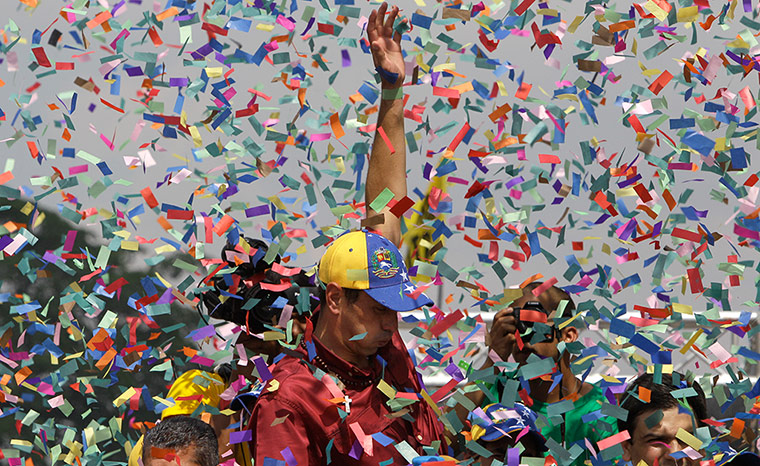
Capriles election rally i 002 e1365772893413 Days From the Election, Capriles Makes His Final Appeal

Courtesy of: Agence France Presse

Last year, Henrique Capriles Radonski, the leader of Venezuela’s opposition, campaigned tirelessly against Hugo Chávez for Venezuela’s presidency. Although he lost that contest, Capriles broke new ground by winning an unprecedented 44 percent of the vote (over 6 million people) against the popular incumbent. This time around, Capriles is just as determined to defeat interim president Nicolás Maduro in the snap April election, and he is pushing himself to the limits to campaign for change in a fraction of the time. Capriles has once again unified the country’s opposition into a nation-wide campaign to oust Chávez’s would-be successor.

Earlier this week, hundreds of thousands of supporters filled the streets of Caracas to attend Capriles’ rally in the capital city. And, as in last year’s now-legendary “house-to-house” campaign, the opposition leader has stopped in dozens of other Venezuelan cities and towns to unite his base and attract more support. In death, Chávez remains extraordinarily popular among his base, but Capriles forcefully argues that Maduro is not the same person as his predecessor. In the campaign’s final days, Capriles works hard to draw contrasts between the late Chávez and the longtime political operative Maduro, who is closely intertwined with the Castros in Cuba.

Meanwhile, even while using the powers of the government to tilt the playing field in his favor, Maduro has sought to exploit Chávez supporters and turn their grief into votes. He copies Chávez’s campaign style, wearing athletic track jackets with the Venezuelan flag and spontaneously breaking out into songs (although Chávez’s charisma and public presence far outstripped the stolid Maduro’s). In bombastic speeches, he insults Capriles and the opposition with lies and slurs about Capriles’ heritage. Maduro’s slogans warn that supporting the opposition means “you don’t love your mother.” His campaign song says that a vote for the opposition means “you don’t have a heart, you’re like a dead man.” Every piece of campaign propaganda features Chávez—sometimes omitting any mention of Maduro himself. Some posters and t-shirts depict just the former president’s eyes, a thinly veiled reminder that Chávez is always watching.

Indeed, Chávez may have died over a month ago, but his image pervades the new presidential elections. Recently, one of Capriles’ televised speeches was interrupted by a national broadcast of Chávez’s last television appearance in which he emotionally asked Venezuelans to support Maduro as his political heir. And to rouse further turnout of the “sympathy vote,” the government is working to prolong Venezuelans’ hysteria and grief over Chávez’s death. The former president’s body traveled the country for weeks, holding funeral services and rallies, and a recent state-funded, animated commercial depicted Chávez’s welcome into heaven by famous Latin American socialists like Eva Perón and Che Guevara.

Maduro has worked so hard to protect his position as Chávez’s successor that he even claims their bond continues. At one campaign stop, he described a bizarre story about a visit from Chávez in the form of a little bird. According to Maduro, he communicated with the bird while at prayer at a chapel in the late president’s hometown. He told supporters that the bird blessed him and urged the campaign onward to victory. Now doubling down on the strategy, Maduro has made the bird part of his campaign rallies, wearing hats and marching in parades featuring the symbol of Chávez.

Meanwhile, Maduro attacks Capriles and his supporters with hostile name-calling and outlandish conspiracy theories. One campaign speech referred to the opposition as the “heirs of Hitler”—a particularly offensive comment since Capriles is of Jewish descent and his maternal grandparents immigrated to Venezuela to escape the Holocaust. Maduro alleged Capriles’ aides hired a group of Salvadoran mercenaries to assassinate him, and, after widespread blackouts in Venezuela, he accused the opposition of trying to sabotage the electrical grid. In a crazier allegation, Maduro spoke of an American plot to kill his opponent. He has also warned rural voters of a centuries-old curse that will afflict anyone who votes against him.

All this is evidence that Maduro will use every weapon in his government-funded arsenal to ensure he wins the election. The dark genius of Chávez’s “appointment” of Maduro last year was that it gave Maduro months to drive up his name recognition and play the part of president, while Capriles was barred from the public eye, forbidden from campaigning at all. Knowing the former president’s condition was graver than he let on, Maduro thus began the campaign with an enormous head start.

Meanwhile, he continues to press the advantages offered to him by the unfair playing field. Government workers are required to attend his rallies, many of which feature heavy participation from government ministries. The courts, electoral council and other so-called oversight bodies are packed with Chávez loyalists. On election day, all government housing tenants will receive free rides to the polls in addition to food and payment. Meanwhile, election watchers will not be surprised if buses in the opposition voters’ residential areas “mysteriously” break down.

Despite his disadvantages, Capriles remains enthusiastic and tirelessly optimistic as the campaign winds down to election day this Sunday. Maduro enjoys government power and control over the media – not to mention a three month head start – but polls show Capriles has narrowed the gap considerably since the campaign began. Capriles presents himself as the best way forward to combat the deplorable state of Venezuela’s current economy and civil society. High crime rates, soaring inflation and desperate food shortages are causing many Venezuelans to rethink their old loyalties. On election day, Capriles will ask for their votes. And he will need every one.

 
Sep
25
2012
Posted by
admin
Comments

ICYMI: Chávez accused of election dirty tricks

Financial Times
September 24, 2012
By Benedict Mander

Chaves ICYMI: Chávez accused of election dirty tricks

Courtesy of: AP

Shortly after Venezuelan television stations began a live broadcast of a major opposition rally this month, coverage was cut and replaced with images of President Hugo Chávez looking jovial and fatherly as he visited young children at school.

It was one of the populist leader’s infamous “chain broadcasts”, in which all regular programming on public access television and radio is suspended so that he can trumpet the achievements of his “Bolivarian revolution”, often for hours on end.

Mr Chávez’s opponents cite this as just another example of how the socialist leader, who has said in the past he wants to rule until 2021, is stacking the decks in an increasingly tight race for the presidency.

Mr Chávez has been in power for more than 13 years and the opposition sees this year’s poll – due to take place on October 7 – as its best chance yet of ousting one of Latin America’s most controversial leaders. Henrique Capriles, the pro-business opposition leader, is Mr Chávez’s main rival. Now allegations of government electoral abuses have raised fears about how far will Mr Chávez go to ensure his victory.

“This is corruption, a crime,” says Eduardo Semtei, a former member of Venezuela’s National Electoral Council (CNE), which oversees the election, of Mr Chávez’s ‘chain broadcasts’.

Mr Semtei, who now advises the opposition, criticises the “fawning” body for abandoning its duties. “Everyone knows that four of the CNE’s five directors are pro-Chávez – that’s one thing. But it’s not OK that they ignore . . . government abuses,” he says.

The CNE’s partial treatment was evident last month when it sought to prevent Mr Capriles from wearing a baseball cap emblazoned with the colours of the national flag. It claimed this violated campaign regulations – although it has never questioned the president’s use of national symbols in his own clothing and logos.

“Without a doubt the greatest weakness of the process lies in the inequitable conditions of competition,” according to a report on Venezuela’s elections released by the Wilson Center, a US think-tank. Although it described the voting system itself as “reliable”, it criticised the politicisation of the electoral council, Mr Chávez’s media advantage and opaque campaign financing.

A major opposition gripe is Mr Chávez’s almost unlimited access to state oil revenues – Venezuela has the largest oil reserves in the world – that allows him to “buy” votes by investing heavily in his popular social programmes. Central government spending grew by 41.1 per cent in real terms last month. By contrast, Mr Capriles must raise campaign funds privately.

And while the president also has almost unlimited access to television time, which he routinely uses to trumpet the government’s achievements and assail his rival – calling him a “pig” and a “loser” – Mr Capriles’ enjoys far less airtime.

Maryclen Stelling, a pro-government sociologist who is also a CNE substitute director, admits that the boundary between Mr Chávez’s role as president and candidate is “blurred”. “It’s difficult to prove when Chávez is no longer acting as president but as candidate,” she said.

Adding to the tension are opposition allegations that people fear they will lose their jobs if they fail to vote for Mr Chávez. Many Venezuelans fear their vote will not be secret. The names of signatories of a petition for a 2004 referendum that attempted to unseat Mr Chávez were made public. The signatories were later blacklisted by government ministries.

Despite the huge challenges he faces, Mr Capriles is confident he can win. “This is David against Goliath,” he told the Financial Times. Mr Capriles won the governorship of Venezuela’s second most populous state in 2008 against one of Mr Chávez’s closest allies. “Nobody ever gave me an election victory as a present.”

At least both sides recognise the validity of Venezuela’s computer-encrypted voting system. “The voting system has so many security controls that if voting counts are manipulated it will be detectable,” said Jennifer McCoy, director of the Americas programme at the Carter Center, which works to promote human rights. “It will be very difficult to change the result on a large scale.”

Furthermore, analysts point out that Mr Chávez derives his legitimacy from winning democratic elections. In 2007, he recognised defeat in a constitutional referendum, although he called the opposition’s win “a victory of sh*t”.

Mr Semtei says that if opposition election observers are present at all voting centres, the probability of fraud will be “nil”. “But the probability that the [government] will try is one hundred per cent.”

To read this article on the Financial Times, please click here.

 
Sep
24
2012
Posted by
admin
Comments

ICYMI: Chávez accused of election dirty tricks

Financial Times
September 24, 2012
By Benedict Mander

Chaves ICYMI: Chávez accused of election dirty tricks

Courtesy of: AP

Shortly after Venezuelan television stations began a live broadcast of a major opposition rally this month, coverage was cut and replaced with images of President Hugo Chávez looking jovial and fatherly as he visited young children at school.

It was one of the populist leader’s infamous “chain broadcasts”, in which all regular programming on public access television and radio is suspended so that he can trumpet the achievements of his “Bolivarian revolution”, often for hours on end.

Mr Chávez’s opponents cite this as just another example of how the socialist leader, who has said in the past he wants to rule until 2021, is stacking the decks in an increasingly tight race for the presidency.

Mr Chávez has been in power for more than 13 years and the opposition sees this year’s poll – due to take place on October 7 – as its best chance yet of ousting one of Latin America’s most controversial leaders. Henrique Capriles, the pro-business opposition leader, is Mr Chávez’s main rival. Now allegations of government electoral abuses have raised fears about how far will Mr Chávez go to ensure his victory.

“This is corruption, a crime,” says Eduardo Semtei, a former member of Venezuela’s National Electoral Council (CNE), which oversees the election, of Mr Chávez’s ‘chain broadcasts’.

Mr Semtei, who now advises the opposition, criticises the “fawning” body for abandoning its duties. “Everyone knows that four of the CNE’s five directors are pro-Chávez – that’s one thing. But it’s not OK that they ignore . . . government abuses,” he says.

The CNE’s partial treatment was evident last month when it sought to prevent Mr Capriles from wearing a baseball cap emblazoned with the colours of the national flag. It claimed this violated campaign regulations – although it has never questioned the president’s use of national symbols in his own clothing and logos.

“Without a doubt the greatest weakness of the process lies in the inequitable conditions of competition,” according to a report on Venezuela’s elections released by the Wilson Center, a US think-tank. Although it described the voting system itself as “reliable”, it criticised the politicisation of the electoral council, Mr Chávez’s media advantage and opaque campaign financing.

A major opposition gripe is Mr Chávez’s almost unlimited access to state oil revenues – Venezuela has the largest oil reserves in the world – that allows him to “buy” votes by investing heavily in his popular social programmes. Central government spending grew by 41.1 per cent in real terms last month. By contrast, Mr Capriles must raise campaign funds privately.

And while the president also has almost unlimited access to television time, which he routinely uses to trumpet the government’s achievements and assail his rival – calling him a “pig” and a “loser” – Mr Capriles’ enjoys far less airtime.

Maryclen Stelling, a pro-government sociologist who is also a CNE substitute director, admits that the boundary between Mr Chávez’s role as president and candidate is “blurred”. “It’s difficult to prove when Chávez is no longer acting as president but as candidate,” she said.

Adding to the tension are opposition allegations that people fear they will lose their jobs if they fail to vote for Mr Chávez. Many Venezuelans fear their vote will not be secret. The names of signatories of a petition for a 2004 referendum that attempted to unseat Mr Chávez were made public. The signatories were later blacklisted by government ministries.

Despite the huge challenges he faces, Mr Capriles is confident he can win. “This is David against Goliath,” he told the Financial Times. Mr Capriles won the governorship of Venezuela’s second most populous state in 2008 against one of Mr Chávez’s closest allies. “Nobody ever gave me an election victory as a present.”

At least both sides recognise the validity of Venezuela’s computer-encrypted voting system. “The voting system has so many security controls that if voting counts are manipulated it will be detectable,” said Jennifer McCoy, director of the Americas programme at the Carter Center, which works to promote human rights. “It will be very difficult to change the result on a large scale.”

Furthermore, analysts point out that Mr Chávez derives his legitimacy from winning democratic elections. In 2007, he recognised defeat in a constitutional referendum, although he called the opposition’s win “a victory of sh*t”.

Mr Semtei says that if opposition election observers are present at all voting centres, the probability of fraud will be “nil”. “But the probability that the [government] will try is one hundred per cent.”

To read this article on the Financial Times, please click here.