Apr
26
2013
Posted by
admin
Comments

In Case You Missed It… Articles Roundup Week of 4/26/13

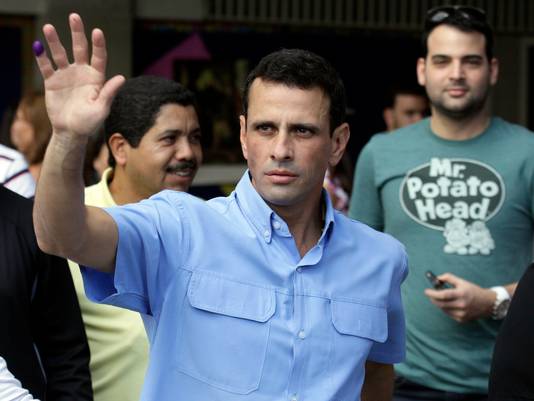
ap venezuela elections 4 3 r536 c534 e1367013802989 In Case You Missed It… Articles Roundup Week of 4/26/13

Courtesy of: Associated Press

This week:  After a controversial election and numerous protests, Nicolás Maduro’s presidency is off to a rocky start; shortly after his inauguration, Maduro shuffles his cabinet, keeping most of Hugo Chávez’s allies and key players; Venezuela’s electoral council and opposition leader Henrique Capriles express widely different expectations for the audit of the contested election; as a result, Capriles announces that the opposition will boycott the election audit because the Electoral Council failed to meet its demand for an examination of the “registers,” which contain voters’ signatures and fingerprints; and Capriles is threatened with jail as the opposition shows government claims of post-election violence to be exaggerated. Venezuela’s opposition accuses the government of engaging in mass arrests of protesters and harassment of government workers suspected of voting against Maduro; the government deals with accusations they exaggerated claims of opposition supporters firebombing Cuban-run neighborhood health clinics; Venezuela’s political climate and unrest worry Pope Francis, who urged politicians to reject any kind of violence and establish dialogue towards a reconciliation; and already with one of the world’s highest murder rates, political violence gets added to the mix of an already crime-ridden Venezuela. The Venezuelan government cuts off Capriles TV speech after he accused the government of robbing the election; Venezuela’s government arrests a US filmmaker, accusing him of plotting post-election instability; Venezuela’s Congressional Speaker, Diosdado Cabello, announces that government employees refusing to recognize Maduro as the legitimate president will not be paid; and Venezuela declares a 90-day electricity emergency amid unrest towards country-wide blackouts.

Maduro’s lousy start, The Economist

HUGO CHÁVEZ has been dead for more than a month, but visitors to Caracas could be forgiven for thinking that Venezuela’s bombastic former president was still alive and in power.

Shortly after narrow election victory, Venezuela’s Nicolas Maduro shuffles Cabinet, Fox News

Newly elected Venezuelan leader Nicolas Maduro has shuffled his Cabinet, putting allies of late president Hugo Chavez in positions to tackle pressing problems including widespread power outages and double-digit inflation.

Opposition, election body differ on Venezuela vote audit, Chicago Tribune

Venezuela’s opposition and electoral authority expressed on Saturday widely differing expectations for an audit of the contested April 14 presidential election, a day after Nicolas Maduro was sworn in to succeed the late Hugo Chavez.

Venezuela opposition to boycott vote audit, USA Today

Venezuelan opposition leader Henrique Capriles Radonski said Thursday his movement will boycott an audit of the election results and push the government to hold a new presidential vote.

Venezuela: Capriles Threatened With Jail As Inquiry Into Election Violence Continues, Fox News Latino

The contested presidential election in Venezuela that saw Hugo Chávez’s successor maintain control of the South American nation has shed light on the deep ideological divide within the country and raised questions over the legitimacy of Venezuela’s state-run media.

Venezuela opposition denounces arrests of protesters, AFP

Venezuela’s opposition Saturday accused the government of President Nicolas Maduro of engaging in mass arrests of protesters and harassing government workers suspected of voting against him.

Venezuelan Govt Targets Disaffected Ex-Supporters, The Associated Press

The razor-close vote to replace late Venezuelan President Hugo Chavez has sparked what opposition leaders and human rights groups say is a government crackdown on public employees who either didn’t back Chavez’s hand-picked successor or failed to show sufficient support for the ruling party.

Venezuela’s Political Climate Worries Pope Francis, Fox News Latino

While he no longer resides in the region, the first pope from South America says he is worried about the political unrest in Venezuela.

Political violence threatens crime-ridden Venezuela, AFP

With one of the world’s highest murder rates, Venezuela’s daily Russian roulette with violent crime now has an added spin: the threat of political violence due to the country’s election impasse.

Venezuela Cuts Off Capriles’s TV Speech Over ‘Robbed’ Election, Bloomberg Businessweek

Venezuela cut off the transmission of a speech by opposition leader Henrique Capriles Radonski yesterday using a system of national broadcasts known as “cadena” after he said this month’s election was “robbed.”

Venezuela Says U.S. Citizen Plotted Unrest, NYTimes.com

An American citizen has been arrested by Venezuelan authorities who said Thursday that he had been taken into custody because he was involved in a plot to destabilize the country after the recent presidential election.

Congress Speaker: Deputies not recognizing Maduro will not be paid, El Universal

During a visit to the state of Anzoátegui, northeast Venezuela, Congress Speaker Diosdado Cabello announced that any deputies failing to recognize Nicolás Maduro as the new president would not be paid.

Venezuela Declares 90-Day Electricity ‘Emergency’, Reuters

President Nicolas Maduro’s government declared a 90-day “emergency” in Venezuela’s electricity sector on Tuesday to speed up infrastructure work and equipment imports needed to prevent politically-contentious power cuts.
 
Apr
15
2013
Posted by
admin
Comments

Venezuela’s Election Leaves Unexpectedly Narrow Margin of Victory

s1.reutersmedia.net  Venezuela’s Election Leaves Unexpectedly Narrow Margin of Victory

Courtesy of: Reuters

Millions of Venezuelans headed to the polls on Sunday to elect a new president for the second time in six months. Though expectations were low heading into the vote – especially among the country’s opposition – an unexpectedly close race has reignited tensions, uncertainty and indeed, hope.

Though Venezuelans had elected Hugo Chávez just last October, a new election was triggered after the former president lost a long battle to cancer in March. The government positioned Nicolás Maduro, the country’s vice-president and Chávez’s handpicked successor, as their new candidate. The opposition once again chose their leader and former candidate, Henrique Capriles.

Nicolas Maduro, in his capacity as acting president, enjoyed a de facto three month head start on the campaign. Capriles, on the other hand, was forced to campaign only during the formal period, which totaled 10 days. Meanwhile, the Venezuelan government did all it could to ensure Hugo Chávez’s memory was never far from the campaign trail. Maduro and the government invoked his image, name and voice in every single rally, trying to seize on the sympathy vote and keep open the subliminal connection with the powerful “Comandante.” Capriles and the opposition sought to draw a distinction between Chávez and Maduro, reminding Venezuelans that Chávez’s supposed “successor” is little more than an un-charismatic and power-hungry former underling of Chávez himself.

Maudro’s control over the country’s media and public resources proved to be an enormous advantage over this short campaign. While Maduro enjoyed more than 65 hours of state media coverage, Capriles received a paltry 23 minutes. In addition, during the auditing of voting machines, the opposition uncovered evidence that the government party had access to the secret codes needed to sabotage the voting process. International observers spoken out against the unfair playing field, also noting the egregious conflict of interest posed by the “independent” National Electoral Council composed of five officials – four who publicly support Maduro.

Given these advantages, analysts and pollsters favored Maduro to win Sunday’s vote by a significant margin. However, in a later than expected announcement, election authorities stunned Venezuelans, announcing Maduro as the winner, but with a margin of victory of only 1.59 percent or around 235,000 votes. The body announced around midnight that Maduro had received 50.6 percent of the vote and Capriles 49.1 percent.

Immediately after, Maduro took the stage to declare victory. The votes, however, clearly reflected the country’s serious doubts about the acting president’s ability to govern. In a brief, 10-day campaign, Capriles, who was predicted to lose by a similar margin as in October of 2012, managed to recover nearly all of 1.5 million votes he lost to Chávez just six months ago. The narrow margin – along with thousands of documented irregularities in the voting process – prompted Capriles and the opposition to call for a full recount of the votes.  Maduro announced he would accept the full recount. One must bear in mind, however, that this recount will be conducted by the Maduro-friendly National Electoral Council.

If the recount suggests a closer margin or reveals that Capriles was actually the winner, Venezuelans can expect a tumultuous time ahead. However, if electoral council upholds the reported results, the task ahead for Maduro is indeed daunting. He already faces a devastated country – left behind by 14 years of socialist rule – with a budget deficit of roughly 15 percent of annual economic output, inflation of almost 30 percent, extreme shortages, violent crime rates among the worst in the world, regular power outages, and a sclerotic state oil industry.

The results will also embolden the political opposition and undermine Maduro’s stature within Chávez’s former supporters. As a result, the political situation within the ruling socialist party will become more tempestuous. Maduro already lacks Chávez’s emotional connection with the nation’s poor; any fiscal retrenchment, therefore, could create a political backlash for the new president. Furthermore, this weak political mandate may spur divisions within the government’s political party. As memories of Chávez fade, other powerful figures like Assembly President Diosdado Cabello may challenge Maduro for primacy within the party.

Maduro’s narrow win has been termed by many a “Pyrrhic victory,” as does nothing to avoid the economic and political reckoning Venezuela’s ruling socialist party are heading for. Most analysts believe Venezuela has less than a year before the festering economic problems turn into a full-blown crisis.  With a sinking economy, a divided political party, and a confident and growing opposition, Venezuela seems set for contentious – and pivotal – days ahead.

 
Sep
25
2012
Posted by
admin
Comments

ICYMI: Chávez accused of election dirty tricks

Financial Times
September 24, 2012
By Benedict Mander

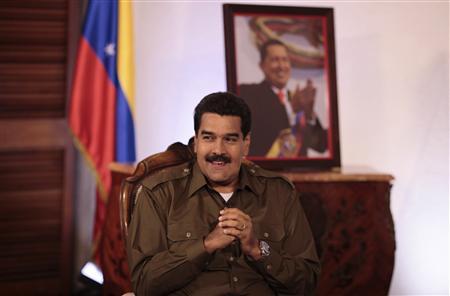
Chaves ICYMI: Chávez accused of election dirty tricks

Courtesy of: AP

Shortly after Venezuelan television stations began a live broadcast of a major opposition rally this month, coverage was cut and replaced with images of President Hugo Chávez looking jovial and fatherly as he visited young children at school.

It was one of the populist leader’s infamous “chain broadcasts”, in which all regular programming on public access television and radio is suspended so that he can trumpet the achievements of his “Bolivarian revolution”, often for hours on end.

Mr Chávez’s opponents cite this as just another example of how the socialist leader, who has said in the past he wants to rule until 2021, is stacking the decks in an increasingly tight race for the presidency.

Mr Chávez has been in power for more than 13 years and the opposition sees this year’s poll – due to take place on October 7 – as its best chance yet of ousting one of Latin America’s most controversial leaders. Henrique Capriles, the pro-business opposition leader, is Mr Chávez’s main rival. Now allegations of government electoral abuses have raised fears about how far will Mr Chávez go to ensure his victory.

“This is corruption, a crime,” says Eduardo Semtei, a former member of Venezuela’s National Electoral Council (CNE), which oversees the election, of Mr Chávez’s ‘chain broadcasts’.

Mr Semtei, who now advises the opposition, criticises the “fawning” body for abandoning its duties. “Everyone knows that four of the CNE’s five directors are pro-Chávez – that’s one thing. But it’s not OK that they ignore . . . government abuses,” he says.

The CNE’s partial treatment was evident last month when it sought to prevent Mr Capriles from wearing a baseball cap emblazoned with the colours of the national flag. It claimed this violated campaign regulations – although it has never questioned the president’s use of national symbols in his own clothing and logos.

“Without a doubt the greatest weakness of the process lies in the inequitable conditions of competition,” according to a report on Venezuela’s elections released by the Wilson Center, a US think-tank. Although it described the voting system itself as “reliable”, it criticised the politicisation of the electoral council, Mr Chávez’s media advantage and opaque campaign financing.

A major opposition gripe is Mr Chávez’s almost unlimited access to state oil revenues – Venezuela has the largest oil reserves in the world – that allows him to “buy” votes by investing heavily in his popular social programmes. Central government spending grew by 41.1 per cent in real terms last month. By contrast, Mr Capriles must raise campaign funds privately.

And while the president also has almost unlimited access to television time, which he routinely uses to trumpet the government’s achievements and assail his rival – calling him a “pig” and a “loser” – Mr Capriles’ enjoys far less airtime.

Maryclen Stelling, a pro-government sociologist who is also a CNE substitute director, admits that the boundary between Mr Chávez’s role as president and candidate is “blurred”. “It’s difficult to prove when Chávez is no longer acting as president but as candidate,” she said.

Adding to the tension are opposition allegations that people fear they will lose their jobs if they fail to vote for Mr Chávez. Many Venezuelans fear their vote will not be secret. The names of signatories of a petition for a 2004 referendum that attempted to unseat Mr Chávez were made public. The signatories were later blacklisted by government ministries.

Despite the huge challenges he faces, Mr Capriles is confident he can win. “This is David against Goliath,” he told the Financial Times. Mr Capriles won the governorship of Venezuela’s second most populous state in 2008 against one of Mr Chávez’s closest allies. “Nobody ever gave me an election victory as a present.”

At least both sides recognise the validity of Venezuela’s computer-encrypted voting system. “The voting system has so many security controls that if voting counts are manipulated it will be detectable,” said Jennifer McCoy, director of the Americas programme at the Carter Center, which works to promote human rights. “It will be very difficult to change the result on a large scale.”

Furthermore, analysts point out that Mr Chávez derives his legitimacy from winning democratic elections. In 2007, he recognised defeat in a constitutional referendum, although he called the opposition’s win “a victory of sh*t”.

Mr Semtei says that if opposition election observers are present at all voting centres, the probability of fraud will be “nil”. “But the probability that the [government] will try is one hundred per cent.”

To read this article on the Financial Times, please click here.