May
8
2013
Posted by
admin
Comments

Nicolás Maduro off to an inauspicious start as Venezuela’s dubiously-elected president

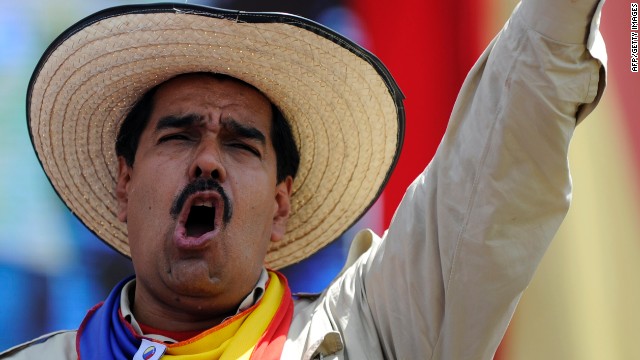
Nicolas Maduro e1368042661461 Nicolás Maduro off to an inauspicious start as Venezuela’s dubiously elected president

Courtesy of: Agence France Presse

Almost immediately after Venezuela’s partisan electoral authority declared Nicolás Maduro the winner of last month’s presidential election, he and his ruling PSUV party faced a choice that may yet define Venezuela’s future for years to come. Reports of thousands of irregularities in the voting process, including suspicions of fraud, sparked fears about the election’s legitimacy. The actions of Maduro – who first consented to the opposition’s calls for a full and transparent recount, later issued a hasty retraction, and then began a crackdown on peaceful opposition protestors – has only deepened those fears.

Maduro’s desperation is perhaps well-founded: a poll today found that a majority of Venezuelans believe the country is on the wrong track and, if given the chance, most would now choose Henrique Capriles for president over Maduro. The uncertainty and repression surrounding the Venezuelan election has grown so egregious that President Obama has abstained from recognizing Maduro as the winner. The President observed that the “entire hemisphere has been watching the violence, the protests, the crackdowns on the opposition.” ABC reports:

President Barack Obama avoided recognizing the government of Venezuela during an interview with Univision, explaining that he was concerned about recent “crackdowns” against members of the Venezuelan opposition. He also said that recent reports suggest that basic principles of democracy and human rights are not being fully observed by Venezuela’s government.

Obama and the U.S. State Department are among a growing chorus calling for a full and transparent recount of the Venezuelan election, a chorus that now includes the Organization of American States, former Colombian president Alvaro Uribe, and internationally-respected human rights watchdog groups. Though Maduro may lack Hugo Chávez’s charisma and support among Venezuelans, he evinces the same contempt for the international community.  That contempt, combined with Maduro’s increasingly flagrant repression of his own people, mean that recent weeks for Venezuela have been turbulent indeed.

It’s hard to deny that Maduro’s “election” lacks legitimacy, before the eyes of both Venezuelans and the world. The partial audit the government agreed to is viewed as little more than a public relations gesture, and hardly sufficient to investigate the serious voting irregularities that led many to wonder whether Capriles was the election’s true winner.

As those doubts grow, Maduro has flexed the government’s authoritarian muscle to stifle dissent and cow the opposition into obedience. The state-run media – which recently tightened its grip on the airwaves by purchasing the previously-independent TV station Globovision – has dutifully propagandized on behalf of Maduro; the government recently severed the video feed of a Capriles speech, preventing the opposition leader from making his case to Venezuelans.

Such tactics haven’t prevented the opposition from making their voice heard. The din of “Cacerola” protests resounds throughout the country. Capriles has filed an official protest with the country’s Supreme Court which, comprised of Maduro’s political allies, is unlikely to intervene. Maduro and the PSUV have met these peaceful expressions of dissent, however, with strongman tactics. Capriles called off an opposition March after the government issued a veiled-threat of violence against the protestors. Opposition lawmakers have been barred from speaking in the National Assembly. And a bloody brawl in the National Assembly injured 17 opposition lawmakers. Now the government has intimated it may throw Capriles in jail.

Such tactics, though they fly in the face of democracy and human rights, at least demonstrate that Maduro is feeling the pressure. The Economist opined after the election that “without Chávez at the helm, chavismo, a noxious cocktail of populism, incompetence and repression, is a far less potent force.” Nicolas Maduro cannot strong-arm his way to legitimacy. But that hasn’t stopped him trying.

 
Apr
22
2013
Posted by
admin
Comments

ICYMI: Maduro’s Lousy Start

The Economist
April 20, 2013

179882148 e1366652149467 ICYMI: Maduro’s Lousy Start

Courtesy of: Agence France Presse

Hugo Chávez has been dead for more than a month, but visitors to Caracas could be forgiven for thinking that Venezuela’s bombastic former president was still alive and in power. His image plasters the streets; his speeches fill the airwaves. The blitz was ordered by his anointed successor, Nicolás Maduro, to harness Chávez’s popularity in order to win a landslide in an election on April 14th. The plan failed.

Six months ago Chávez romped to a third term with a cushion of 11 percentage points. Polls had predicted that Mr Maduro (pictured) would repeat the feat, riding a wave of chavista sympathy. Instead he won by less than 2%, and then only after flagrantly breaking electoral rules. The result demonstrates that, without Chávez at the helm, chavismo, a noxious cocktail of populism, incompetence and repression, is a far less potent force. That is the good news. The bad news is that Venezuela’s already polarised society is now split down the middle, and seething. The country could unravel unless Mr Maduro steers a responsible course. It is far from clear that he will.

Henrique Capriles, the centrist who came second in the polls, demands a recount. During the campaign Mr Maduro enjoyed untrammelled freedom to bore viewers rigid on state television. More serious alleged breaches of electoral rules include the use of fake IDs and intimidation at polling stations. Appeals are likely to fall on deaf ears, because the electoral authority is among the institutions that lost their independence during Chávez’s 14 years in power. As Mr Maduro whipped up hysteria against the “fascist” opposition, Mr Capriles wisely called off a big rally for fear that, with seven already dead, violence would spread. There are already worrying signs that the government is ramping up repression.

There is at least some justice that the mess created during the Chávez years now falls to a fellow chavista. The economy is in ruins. Growth has stalled, the currency is digesting a 32% devaluation in February and inflation is likely to reach 30%. Price controls, the expropriation of farms and anti-business policies have created food shortages. The appearance in Caracas of sugar or cooking oil can create queues and excitement otherwise seen only in Cuba.

Chávez loyalists, of whom there are many millions, will tell Mr Maduro to be more chavista: more populist, more profligate, more authoritarian. He has already aped his predecessor, and fawned on his memory, to the point of parody. Describing Chávez as a “Christ of the Americas”, he referred to the election as “Resurrection Day”.

Yet chavismo’s bill is now due. Last year the budget deficit was 8.5% of GDP. Even with oil at over $100 a barrel, Venezuela’s public spending is unsustainable. Power cuts are frequent and roads are crumbling. Under an ineffective police force, the murder rate has soared to twice that of Mexico.

Reap what you sow

Now is the time for Mr Maduro to unite his country, not crush dissent. He should agree to recount the ballots. The state’s institutions, above all the judiciary and armed forces, need to regain their neutrality. And the weak economy will grow only if the government seeks rapprochement with the private sector and scraps controls on prices and foreign exchange. Mr Maduro’s tainted, wafer-thin victory suggests that Venezuelans want less chavismo, not more. That is certainly what their unfortunate country needs.

To read this article at The Economist, please click here.


Apr
17
2013
Posted by
admin
Comments

ICYMI: U.S. holds back recognition for Venezuela’s Maduro

Reuters
April 17, 2013
By Patricia Zengerle, Steve Holland and Paul Eckert

Nicolas Maduro 008 ICYMI: U.S. holds back recognition for Venezuelas Maduro

Courtesy of: EPA

The United States on Wednesday held back recognition of leftist President-elect Nicolas Maduro and called on the Venezuelan government to respect the right of free assembly after violence at opposition protests over a disputed election.

Last weekend’s razor-thin election victory by Maduro, the chosen successor of the late socialist President Hugo Chavez, has been rejected by his rival, Henrique Capriles, who is alleging voting irregularities and calling for an audit of the ballots. Seven people have died in opposition-led protests.

Secretary of State John Kerry said the United States had not decided whether to recognize Maduro as president.

“That evaluation has to be made and I haven’t made it,” Kerry told the House of Representatives Foreign Affairs Committee. “We think there ought to be a recount,” he said.

“Obviously, if there are huge irregularities, we are going to have serious questions about the viability of that government,” Kerry added.

White House spokesman Jay Carney urged all to refrain from violence and other actions that could raise tensions in the South American oil-producing nation.

“We call on the Venezuelan government to respect the rights of Venezuelan citizens to peaceful assembly and free speech,” Carney said in a statement.

Carney said that Washington “notes the acceptance by both candidates for an audit of the ballots and supports calls for a credible and transparent process to reassure the Venezuelan people regarding the results.”

Maduro initially accepted the proposal for a full audit of the close election, but backtracked and hardened his stance against it.

During Chavez’s 14-year tenure, Venezuela was the U.S. government’s main irritant in Latin America and the former soldier frequently invoked “imperialist” plots against him.

To read this article at Reuters, please click here.