Apr
17
2013
Posted by
admin
Comments

ICYMI: U.S. holds back recognition for Venezuela’s Maduro

Reuters
April 17, 2013
By Patricia Zengerle, Steve Holland and Paul Eckert

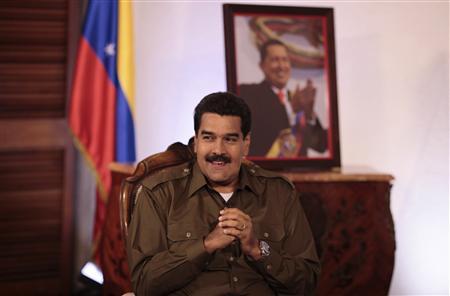
Nicolas Maduro 008 ICYMI: U.S. holds back recognition for Venezuelas Maduro

Courtesy of: EPA

The United States on Wednesday held back recognition of leftist President-elect Nicolas Maduro and called on the Venezuelan government to respect the right of free assembly after violence at opposition protests over a disputed election.

Last weekend’s razor-thin election victory by Maduro, the chosen successor of the late socialist President Hugo Chavez, has been rejected by his rival, Henrique Capriles, who is alleging voting irregularities and calling for an audit of the ballots. Seven people have died in opposition-led protests.

Secretary of State John Kerry said the United States had not decided whether to recognize Maduro as president.

“That evaluation has to be made and I haven’t made it,” Kerry told the House of Representatives Foreign Affairs Committee. “We think there ought to be a recount,” he said.

“Obviously, if there are huge irregularities, we are going to have serious questions about the viability of that government,” Kerry added.

White House spokesman Jay Carney urged all to refrain from violence and other actions that could raise tensions in the South American oil-producing nation.

“We call on the Venezuelan government to respect the rights of Venezuelan citizens to peaceful assembly and free speech,” Carney said in a statement.

Carney said that Washington “notes the acceptance by both candidates for an audit of the ballots and supports calls for a credible and transparent process to reassure the Venezuelan people regarding the results.”

Maduro initially accepted the proposal for a full audit of the close election, but backtracked and hardened his stance against it.

During Chavez’s 14-year tenure, Venezuela was the U.S. government’s main irritant in Latin America and the former soldier frequently invoked “imperialist” plots against him.

To read this article at Reuters, please click here.

 
Apr
15
2013
Posted by
admin
Comments

Venezuela’s Election Leaves Unexpectedly Narrow Margin of Victory

s1.reutersmedia.net  Venezuela’s Election Leaves Unexpectedly Narrow Margin of Victory

Courtesy of: Reuters

Millions of Venezuelans headed to the polls on Sunday to elect a new president for the second time in six months. Though expectations were low heading into the vote – especially among the country’s opposition – an unexpectedly close race has reignited tensions, uncertainty and indeed, hope.

Though Venezuelans had elected Hugo Chávez just last October, a new election was triggered after the former president lost a long battle to cancer in March. The government positioned Nicolás Maduro, the country’s vice-president and Chávez’s handpicked successor, as their new candidate. The opposition once again chose their leader and former candidate, Henrique Capriles.

Nicolas Maduro, in his capacity as acting president, enjoyed a de facto three month head start on the campaign. Capriles, on the other hand, was forced to campaign only during the formal period, which totaled 10 days. Meanwhile, the Venezuelan government did all it could to ensure Hugo Chávez’s memory was never far from the campaign trail. Maduro and the government invoked his image, name and voice in every single rally, trying to seize on the sympathy vote and keep open the subliminal connection with the powerful “Comandante.” Capriles and the opposition sought to draw a distinction between Chávez and Maduro, reminding Venezuelans that Chávez’s supposed “successor” is little more than an un-charismatic and power-hungry former underling of Chávez himself.

Maudro’s control over the country’s media and public resources proved to be an enormous advantage over this short campaign. While Maduro enjoyed more than 65 hours of state media coverage, Capriles received a paltry 23 minutes. In addition, during the auditing of voting machines, the opposition uncovered evidence that the government party had access to the secret codes needed to sabotage the voting process. International observers spoken out against the unfair playing field, also noting the egregious conflict of interest posed by the “independent” National Electoral Council composed of five officials – four who publicly support Maduro.

Given these advantages, analysts and pollsters favored Maduro to win Sunday’s vote by a significant margin. However, in a later than expected announcement, election authorities stunned Venezuelans, announcing Maduro as the winner, but with a margin of victory of only 1.59 percent or around 235,000 votes. The body announced around midnight that Maduro had received 50.6 percent of the vote and Capriles 49.1 percent.

Immediately after, Maduro took the stage to declare victory. The votes, however, clearly reflected the country’s serious doubts about the acting president’s ability to govern. In a brief, 10-day campaign, Capriles, who was predicted to lose by a similar margin as in October of 2012, managed to recover nearly all of 1.5 million votes he lost to Chávez just six months ago. The narrow margin – along with thousands of documented irregularities in the voting process – prompted Capriles and the opposition to call for a full recount of the votes.  Maduro announced he would accept the full recount. One must bear in mind, however, that this recount will be conducted by the Maduro-friendly National Electoral Council.

If the recount suggests a closer margin or reveals that Capriles was actually the winner, Venezuelans can expect a tumultuous time ahead. However, if electoral council upholds the reported results, the task ahead for Maduro is indeed daunting. He already faces a devastated country – left behind by 14 years of socialist rule – with a budget deficit of roughly 15 percent of annual economic output, inflation of almost 30 percent, extreme shortages, violent crime rates among the worst in the world, regular power outages, and a sclerotic state oil industry.

The results will also embolden the political opposition and undermine Maduro’s stature within Chávez’s former supporters. As a result, the political situation within the ruling socialist party will become more tempestuous. Maduro already lacks Chávez’s emotional connection with the nation’s poor; any fiscal retrenchment, therefore, could create a political backlash for the new president. Furthermore, this weak political mandate may spur divisions within the government’s political party. As memories of Chávez fade, other powerful figures like Assembly President Diosdado Cabello may challenge Maduro for primacy within the party.

Maduro’s narrow win has been termed by many a “Pyrrhic victory,” as does nothing to avoid the economic and political reckoning Venezuela’s ruling socialist party are heading for. Most analysts believe Venezuela has less than a year before the festering economic problems turn into a full-blown crisis.  With a sinking economy, a divided political party, and a confident and growing opposition, Venezuela seems set for contentious – and pivotal – days ahead.

 
Apr
12
2013
Posted by
admin
Comments

In Case You Missed It… Articles Roundup Week of 4/12/13

i6QvFtK66Hb8 e1365799638594 In Case You Missed It… Articles Roundup Week of 4/12/13

Courtesy of: Agence France Presse

This week: Interim president Nicolás Maduro, once ahead by double digits, takes a quickly narrowing lead into the presidential election weekend in Venezuela; though many thought he was a long shot, opposition candidate Henrique Capriles may indeed have what it takes to defeat Venezuela’s socialist establishment; this election presents the ultimate test for the late Hugo Chávez’s 21st century socialism, something that not lived up to its leaders’ promises; if elected, Capriles wants to improve ties with the United States and other nations. The campaign between Capriles and Maduro has been anything but boring; Maduro continues to churn out ridiculous conspiracy theories, in hopes they will deter attention away from the real issues Venezuela has faced under his and his predecessor’s leadership; Willie Colón, a Bronx-born salsa performer with Puerto Rico ties, releases a new song targeting Maduro; 40 student protestors participating in a hunger strike to promote a fair election were attacked by radical Chávez and Maduro supporters; to combat the increase of kidnapping cases, Venezuelans are banding together to create informal insurance societies to pay off ransoms; Capriles and Maduro end a hotly-contested yet short campaign season each with large rallies; a “reckoning” approaches for Venezuela, as the economy is set to suffer even more in the coming year; despite being one of the most oil rich countries on the planet, Venezuelans still struggle to find the most basic necessities; power shortages also remain a focus for Venezuelan voters, as many blame the current government for ignoring the problem and not taking the necessary steps to deal with the issue. Meanwhile, Maduro is poised to go after Venezuela’s most successful private company, Polar; the Venezuelan government continues to struggle against the inflation and shortages its economic policies have created; meanwhile, a new bill under consideration may increase expropriations and further marginalize Venezuela’s dwindling private sector.

Maduro Takes Narrowing Lead Into Sunday Vote, The Associated Press

Red-shirted backers of Hugo Chavez’s chosen heir transformed downtown Caracas into a raucous festival on the final day of campaigning for the weekend presidential election, flooding the streets Thursday in the hundreds of thousands to dance, drink beer and set off ear-splitting fireworks.

Can Henrique Capriles Defeat Venezuela’s Socialist Establishment?, ABC News

His presidential campaign has been viewed by many as a long shot, or described as an impossible dream. But on Sunday, as hundreds of thousands of people jammed the streets of Caracas to hear him speak, Venezuelan opposition candidate Henrique Capriles assured his ecstatic supporters that he would win the country’s upcoming election.

Venezuela election to test Chavez’s socialist legacy, Reuters

The late Hugo Chavez’s self-declared socialist revolution will be put to the test at a presidential election on Sunday that pits his chosen successor against a younger rival promising change in the nation he polarized.

Venezuela’s Capriles Wants Better Ties With U.S. If Elected President, Fox News Latino

Cutting off subsidized oil to Cuba, distancing his country from nations that disrespect human rights and shoring up the South American country’s own troubled economy with the billions it now sends abroad to socialist friends are some of the thing that Venezuelan presidential candidate Henrique Capriles has promised if elected.

Say again? Venezuela’s presidential candidates trade barbs, zingers in animated campaign, Fox News

Venezuela’s animated campaign ahead of its April 14 presidential election has seen its share of shake-your-head remarks by both candidates: Interim President Nicolas Maduro of the ruling party, and opposition candidate Henrique Capriles.

Plots and sabotage: Chavez candidate spins conspiracy theories ahead of Venezuelan election, The Washington Post

Salvadoran mercenaries are plotting with Venezuela’s opposition candidate to assassinate interim President Nicolas Maduro.

Star Hurls Musical Barbs Before Venezuela’s Vote, The New York Times

Political campaigns in Venezuela often can seem like a battle of the bands. Songs written for the campaigns blast from huge speakers at rallies and from the backs of trucks that drive around cities where candidates appear.

Radical Socialists Attack Student Protesters in Venezuela, ABC News

A group of 40 students that is currently on hunger strike to demand fair elections in Venezuela was attacked on Monday night by alleged supporters of Venezuelan interim president, Nicolas Maduro.

Venezuelan Ransom Funds Hedge Against Kidnaps as Candidates Spar, Bloomberg Businessweek

Venezuelans are banding together to create informal insurance societies to pay off criminals in case of kidnapping as violence soars and moves to the forefront of voters’ priorities before the April 14 presidential election.

Venezuela’s bitter campaign ends with big rallies, Global Post

Venezuela’s acting President Nicolas Maduro tearfully vowed to complete Hugo Chavez’s socialist revolution Thursday while rival Henrique Capriles promised change at emotional rallies to close their bitter campaign.

The reckoning after Venezuela’s election, The Washington Post

AN INTREPID Venezuelan tweeter has been keeping track of the number of times that Nicolas Maduro, the country’s interim president, has mentioned Hugo Chavez on television or radio since the caudillo’s death on March 5.

In Venezuelan election, food security – or lack thereof – can turn votes, USA Today

Venezuelans complain that what goes into their Sunday dinner plate comes from abroad: Steak, from Brazil; plantains, the Dominican Republic; rice, South Africa; Parmesan cheese, Uruguay; oats, Chile. Even coffee, in a country famed for it, often is Colombian.

Power Shortages Become a Hot Topic in Venezuela’s Presidential Race, ABC News

Venezuela’s interim president Nicolas Maduro launched his presidential campaign in Hugo Chavez’s home state of Barinas hoping that when voters head to the polls this Sunday they will identify him with the deceased socialist leader.

Venezuela goes after Polar, Financial Times

The Hugo Chávez years went well for Polar, Venezuela’s biggest privately owned company, which did solid business despite all the president’s radical socialist rhetoric.

Venezuela to Hold New Dollar Auction After Election This Month, Bloomberg

Venezuela will hold a second dollar auction on a complementary currency system created last month after presidential elections are held on April 14, Oil Minister Rafael Ramirez told reporters yesterday during an interview.

Draft Law in Venezuela Is the Private Sector’s Death Knell, The Huffington Post

On April 4, acting Venezuelan President Nicolas Maduro announced he had uncovered a “conspiracy” to destabilize the government in order to lend support to his opponent in the upcoming elections, Miranda Governor Henrique Capriles Radonski.