Aug
26
2013
Posted by
admin
Comments

ICYMI: Chavez’s Inflation Bites His Successor

Wall Street Journal
August 25, 2013
By Mary O’Grady

OB YQ920 amcol0 G 20130825120857 e1377534741885 ICYMI: Chavez’s Inflation Bites His Successor

Courtesy of: European Pressphoto Agency

Hyperinflation and political witch hunts seem to go together. Just ask the Venezuelan opposition.

With the bolivar collapsing and prices spiraling higher, the government alleged this month that its No. 1 adversary, former presidential candidate Henrique Capriles, is linked to a prostitution ring that was using minors in the state of Miranda, where he is governor.

Lest that not be enough to turn Venezuela’s socially conservative working-classes against the popular Mr. Capriles, a leading congressman from the ruling United Socialist Party of Venezuela (PSUV) used gutter talk on the floor of the national assembly to accuse the governor of homosexuality.

Don’t suppose for a minute that this mudslinging is merely about destroying Mr. Capriles. The ruling chavistas, led by President Nicolás Maduro, need a circus because there is no bread—and that’s not a metaphor. At times in Venezuela, there really is no bread. Earlier this year there was, for a time, no toilet paper. Mr. Maduro knows he is in trouble.

The “proof” of the allegations against Mr. Capriles’s chief of staff, who is accused of running the sex ring, cannot be shown to the public, according to Mr. Maduro. He says that the “videos and photos” that the government confiscated in a raid are of “un-publishable orgies.” Venezuelans will have to use their imaginations while trusting the courts—now controlled by the military government—and the government itself to get to the bottom of it all. Developments will be reported on television, which is almost exclusively state-controlled and where most Venezuelans get their news.

Mr. Capriles has said that the allegations are an attempt to distract the population from the real problems in the country. The charges are certainly well timed. An official 46% devaluation in April took the bolivar-to-dollar exchange rate to 6.3 from 4.3. Those who actually need dollars are unlikely to get them at that rate. Instead they have to go to the black market, where one greenback costs as much as 38 bolivars, up from 22 in March.

The government forecasts that inflation will hit 40% this year. But Johns Hopkins University economist Steve Hanke, director of the Cato Institute’s Troubled Currency Project, says that the soaring cost for the bolivar in the market translates into an implied annual inflation rate of more than 250%.

Earlier this month Caracas-based economist José Manuel Puente described the perfect storm to the Los Angeles Times this way: “The slowdown in economic growth, high and persistent inflation and high levels of scarcities [of basic foodstuffs] will combine to make Venezuela’s the worst-performing economy on the continent, despite the extraordinary oil boom that the country is still benefiting from.”

A mid-July survey by the Venezuelan polling company IVAD, posted on the website lapatilla.com, suggests Mr. Maduro is having no luck dodging the blame like his predecessor Hugo Chávez did so deftly. Asked what are the principal problems facing the country, almost 82% of respondents named crime. More than 53% also pointed to shortages. The scarcity is caused by the price controls that the government is using to try to hold down inflation. Those controls could explain why only 31% named “the high cost of living.”

But more than 65% said the economic situation was worse or much worse than one year ago, and more than half blamed either the national government or Mr. Maduro for the country’s problems.

Because the allegations against Mr. Capriles by the PSUV included a pejorative term for a homosexual, gay-rights groups took offense. But Venezuela’s homosexuals needn’t feel special. Hate speech as a political tool has been common practice in Venezuela’s military government for more than a decade. Catholics, Jews, entrepreneurs and the bourgeoisie have all been on the receiving end.

Mr. Maduro, coached as he is by Fidel Castro, immediately recognized that gay rights are a priority for many members of the international left. So in the aftermath of the impolitic comments by his colleague in Congress, he quickly seized a gay-pride flag to wave while he continued his verbal assaults against Mr. Capriles.

Political nonconformists regularly singled out by chavista politicians for ridicule and acrimony won’t get off so easily. This week Mr. Maduro is expected to try again to force through congress an “enabling law” that will allow him to rule by decree.

Opposition Congressman Richard Mardo has already been stripped of his congressional immunity and is slated for trial on corruption charges. Other opponents are being investigated. The Venezuelan daily El Nacional reported this month that more than one third of congressional sessions in the first half of the year were spent “harassing the opposition,” including with physical violence.

The goal is to drum up mass hysteria against opponents. Apparently Mr. Maduro has decided that if inflation cannot be contained, Mr. Capriles and his allies will be.

To read this article at Wall Street Journal, please click here.
 
Aug
2
2013
Posted by
admin
Comments

In Case You Missed It…Articles Roundup Week of 8/2/13

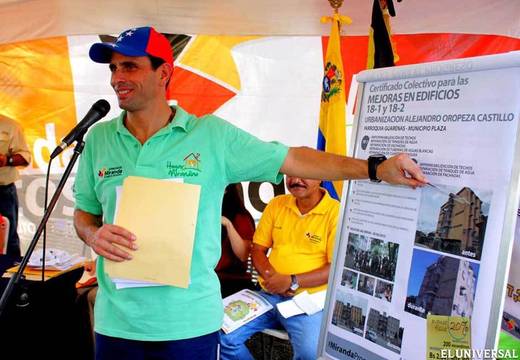
caprilesguarenas guatire.520.360 e1375469944950 In Case You Missed It…Articles Roundup Week of 8/2/13

Courtesy of: El Universal

This week: The Venezuelan government tightens its control over the media as authorities freeze the assets of “El Nacional” owner Miguel Henrique Otero; Otero then accuses the government of trying to intimidate and silence his paper; pro-government deputies in Venezuela revoke the immunity of opposition lawmaker Richard Mardo and drum up “corruption” charges; Henrique Capriles responds by accusing the PSUV of “trashing” the Venezuelan constitution. An Economic Survey conducted by the Economic Commission for Latin America and the Caribbean shows that inflation takes a bigger toll on Venezuela’s poor than in any other Latin American country; daily sales of U.S. dollars to the private sector sink 13 percent as the cost of government imports and foreign debt payments take money from the private sector; Venezuela’s strong currency controls create opportunities for illegal profiteering schemes. A poll conducted by the Venezuelan Data Analysis Institute (Ivad) reveals that today 45.1 percent of Venezuelans would vote for Capriles, while only 39.3 percent would choose Maduro; former ambassador Otto Reich files a lawsuit against three Venezuelan businessmen for bribery; seven U.S. Senators introduce a bill condemning violence against the opposition in Venezuela.

Venezuela Freezes Assets of Opposition Newspaper Editor, Wall Street Journal

Venezuelan authorities have frozen the assets of Miguel Henrique Otero, the editor and owner one of the country’s largest opposition-leaning newspaper, the attorney general’s office announced Saturday.

Editor: Venezuela Government Trying to Silence Us, Associated Press

The head of one Venezuela’s last two nationally circulating opposition newspapers accused the leftist government on Monday of trying to intimidate and silence it.

Pro-gov’t deputies lift immunity of opposition lawmaker Richard Mardo, El Universal

During the regular session held at the Venezuelan Parliament on Tuesday, pro-government legislators lifted the parliamentary immunity of opposition legislator Richard Mardo on corruption accusations filed by Parliament’s Speaker Diosdado Cabello and endorsed by the president of the Comptrollership Committee of the Parliament, Pedro Carreño, both ruling party legislators.

Capriles: Deputies trashed the Constitution by revoking Mardo’s immunity, El Universal

During a public event at a local community, Venezuelan opposition leader Henrique Capriles Radonski brought out the issue of opposition Legislator Richard Mardo and his parliamentary immunity –revoked– in Parliament, and stated that the “circumstantial majority in Parliament trampled on the Constitution and the decision of the Supreme Tribunal of Justice.”

Venezuela the only country where inflation lashes the poor the most, El Universal

Fairer distribution of national income has not been enough to solve the imbalance of the Venezuelan economy, which lashes the most vulnerable sector of society: the poor.

Daily US dollar sale to the private sector down 13%, El Universal

Claiming that the Venezuelan private sector was sold USD 125 million on a daily basis for ordinary imports in the first half of the year via both the Latin America Integration Association (Aladi) and the Unified System for Regional Compensation (Sucre), Armando León, member of the board of directors of the Central Bank of Venezuela, rejected allegations that authorities sold a lower amount of foreign currency with respect to the same period last year.

Venezuelan gov’t sucks up the dollars required by the private sector, El Universal

The minutes of meetings recording the decisions made by the Central Bank of Venezuela’s Board of Directors; the bank’s balance of payments; and the performances of both the Transaction System for Foreign Currency Denominated Securities (Sitme) and the Ancillary Foreign Currency Administration System (Sicad) are all cut pieces that are to be fitted together into a big jigsaw puzzle wherein foreign currency availability for the private sector is plummeting.

Venezuela central bank to sell $180 mln in forex auction, Reuters

Venezuela’s central bank said on Friday it would auction $180 million under its revamped currency exchange system known as Sicad, part of an effort to boost the flow of dollars to the economy and ease product shortages.

How Venezuelan Used ‘Scrape’ to Make Six Times Her Salary, Bloomberg

Venezuela’s currency controls are turning trips abroad into profitable junkets. A 27-year-old trade analyst from Caracas said she earned six times her monthly salary by traveling in April to Lima, where a business swiped her credit card and gave her $1,600 cash, charged at the official exchange rate of 6.3 bolivars per dollar.

Poll shows 45.1% of Venezuelans would vote Capriles, El Universal

Regardless of the outcome of the presidential election held in Venezuela last April 14, a survey conducted by the Venezuelan Data Analysis Institute (Ivad), Government Management, and Political Situation, showed that 45.1% of Venezuelans would vote Henrique Capriles over 39.3% who said would vote Nicolás Maduro.

Presumed corruption in Pdvsa and CVG aired in the United States, El Universal

The New York District Court admitted last Tuesday a racketeering and defamation lawsuit filed by US former ambassador Otto Reich against the partners of Derwick Associates in relation to contracts for the installation of electrical system executed with state-run oil holding Petróleos de Venezuela, electricity utility Corpoelec and the Venezuelan Guayana Corporation.

Suit Alleges Graft in Venezuelan Contracts, Wall Street Journal

A former top U.S. diplomat filed a lawsuit against three young Venezuelan businessmen whom he accuses of bribing senior Venezuelan officials in exchange for contracts worth hundreds of millions of dollars. The suit puts a spotlight on a group of executives who the diplomat, Otto Reich, and other critics say have made fortunes from links to Venezuela’s self-proclaimed socialist government.

US senators condemn political violence in Venezuela, Global Post

Seven US senators from both parties introduced a bill condemning violence against the opposition in Venezuela, calling for dialogue after a contested election.

 
Apr
12
2013
Posted by
admin
Comments

In Case You Missed It… Articles Roundup Week of 4/12/13

i6QvFtK66Hb8 e1365799638594 In Case You Missed It… Articles Roundup Week of 4/12/13

Courtesy of: Agence France Presse

This week: Interim president Nicolás Maduro, once ahead by double digits, takes a quickly narrowing lead into the presidential election weekend in Venezuela; though many thought he was a long shot, opposition candidate Henrique Capriles may indeed have what it takes to defeat Venezuela’s socialist establishment; this election presents the ultimate test for the late Hugo Chávez’s 21st century socialism, something that not lived up to its leaders’ promises; if elected, Capriles wants to improve ties with the United States and other nations. The campaign between Capriles and Maduro has been anything but boring; Maduro continues to churn out ridiculous conspiracy theories, in hopes they will deter attention away from the real issues Venezuela has faced under his and his predecessor’s leadership; Willie Colón, a Bronx-born salsa performer with Puerto Rico ties, releases a new song targeting Maduro; 40 student protestors participating in a hunger strike to promote a fair election were attacked by radical Chávez and Maduro supporters; to combat the increase of kidnapping cases, Venezuelans are banding together to create informal insurance societies to pay off ransoms; Capriles and Maduro end a hotly-contested yet short campaign season each with large rallies; a “reckoning” approaches for Venezuela, as the economy is set to suffer even more in the coming year; despite being one of the most oil rich countries on the planet, Venezuelans still struggle to find the most basic necessities; power shortages also remain a focus for Venezuelan voters, as many blame the current government for ignoring the problem and not taking the necessary steps to deal with the issue. Meanwhile, Maduro is poised to go after Venezuela’s most successful private company, Polar; the Venezuelan government continues to struggle against the inflation and shortages its economic policies have created; meanwhile, a new bill under consideration may increase expropriations and further marginalize Venezuela’s dwindling private sector.

Maduro Takes Narrowing Lead Into Sunday Vote, The Associated Press

Red-shirted backers of Hugo Chavez’s chosen heir transformed downtown Caracas into a raucous festival on the final day of campaigning for the weekend presidential election, flooding the streets Thursday in the hundreds of thousands to dance, drink beer and set off ear-splitting fireworks.

Can Henrique Capriles Defeat Venezuela’s Socialist Establishment?, ABC News

His presidential campaign has been viewed by many as a long shot, or described as an impossible dream. But on Sunday, as hundreds of thousands of people jammed the streets of Caracas to hear him speak, Venezuelan opposition candidate Henrique Capriles assured his ecstatic supporters that he would win the country’s upcoming election.

Venezuela election to test Chavez’s socialist legacy, Reuters

The late Hugo Chavez’s self-declared socialist revolution will be put to the test at a presidential election on Sunday that pits his chosen successor against a younger rival promising change in the nation he polarized.

Venezuela’s Capriles Wants Better Ties With U.S. If Elected President, Fox News Latino

Cutting off subsidized oil to Cuba, distancing his country from nations that disrespect human rights and shoring up the South American country’s own troubled economy with the billions it now sends abroad to socialist friends are some of the thing that Venezuelan presidential candidate Henrique Capriles has promised if elected.

Say again? Venezuela’s presidential candidates trade barbs, zingers in animated campaign, Fox News

Venezuela’s animated campaign ahead of its April 14 presidential election has seen its share of shake-your-head remarks by both candidates: Interim President Nicolas Maduro of the ruling party, and opposition candidate Henrique Capriles.

Plots and sabotage: Chavez candidate spins conspiracy theories ahead of Venezuelan election, The Washington Post

Salvadoran mercenaries are plotting with Venezuela’s opposition candidate to assassinate interim President Nicolas Maduro.

Star Hurls Musical Barbs Before Venezuela’s Vote, The New York Times

Political campaigns in Venezuela often can seem like a battle of the bands. Songs written for the campaigns blast from huge speakers at rallies and from the backs of trucks that drive around cities where candidates appear.

Radical Socialists Attack Student Protesters in Venezuela, ABC News

A group of 40 students that is currently on hunger strike to demand fair elections in Venezuela was attacked on Monday night by alleged supporters of Venezuelan interim president, Nicolas Maduro.

Venezuelan Ransom Funds Hedge Against Kidnaps as Candidates Spar, Bloomberg Businessweek

Venezuelans are banding together to create informal insurance societies to pay off criminals in case of kidnapping as violence soars and moves to the forefront of voters’ priorities before the April 14 presidential election.

Venezuela’s bitter campaign ends with big rallies, Global Post

Venezuela’s acting President Nicolas Maduro tearfully vowed to complete Hugo Chavez’s socialist revolution Thursday while rival Henrique Capriles promised change at emotional rallies to close their bitter campaign.

The reckoning after Venezuela’s election, The Washington Post

AN INTREPID Venezuelan tweeter has been keeping track of the number of times that Nicolas Maduro, the country’s interim president, has mentioned Hugo Chavez on television or radio since the caudillo’s death on March 5.

In Venezuelan election, food security – or lack thereof – can turn votes, USA Today

Venezuelans complain that what goes into their Sunday dinner plate comes from abroad: Steak, from Brazil; plantains, the Dominican Republic; rice, South Africa; Parmesan cheese, Uruguay; oats, Chile. Even coffee, in a country famed for it, often is Colombian.

Power Shortages Become a Hot Topic in Venezuela’s Presidential Race, ABC News

Venezuela’s interim president Nicolas Maduro launched his presidential campaign in Hugo Chavez’s home state of Barinas hoping that when voters head to the polls this Sunday they will identify him with the deceased socialist leader.

Venezuela goes after Polar, Financial Times

The Hugo Chávez years went well for Polar, Venezuela’s biggest privately owned company, which did solid business despite all the president’s radical socialist rhetoric.

Venezuela to Hold New Dollar Auction After Election This Month, Bloomberg

Venezuela will hold a second dollar auction on a complementary currency system created last month after presidential elections are held on April 14, Oil Minister Rafael Ramirez told reporters yesterday during an interview.

Draft Law in Venezuela Is the Private Sector’s Death Knell, The Huffington Post

On April 4, acting Venezuelan President Nicolas Maduro announced he had uncovered a “conspiracy” to destabilize the government in order to lend support to his opponent in the upcoming elections, Miranda Governor Henrique Capriles Radonski.