Jul
16
2012
Posted by
admin
Comments

Venezuela’s Chavez maintains poll lead over rival

Reuters
July 16, 2012
By Diego Ore and Daniel Wallis
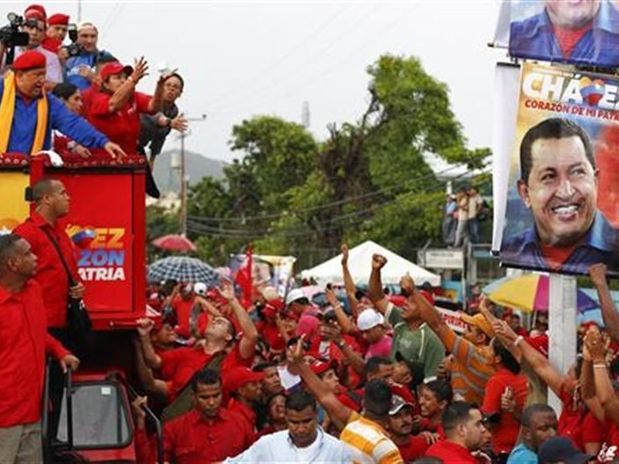
chavez Venezuelas Chavez maintains poll lead over rival

Courtesy of: Reuters

Venezuelan President Hugo Chavez maintained a 15 percentage-point lead over his opposition rival Henrique Capriles in a closely watched poll published on Monday, less than three months ahead of an October 7 presidential election.

The June survey by respected local pollster Datanalisis showed 46.1 percent of voters backing Chavez and 30.8 percent for Capriles, while the rest were undecided or did not respond.

Chavez is seeking a new six-year term at the helm of South America’s biggest oil exporter, but he has been battling cancer for a year and not able to match the intensive campaigning of his younger opponent, a basketball-loving former state governor.

The 57-year-old socialist remains popular in his 14th year in power thanks to huge state spending on social programs and the enduring emotional connection that even his fiercest critics concede he shares with the country’s poor majority.

Capriles, 40, has been drawing big crowds while projecting an image of youth and energy. Some recent polls have shown him narrowing the gap with Chavez — one had them neck and neck — but the new poll on Monday showed Chavez keeping a solid lead.

His 15.3 percentage-point advantage was slightly narrower than the 15.9 percent gap recorded by Datanalisis in May, but still within the margin of error of 2.7 percentage points.

“As the campaigns heat up, it’s normal for the numbers to begin to get closer,” Datanalisis president Luis Vicente Leon told reporters. “Undecided voters continue to be the ones who will define the election.”

Most of Venezuela’s best-known pollsters give Chavez a double-digit lead over Capriles, who is promising to end the president’s radical, statist policies and set up a Brazilian-style “modern left” administration.

Chavez has staged a remarkable recovery from an undisclosed type of cancer that was diagnosed last year and left him all but silent and off the political stage for weeks at a time.

RALLIES ‘FORGED’ DOCUMENTS

He says he is completely recovered after three operations, and in recent weeks he has sharply increased his number of public appearances. Last week, he launched a series of big street rallies featuring his typically thundering speeches.

On Sunday, Capriles led a large march through the capital Caracas that sought to highlight a key concern of many voters: insecurity and a crime rate that is one of the worst in the world.

Over the weekend both sides focused on a spat over the armed forces after Capriles issued a video message to troops and his team released what it said was a leaked Defense Ministry order prohibiting his speech from being played on military bases.

Chavez said that document had been forged as part of the opposition’s “dirty war.” He compared it on TV with what he said was a real order from the ministry and suggested Capriles may have committed a crime by publishing it.

Asked about Chavez’s comments, Capriles said “threats and intimidation” would not stop the opposition.

He has kept up a blistering pace since winning the opposition’s primaries in February. On Sunday he told the rally he had visited 53 towns in just the last 15 days, and his aides say his efforts will bear fruit before election day.

Capriles has adopted “The Hurricane of Progress” as a nickname, while Chavez styles himself as the “Bolivarian Hurricane” – which refers to the president’s idol and South American independence hero Simon Bolivar.

Unable to match Capriles’ tireless crisscrossing of the country because of his delicate health, Chavez is increasingly leaning on the powerful, quasi-religious emotional ties he enjoys with Venezuela’s long-marginalized working classes.

A new campaign video tells voters that “they too are Chavez,” and at a rally in the western city of Barquisimeto on Saturday he said — in typically colorful fashion — that even the youngest Venezuelans knew who to vote for.

“The vast majority of children know, from the depths of their genetic inheritance, that the route to the fatherland is with Chavez and victory on October 7!” he shouted, to cheers from thousands of red-clad supporters. “Even though they don’t know how to talk yet, if they could, they would say ‘Chavez!’”

(Editing by Cynthia Osterman)

To read this article on Reuters, please click here.

 
Apr
20
2012
Posted by
admin
Comments

In Case You Missed It… Articles Roundup Week of 4/20/12

This week: President Chávez continues to receive cancer treatment in Cuba, as his illness forces him to skip the Summit of the Americas; A former Venezuelan judge alleges that high-ranking officials in the government are complicit in the country’s illegal drug trade; State-run oil company PDVSA posts surging profits, but also reports a 69 percent increase in oil spills. Meanwhile, the International Monetary Fund expresses concern about the damage rampant inflation is doing to Venezuela’s economy; Polling data shows that Venezuelans are opposed to Chávez’s policies on housing, roads and education; and Chávez applauds Argentina’s expropriation of Spanish oil assets.

Venezuela’s Chavez skips summit citing medical reasons, heads to Cuba for cancer treatment, Associated Press via The Washington Post

Venezuelan President Hugo Chavez skipped the Summit of the Americas for medical reasons Saturday and headed to Cuba to continue with cancer treatment that is increasingly forcing him out of the international spotlight.

Venezuela ex-judge says officials tried to manipulate judiciary, government dismisses claims, AP via The Washington Post

A fired judge’s allegations that high-ranking officials in President Hugo Chavez’s government and military manipulate Venezuelan court cases were dismissed on Thursday by the country’s foreign minister, who said the ex-judge isn’t credible because he was removed for alleged ties to a prominent drug suspect.

TNK-BP Said to Seek $200 Million From PDVSA at Venezuela Venture, Business Week

TNK-BP, BP Plc (BP/)’s Russian venture with a group of billionaires, estimates it’s owed more than $200 million by Petroleos de Venezuela SA for crude sales from their heavy oil venture, said two people with knowledge of the matter.

PDVSA Profit Surges 42% in 2011 on Record Export Oil Price, Business Week

Petroleos de Venezuela SA, the state oil company, said net income surged 42.4 percent last year to $4.5 billion as the average price for the country’s crude-oil exports rose to a record high. PDVSA, as the company is known, said that revenue rose 31.4 percent to $124.8 billion.

Oil spills up 69% in 2011 in Venezuela, El Universal

The numbers disclosed by state-run oil firm Petróleos de Venezuela (Pdvsa) confirm an increase in the number of oil spills. Although the 2011 report on social and environmental management highlights “significant progress” in environmental matters, the government statistics show otherwise.

Chavez battles re-election hurdle: Venezuela inflation, Reuters

Venezuelan President Hugo Chavez is so determined to contain one of the world’s highest inflation rates in an election year that his price control officials are sticking signs outside stores to enforce compliance.

IMF voices concern about Venezuela’s inflation, El Universal

The International Monetary Fund said in its World Economic Outlook that Venezuelan economy is expected to grow in 2012 and 2013, but it showed concerned about the country’s high inflation rate.  The IMF forecast that the Venezuelan economy will grow 4.7% in 2012, with a slowdown in 2013 (3.2%).

Pollster: 72% of the population says that housing policy is negative, El Universal

Luis Vicente León, the director of polling firm Datanálisis said that 72% of Venezuelans believe that the government housing policy is negative.

Venezuela’s election battle: Chavez vs Chavez, Reuters

Hugo Chavez’s biggest enemy ahead of this year’s presidential election in Venezuela could be the socialist leader himself. It is a battle between the sick Chavez who needs peace and quiet to recover from cancer, and the workaholic Chavez determined to keep up the pace to win re-election in October in the toughest political fight of his life.

Documents: Closing of Miami’s Venezuelan consulate was punishment for Chávez foes, Miami Herald

The closing of the Venezuelan consulate in Miami was more about punishing the “feverish” opponents of President Hugo Chávez who live in South Florida than a response to Washington’s decision to expel the consul, according to documents obtained by El Nuevo Herald.

Chavez applauds Argentina’s seizure of Spanish oil assets, London Evening Standard

Fears that Argentina is embarking on a full-scale Venezuelan-style forced nationalisation of foreign-owned oil assets mounted today as President Hugo Chavez gave the country a massive supportive pat on the back.

 
Apr
2
2012
Posted by
admin
Comments

ICYMI: Venezuelans lose their homes for government housing program

The Miami Herald
April 2, 2012
By Jim Wyss

Like many Venezuelans, Calogero Alotto was sympathetic to the estimated 30,000 families left homeless by flooding during 2010 and 2011. When government officials told him they needed his small parking lot and mechanic shop to build housing for the refugees, he accepted it as a patriotic duty.

But 15 months later, the housing has yet to materialize and Alotto is still waiting to get paid.

“I worked for 42 hard years to build my business and it didn’t count for anything,” said Alotto, 57. “I’ve been left without property and without a job. I’ve had to sell two trucks just to keep surviving.”

As President Hugo Chávez, 57, heads into a tight presidential race, housing is at the center of his campaign. The government says it will plow $16 billion into building 200,000 homes this year under a program called The Great Housing Mission. The initiative is popular in this oil-rich nation, where many still live in wooden and tin shacks. And Chávez has said it’s key to his “Socialist Revolution” that aims to reduce the gap between the rich and the poor.

A recent poll by the Venezuelan Institute of Data Analysis found 75 percent of those surveyed said they expected to receive a house sometime during the next two years, thanks to the program.

But as the government has been seizing property in middle- and lower-class neighborhoods to build the projects, it’s starting to create a backlash from some of those who once considered themselves as Chávez supporters.

When police tried to evict home and business owners out of a three-block stretch of the Catia neighborhood in February, residents revolted. The government backed down, but many fear that if Chávez wins the Oct. 7 election, the evictions will continue.

“We know that people need housing, but what happens to us?” said Carlos Rubio, who has joined forces with 20 other small business owners in resisting the evictions. “Now that Chávez is trying to win the presidency, he’s promising homes to everybody.”

Driving the backlash are stories of people such as Alotto who were never compensated for their property.

Alotto and 19 of his neighbors — mainly the owners of parking lots — began receiving eviction notices in late 2010. All of them were assured the government would expedite payments for the property. But that hasn’t happened.

Nelson Rojas said he was forced out of the home that he shared with his physically disabled son. The government put him in a public housing complex, where they are crowded into a two-bedroom apartment with two other families. Rojas and his son share a bed and cook in their room.

“We always heard about big consortiums or foreign investors getting expropriated,” said Rojas, who had lived and worked on the site for a decade. “But I never thought it would happen to me. We’re not rich, we’re not bourgeoisie.”

It’s unclear how many people find themselves in Rojas’ and Alotto’s situation. Venezuela’s Ministry of Communications, which handles all media requests, did not respond to phone calls or questions sent via email.

The Front for National Property, an organization that defends private ownership, said that from 2006 to 2008 it registered 241 expropriations representing 4,000 dwellings in the capital alone. Of those expropriations, the government only paid for 12, the organization said. In addition, over the last three years, the organization has tracked another 100 expropriations, including Alotto’s.

The government has minimized the problem. Housing Minister Ricardo Molina recently said 80 percent of the land used in the program is state-owned. Of the private property seized, some of it was owned illegally. But when rightful owners are found “we determine the value of the property and pay the owner,” he said.

It’s not clear how often, or how quickly, that’s happening. The government just announced it’s planning to indemnify farmers who had their land seized in 2005. And the problems are likely to get worse. Molina said the government needs an another 231 square miles to fulfill the housing initiative.

Whatever pain might be caused to those who lose property, the housing program, and other “missions,” have been key to Chávez’s popularity. In power for 13 years and battling an undisclosed form of cancer, Chávez retains high approval ratings and is leading in most presidential polls.

His presidential rival, Henrique Capriles, 39, has accused the government of lying about its housing efforts and using the misery to win votes. During a recent conference, Capriles said the government’s math doesn’t add up. The administration claims it built 146,000 homes in 2011 — more than enough to house the 30,000 families it said had been left homeless by the flooding. Yet, the country still has more than 800 shelters holding more than 27,000 families.

“It’s a lie that the government built 140,000 homes last year,” Capriles said. “If that’s true, why are there still so many people in shelters?”

The homes are not just for flooding victims, the government has said. It’s priority also is to move homeless families out of shopping centers, office buildings and apartment blocks that have been turned into shelters.

Like many hotels, the four-star Hotel President in Caracas has been forced to house flood victims. The families have a private exit so they never mingle with paying guests and elevators don’t stop on that level. Workers said the administration was hoping to keep the residents’ presence a secret to customers. One worker said if the hotel has a problem with a family, staff calls the military. “The official threatens to move them to one of the other shelters and they usually don’t cause anymore problems,” the worker said. “They have it really good here.”

Yolis has been living in one of those “other shelters” — a gray office building, just blocks away from Caracas’ JW Marriott hotel.

For the last 16 months, Yolis, her husband and two children have been sharing a small cubicle in the building. There’s no running water and the building leaks, she said. Despite promises that they would be moved to a new home, they were recently told that wouldn’t happen until 2013. “We can’t take this anymore,” said Yolis, who feared she might be evicted if she gave her last name. “These are not conditions under which you would raise children. It’s dark and dirty.”

Security personnel would not allow The Miami Herald into the building, but other residents confirmed Yolis’ claims. Despite the problems, Yolis said she was grateful to Chávez for helping her get a new home.

From the roof of his home, Alotto has a commanding view of his old parking lot. On a recent weekday, he said workers there hadn’t moved a brick in 11 days. The rumor was that the government has run out of cement. As far as Alotto is concerned, the government is building on top of what he hoped would be his retirement. “I don’t dislike the president,” Alotto said. “But I can’t vote for a party that ruined my life.”

To read this article on the Miami Herald website, please click here.