Jul
18
2012
Posted by
admin
Comments

Capriles: Abuse of power will be defeated on the election day

Opposition presidential candidate Henrique Capriles said that the government “stopped liking the Constitution and laws a while ago” and the “abuse of power” continues, especially in the election campaign

El Universal
July 18, 2012

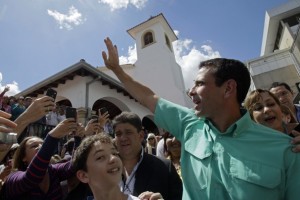
Capriles 300x199 Capriles: Abuse of power will be defeated on the election day

Courtesy of: Reuters/Carlos Garcia Rawlins

Opposition presidential candidate Henrique Capriles said that the “abuse of power” during the election campaign, under the form of mandatory nationwide radio and television broadcasts and the use of public funds for the government’s candidate electioneering, will be punished by the people next October 7, in the presidential election.

“Mandatory radio and television broadcasts are not intended to inform about the government’s works and accomplishments, but for electioneering. There exists a regulation governing this: I am entitled only to three minutes of airtime on mass media each day. Therefore, the national public media and the mandatory radio and television broadcasts should not be used for political propaganda,” said Capriles.

“We will defeat opportunism and abuse of power on October 7. We have the key to open the door to the future,” he added.

To read this article on El Universal, please click here.

 
Jun
4
2012
Posted by
admin
Comments

What’s Next Venezuela Election Update: June 4, 2012

Venezuela Capriles Seamstress.JPEG 0446b 300x200 What’s Next Venezuela Election Update: June 4, 2012

Courtesy of: the Associated Press

With four months until the elections, presidential candidates Hugo Chávez and Henrique Capriles have taken the first steps to officially register their candidacies. A new poll released last week shows that the race is nearly tied. Capriles, meanwhile, has been campaigning furiously, going house to house in Venezuela’s poorer regions, wearing bright shirts that his supporters also don in shows of solidarity. Capriles presents his plans to solve the drug problems and violence that plague the country. Though the campaign has begun, Chávez has been conspicuous only in his absence, as his party essentially runs his campaign without him. He is instead trying to win votes by pumping billions of borrowed bolivars into the economy. All the while, his silence and the mystery surrounding his illness continue to have analysts wondering what is in store for the country’s future.

Chavez Registers Presidential Candidacy Via Internet, Bloomberg

Venezuelan President Hugo Chavez carried out the first step of registering his candidacy for October presidential elections via Internet today, an electoral official said.

New poll has Venezuela’s Chávez still in lead, The Miami Herald

With less than five months to go before Venezuelan elections, President Hugo Chávez is leading in a new poll, but the race remains tight amid doubts about his health.

In Venezuela, casual shirts worn by opposition’s presidential candidate a boon for seamstress, The Washington Post

In a home with bare brick walls and a zinc roof, a 58-year-old seamstress with short, curly hair is sewing shirts for a young politician who she thinks has a good shot at unseating Hugo Chavez as president of Venezuela.

Capriles vows to fight against drug trafficking, El Universal

Henrique Capriles, the presidential candidate for opposition umbrella group Unified Democratic Panel (MUD), on Wednesday visited Achaguas, in central Apure state, where he received many complaints about alleged drug trafficking in the area.

Capriles: The country will elect between life and death on October 7, El Universal

In the opinion of Henrique Capriles Radonski, the candidate for opposition Unified Democratic Panel (MUD), in 14 years of government, Venezuela’s President Hugo Chávez has eluded the issue of insecurity.

Chavez absent as team oils campaign machine, AFP

In a crowded square of the biggest shantytown in Caracas, President Hugo Chavez’s reelection campaign wheels are spinning. But a bit like a movie missing its star, the president is not on the trail.

Venezuela Lawmakers Approve Extra Spending Ahead of Election, Businessweek

The finance committee of Venezuela’s National Assembly approved an extra 5.9 billion bolivars ($1.4 billion) in spending this year, in part to fund an increase in the minimum wage five months before the presidential election.

Hugo Chávez’s Terminal Mystery Cancer And Venezuela’s Looming Power Vacuum, International Business Times

Venezuelan President Hugo Chávez appeared vigorous and in high spirits, wearing a track suit like his Socialist comrade Fidel Castro, in front of television cameras as he stepped off the plane in Caracas earlier this month.

 
Jun
3
2012
Posted by
admin
Comments

Chavez absent as team oils campaign machine

AFP
June 3, 2012
By Anna Pelegri

ALeqM5iyiTlw0N06fH3RjwO8u0hMsm9zRA 300x209 Chavez absent as team oils campaign machine

Courtesy of: AFP / Juan Barreto

In a crowded square of the biggest shantytown in Caracas, President Hugo Chavez’s reelection campaign wheels are spinning. But a bit like a movie missing its star, the president is not on the trail.

Aides to the flamboyant Chavez — Latin America’s most prominent leftist leader, who is seeking reelection to a third consecutive six-year term — insist that any talk of replacing him is a non-starter.

The former paratrooper has stayed largely out of public view for several recent weeks as he recovers from cancer treatment.

Chavez, who before his illness dominated national airwaves for hours on end, sometimes speaking and even singing on state media almost around the clock, has become conspicuous in his relative absence ahead of the October 7 election. The silence has fueled speculation, rumors and doubts.

And the government has been very sparing in its release of details about the president’s illness, including why he sought treatment in ally Communist Cuba when he could have been treated here or indeed anywhere.

Chavez, 57, has until June 11 to register as a presidential candidate formally — and has not said when he will do so.

Just 40 kilometers (25 miles) away, Chavez’s main rival in the race is hard at work against a sort of phantom foe with a long shadow.

Henrique Capriles is a pragmatic center-leftist who cuts a picture of contrast as an energetic 39-year-old. He has been campaigning door-to-door in Catia la Mar, an impoverished Caribbean coast town.

For the past four months, Capriles has been on a “listening tour” of the South American nation, going all-in for group hugs, broad smiled and underscoring that, unlike Chavez, he is there with the people.

In Sucre Square in the Petare slum, Chavez supporters try to rev up the crowd with a taped version of the president singing the national anthem.

Chavez is supposed to be the focus of the event. In fact, it is being headlined by Vice President Elias Jaua.

And for many ruling party supporters, dressed in a sea of revolutionary red, Jaua is all they have for now.

“The supreme (national) interest is Chavez’s victory,” Jaua said, urging each supporter to personally ensure that 10 people vote to reelect Chavez.

For the government, preserving what it sees as the achievements of a socialist “revolution” are at stake. And Jaua argues that “political hegemony” is needed in the legislature to lock in Venezuela’s progress on its revolutionary path.

“There are so many things that we have to defend,” the vice president said, claiming that Capriles will revoke social benefits Chavez has given the poor of this oil-rich nation.

Getting into campaign attack mode is not considered Jaua’s natural forte, unlike Chavez.

But with the president sidelined in recent months, his team has had to fill the charismatic president’s big shoes.

“We ourselves, the people, are Commander Chavez. He is here with us,” said Alicia Chacon, a Venezuelan former government worker who was recently trained in Cuba to work as a pro-government social activist in Venezuela.

Ironically, her words are nearly identical to those used by Cuban authorities in official state media after revolutionary icon Fidel Castro took ill in 2006 following more than five decades in power and eventually stepped aside, raising questions about whether his death might mean the end of the “revolution.”

“God put Chavez there for us, and I think he will heep him there,” said Ransa Rio, who plans to vote for the president. “He is the president of the poor. I wrote to him several times, and thanks to him, I have my house.”

Capriles, in Catia la Mar, spoke with locals in slums without running water or toilets.

“I live in a neighborhood that always used to be pro-Chavez,” said Romulo Delgado, a retiree. “Now, people tell me quietly that they are going to vote for Capriles.”

To read the original article from AFP, please click here.