Jan
3
2013
Posted by
admin
Comments

An Ailing Chávez Hides From View As A Constitutional Crisis Looms

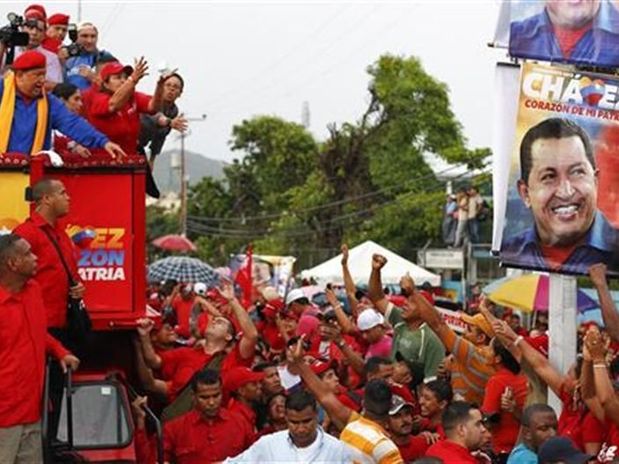
hugo chavez campaign stump An Ailing Chávez Hides From View As A Constitutional Crisis Looms

Courtesy of: Reuters

In Venezuela, the significance of events during the last several weeks cannot be overstated. After promising the Venezuelan people that he was “totally free” of the abdominal cancer that plagued him for more than a year, Hugo Chávez won re-election on October 7. Two months later, however, a visibly weak Chávez announced that his cancer had returned. He was rushed to Cuba for surgery on December 11; reports later surfaced that he had suffered serious “complications” after his fourth operation in 18 months.

Before leaving the country, Chávez designated newly-named Vice President Nicolas Maduro as his successor. According to Venezuela’s constitution, if a president dies or is unable to serve, a new election must be called within 30 days. A pallid Chávez, speaking on December 8th at the presidential palace, asked Venezuela to “elect Nicolás Maduro” if a special election occurs.

Though the special election requirement seems unambiguous, any transition of power is likely to be protracted and – because to several confusing provisions in Venezuela’s constitution – perhaps quite contentious. Chávez is due to be re-inaugurated on January 10th. As Foreign Policy explained this week, Chávez’s inability to be sworn in will pose significant problems for his party and thereby, the future of his self-styled socialist revolution:

“The problem for Maduro is that his term as vice president expires January 10th, when the current presidential term ends and a new one begins. Chávez, who is also president-elect, may not be healthy enough to be sworn in and appoint him vice president again. If that doesn’t happen, Maduro will be out of a job, even though he would remain the ruling party candidate in any follow-up election.”

If Chávez misses his inauguration, National Assembly president Diosdado Cabello would then assume control of the government until the President is finally sworn in or declared by the Assembly to be “totally absent.” Such a declaration, however, is unlikely to occur unless the President actually dies. Indeed, some of his socialist allies have suggested postponing the inauguration to accommodate Chávez’s health – a constitutionally dubious step that has drawn criticism from opposition leaders.

Even within the ruling socialist party there are divisions. Maduro and Cabello have emerged as the figureheads in a behind-the-scenes battle over the future of the party. Already faced with a slumping economy, a much-needed currency devaluation and a cancer-stricken president, Venezuelans may well have a full-blown constitutional crisis on their hands to start 2013.

If recent reports are to be believed, the country draws ever closer to such a scenario. Multiple outlets report that Chávez, his immune system ravaged by the cancer, suffered a severe respiratory infection following his most recent surgery. News also emerged that the infection was so serious it prevented Chávez from breathing, requiring doctors to perform a tracheotomy. Last month, Maduro sped to Havana to speak with the ailing president, sparking rumors that Chávez was on his deathbed.

For their part, members of the Venezuelan opposition have demanded the government tell ‘the whole truth’ about the president’s health. So far, the information released has lacked much needed specifics to determine the likelihood of Chávez’s survival.

For Venezuelans seeking clarification from the president himself, it may be a long wait. Chávez has not been seen or heard from since his statement nearly a month ago on December 8th. And this week, a source inside the Cuban hospital claimed that Chávez has been put in an induced coma, is “only kept alive by life support,” or may have even died. Chávez’s end may indeed be near, but we can be sure this is only the first chapter of a critical period for the future of Venezuelan’s government.
 
Nov
12
2012
Posted by
admin
Comments

Having Secured a Third Term, Chávez pushes Commune System

chavez Having Secured a Third Term, Chávez pushes Commune System

Courtesy of: Reuters

On the night of his reelection, Hugo Chávez said in his acceptance speech that he planned to advance his vision of “21st century socialism” in the next term of his presidency. Now, just one month later, it has become clear that the plan involves the massive expansion of the “commune” system, which experts say is a plot to diminish the power of the opposition.

Communes are a standard feature of the socialist model of government. Chávez touts them as essential to his agenda, as he claims they will give people the power to manage their own resources. But many believe that his renewed interest in them – following an election in which he was victorious by a narrower margin than ever before – is not as ideological as he claims. Instead, many characterize the push for communes as motivated by a desire to reclaim power for his own party on the state and local levels.

To date, Chávez has attempted to weaken the power of state and municipal authorities merely by withholding the share of the national budget they are guaranteed by the constitution. He’s effectively accomplished this by significantly underreporting oil revenue, which limits the amount paid to municipal leaders, many of which are his political foes. But the commune proposal now on the table has been criticized as an offensive to further destabilize the country’s pluralist constitution and decimate any remaining shreds of capitalism.

The implementation of communes could prove disastrous for the opposition by absorbing and ultimately diminishing much of the power of mayors and governors. Already, as part of its most recent budget proposal, Chávez’s party proposed a far greater increase (37 percent) in the amount of funding going to the communes than to either the state or municipal governments (22 and 23 percent, respectively). A logical next step could potentially involve the assignment of the few remaining political responsibilities from local authorities to the communes.

In 2007, the people of Venezuela rejected an amendment to the constitution that would have provided for the legal establishment of the communes. However, in December of 2010 the National Assembly passed the Enabling Law, which granted the president broad authority to mandate by decree following the flooding that left approximately 100,000 Venezuelans homeless. The law gave Chávez unchecked power for eighteen months, through which he created a ministry charged with setting up the communes. However, creation of communes had stalled until October 20 – just 13 days after his reelection – when he urged the National Assembly to implement of the Communes Law.

But implementation has been slow because the act is unconstitutional. It illegally changes the very nature of Venezuela’s government by shifting responsibilities from democratically-elected local officials to a central authority. According to the constitution, the deadline has passed for making such dramatic changes this year.

If realized, millions of Venezuelans would be affected by these changes. By the numbers, Chávez is looking to grow the communes at a record-breaking pace: 3,000 between 2013 and 2019 at the rate of 450 per year. Ultimately this will incorporate more than 21 million citizens – nearly 68 percent of the country’s population. By consolidating local power into the communes, the president is ensuring that these Venezuelans are largely controlled by the central government – not their locally elected officials.

 
Oct
4
2012
Posted by
admin
Comments

ICYMI: Venezuelan President Faces First Real Threat

The Wall Street Journal
October 2, 2012
By José De Córdoba and Kejal Vyas

WO AL294 CAPRIL G 20121002203421 300x200 ICYMI: Venezuelan President Faces First Real Threat

Courtesy of: European Pressphoto Agency

CARACAS—Henrique Capriles is a skinny marathon runner and opposition governor who has done something no Venezuelan politician has managed in the past 14 years: pose a serious threat to President Hugo Chávez.

This Sunday, Venezuelans vote in presidential elections that will be the first time since Mr. Chávez won power in 1998 that the outcome isn’t a foregone conclusion.

Opinion polls vary widely, partly because Venezuelans mistrust pollsters. Some surveys show Mr. Chávez with a 10- or even 20-point lead. Others show the race neck-and-neck. Respected local pollster Consultores 21 said Tuesday its last pre-election survey shows Mr. Capriles ahead by 48.9% to 45.7%.

In all polls, however, Mr. Capriles has been gaining ground. And while the president remains the favorite, Mr. Capriles seems poised for the best showing for an opposition politician against Mr. Chávez to date—an outcome likely to position him as the leader of the opposition for years to come.

A close election in this highly polarized country could reverberate far beyond Caracas. Venezuela holds the world’s largest oil reserves. Political turmoil could send oil prices soaring.

No one is sure whether Mr. Chávez would accept a narrow defeat. The opposition plans to have at least two witnesses at every polling station to make sure the vote is counted correctly.

Defeat for Mr. Chávez would transform the political landscape in Latin America. For the past decade, he has been a beacon for anti-American sentiment and symbolic leader of a populist left that governs in Bolivia, Ecuador, Nicaragua and Argentina.

Mr. Capriles, a 40-year-old known as “El Flaco,” or “The Skinny One,” says he would normalize relations with Washington and multinational companies, which have been hit hard by nationalizations under Mr. Chávez.

But the governor’s surge in the polls has little to do with promises to play nice with Uncle Sam or private companies. Rather, he has hit on a formula for challenging the populist president: veer to the left on economic issues and play up the populism. The state governor has vowed to keep Mr. Chávez’s emphasis on the poor as well as the president’s spending programs, some 30 so-called missions that provide everything from subsidized food and housing to free basic medical care.

“We have to improve, strengthen and legalize the Missions,” Mr. Capriles, the grandson of a Holocaust survivors, said in an interview. A devout Catholic, he describes himself as center-left.

Mr. Capriles’s economic team pledges to launch a $100 billion infrastructure spending program and start a cash transfer program for the poor modeled on Mexico and Brazil. It wants to raise the minimum wage and index it to prices—a move that worries economists in Venezuela, which has among the world’s highest inflation rates.

The head of Mr. Capriles’s Justice First Party, Julio Borges, said a Capriles administration would try to make social spending more efficient, but makes no bones about what sells politically in this oil-rich nation of 29 million: “Our movement is called Justice First, not Markets First.”

Mr. Chávez tells supporters that Mr. Capriles is lying about keeping the social programs. In a televised interview Sunday morning, the president complained that his rival is hiding his true colors. “The right wing has had to disguise itself as the left,” he said. Mr. Chávez’s message may be working: Some 44% of Venezuelans believe a Capriles victory would end their social handouts, according to Consultores 21.

And even in the face of Mr. Capriles’ surge, the charismatic president remains the favorite for the vote on Sunday thanks to a mixture of carrots and sticks. Last year, state oil monopoly Petroleos de Venezuela alone spent $30 billion on social programs at Mr. Chávez’s command, including new high-rise apartment towers for the poor that dot the Caracas skyline, according to company data. His government also controls most television and radio.

In the past, opposition candidates have run against a Chávez they have demonized, convinced that most Venezuelans disliked the president as much as they did. But they offered little to Venezuelans who sympathized with the president.

Mr. Capriles seems determined to win Chávez supporters. During the campaign, he has visited more than 300 towns, dashing through hard-bitten hillside slums. He tells crowds that Mr. Chávez did the right thing by putting the poor first, but that his government has been disorganized and corrupt.

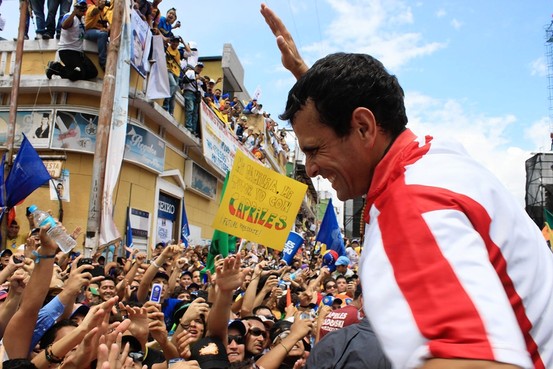
Increasingly, he is getting a rock-star reception even in Chávista strongholds, with women throwing themselves at him to touch or kiss him. One fan, saying she wanted to see what he tasted like, bit the candidate in the hand.

Everywhere he goes, Mr. Capriles focuses on the daily ills that plague Venezuelans like electricity and food shortages, drawing a contrast to Mr. Chávez’s often grandiose goals. The president’s campaign platform calls for the development of a new geopolitical balance that “permits the equilibrium of the universe and guarantees peace on the planet.”

“The people have told us their problems with public services, blackouts, with highways, and with the lack of high schools and housing which the government keeps promising,” Mr. Capriles said during a recent stop in Mr. Chávez’s home state of Barinas.

Even if Mr. Capriles loses, he may get another shot. The president, who has battled cancer for much of the past two years, may be seriously ill. His health is a state secret in Venezuela. If Mr. Chávez dies within the first four years of his term, Venezuela’s constitution calls for holding new presidential elections.

Mr. Capriles plays down his background as the son of wealthy entrepreneurs. Instead, he talks about his grandparents on his mother’s side, Polish and Russian Jews who survived the Warsaw Ghetto before emigrating to Venezuela with a suitcase of clothes and a movie reel that Mr. Capriles’s grandfather used to begin what eventually became Venezuela’s most important movie house chain.

Now a marathon runner, Mr. Capriles was a chubby, shy kid, says one of his best school friends, Alejandro Barrios. Mr. Barrios says that when they were both teens in high school, Mr. Capriles told him he wanted to be president. “I laughed out loud,” said Mr. Barrios. “He was just a normal guy.”

After law school, Mr. Capriles got an early jump on his political career, becoming the youngest ever member of Venezuela’s congress by winning a seat in 1998 elections, the same vote that brought Mr. Chávez to power.

Within two years, he became mayor of Baruta, a key municipality in the capital. In 2004, as mayor, he was imprisoned on charges that he had led a mob against the Cuban embassy during a 2002 coup, which briefly ousted Mr. Chávez from power. He spent four months in jail before being eventually absolved of all charges.

At the time, the jailing was widely seen as a government attempt to sideline Mr. Capriles as an up-and-coming opposition figure. But if so, it backfired. That same year, he won re-election as mayor with 79% of the vote.

He went on to defeat a key Chávez ally, Diosdado Cabello, to become governor of Miranda state. During his tenure, he expanded social programs like free food and housing. He also overcame efforts to undermine him from the federal government, including a move to disarm his state police.

Write to José de Córdoba at [email protected] and Kejal Vyas at [email protected]

To read this article on The Wall Street Journal, please click here.