Sep
10
2013
Posted by
admin
Comments

ICYMI: Capriles appeals to OAS human rights commission

BBC News
September 9, 2013

69757497 69757496 ICYMI: Capriles appeals to OAS human rights commission

Courtesy of: AFP

The defeated Venezuelan presidential candidate, Henrique Capriles, has filed a request at the Inter-American Commission on Human Rights to declare the April election void.

Mr Capriles alleges there was widespread fraud in the vote narrowly won by acting president Nicolas Maduro.

Last month, the Venezuelan Supreme Court rejected a final plea by Mr Capriles to have the vote annulled.

Mr Capriles vowed to take his fight beyond Venezuela.

Mr Maduro has repeatedly rejected the opposition allegations of fraud.

‘Supranational power’

He also dismissed the Washington-based human rights organisation as lacking credibility.

He praised the late president, Hugo Chavez, for beginning proceedings to pull out from the body last year.

Venezuela is due to officially withdraw from the Commission on Tuesday.

Mr Maduro accused the OAS Human Rights Commission of hating and despising Latin America

The Inter-American Commission on Human Rights is part of the Organisation of American States (OAS).

“They believe they are a supranational power, a power above the legitimate governments of the continent. Their time is passed,” said Mr Maduro.

The Venezuelan government decision was criticised by Amnesty International as “a serious setback for the rights of Venezuelans.”

‘Reinstate rights’

Opposition politician Ramon Jose Medina filed the request, signed by Mr Capriles, at the OAS headquarters.

The Venezuelan government “must be forced to reinstate the rights they violated,” said Mr Medina.

“The elections, which were fraudulent, must be repeated and the electoral process must be free and fair.”

Mr Maduro won the 14 April vote by less than 1.5 percentage points – about 200,000 votes.

Mr Chavez died on 5 March after a long battle against cancer.

Before going to Cuba for a last round of treatment in December, he appointed Mr Maduro as his preferred successor.

To read this article at BBC News, please click here.

 
Aug
12
2013
Posted by
admin
Comments

ICYMI: Venezuela Opposition Comes Under Siege

Wall Street Journal
August 9, 2013
By José de Córdoba and Ezequiel Minaya
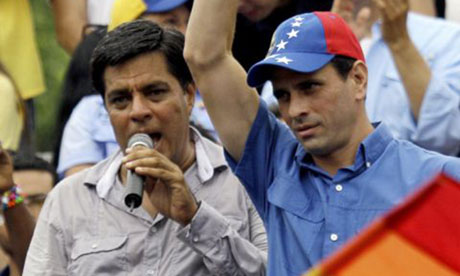
Oscar Lopez left adviser 010 ICYMI: Venezuela Opposition Comes Under Siege

Courtesy of: Associated Press

CARACAS—Venezuela’s President Nicolás Maduro, the political heir to late populist Hugo Chávez, is ratcheting up intimidation of his political foes as his government prepares for key municipal elections amid a deteriorating economy.

Oscar López, a senior aide to former opposition presidential candidate Henrique Capriles, was in hiding Friday after a government legislator said a warrant had been issued for the aide’s arrest. Days earlier, the apartment of Mr. López, Mr. Capriles’s chief of staff, was searched by military-intelligence agents, according to opposition officials.

“He doesn’t know what this circus is all about so he is taking care of himself” by going into hiding, said Julio Borges, a legislator and national coordinator of Venezuela’s leading opposition party, Justice First.

Mr. Capriles himself faces possible arrest after the Supreme Court on Wednesday rejected his challenge to Venezuela’s April presidential election, which Mr. Maduro won by a sliver but which was marred by allegations of fraud. The court went on to fine Mr. Capriles $1,700 for what it said was a “disrespectful” filing and said the opposition leader should be prosecuted for trying to undermine the election.

“It’s a way to attack Henrique and his movement,” Mr. Borges said.

A senior U.S. official said Washington is worried about developments in Venezuela. “The Venezuelan government is increasingly taking legal actions against the opposition, a development the United States finds profoundly worrying,” the official said. The wave of actions against opposition leaders like Mr. Capriles “raises legitimate and urgent concerns,” the official said.

Venezuela’s Attorney General’s Office declined to comment as did Venezuela’s Information Ministry.

Venezuelans go to the polls in December to contest some 335 mayors’ posts throughout the country, as well as hundreds of other local offices. The elections will be the first gauge of Mr. Maduro’s popularity since his win in April’s election.

In the run-up to the vote, Venezuela’s economy has shown signs of increasing stress after years of ramped-up public spending under Mr. Chávez, who died in March. The country’s inflation is north of 42%, common consumer goods like toilet paper are scarce, and despite high oil prices, Venezuela just defaulted on the payment of a $100 million bond of a nationalized steel company, spooking bond buyers. Divisions in the Chavista movement, nominally led by Mr. Maduro, are deep.

“This is clearly a wounded government as far as its mandate and its internal dynamics. And like any wounded animal, it can be dangerous. It is taking very severe steps to consolidate power,” said Christopher Sabatini, senior director of policy at the Americas Society and Council of the Americas.

Also this week, authorities jailed and froze the assets of the editor of a small independent paper and website, Leocenis García of Sexto Poder, who has published detailed reports of alleged government corruption. On Thursday, a judge fined two opposition newspapers—including El Nacional, the country’s most influential daily—1% of their 2009 income for showing a photograph of deteriorated conditions in a morgue. The judge said showing the photo was harmful to the welfare of children.

In Caracas, Juan Carlos Zapata, an author and political analyst, said the escalating repression shows a clear government intention to frighten the opposition. “They want to dismantle the opposition, they want Capriles’s aides to flee the country, and for Capriles to throw in the towel before elections,” said Mr. Zapata. “It’s an orchestrated plan to scare off the opposition.”

The Maduro government has said that it is simply rooting out corruption, regardless of political affiliation. Soon after taking office, Mr. Maduro launched an antigraft initiative that has resulted in the arrest of a handful of mid-level state officials.

The latest government moves follow last week’s stripping of parliamentary immunity by government deputies of a popular opposition congressman, by less than the constitutionally required two-thirds majority. Richard Mardo, who has built up a large following in the Chavista state of Aragua, now must face charges of alleged corruption.

Legal moves by the government against its foes are common in Venezuela. A study by Human Rights Watch found that as of May 2012, Venezuela’s Comptroller General’s Office had temporarily disqualified some 800 people, most of them Chávez foes, from running for office due to accusations of corruption—even though charges hadn’t been filed against them. About 300 people are still barred from running for office.

During his time in office Mr. Chavez routinely brushed aside international criticism as attempts to meddle with domestic affairs and plots to topple his government.

Meanwhile, the opposition is struggling to get out its message to ordinary Venezuelans. Globovisión, once a feisty opposition TV channel—and the only one that gave Mr. Capriles significant airtime—was sold earlier this year, and its coverage of Mr. Capriles has fallen sharply. News about Mr. Capriles is now relegated to a recently opened Web channel dubbed “Capriles TV.” Mr. Borges said that the opposition would have to work hard to get its message out by taking a “grass-roots” approach.

Opposition figures as well as analysts say the repressive wave points to the deep divisions in Mr. Chávez’s movement following his death. “Chávez was a kind of crazy glue that was able to keep different elements together,” says Mr. Borges.

Mr. Borges sees different power groups within the government fighting for influence and control. Within these groups are groups of powerful businessmen and executives who control different sectors of the economy such as the state oil industry, food imports, and the country’s other basic industries. “There are no institutions anymore, just different clans balancing each other,” Mr. Borges said. “Maduro is not president of the country, he is the boss of one of these groups.”

Analysts foresee a difficult time ahead for Venezuela. “It’s a disaster in the making because nobody is in charge,” says Riordan Roett, the head of Latin American studies at Johns Hopkins University.

Many analysts believe the most powerful faction is led by Diosdado Cabello, the president of the National Assembly. Mr. Cabello, a burly and bull-necked former army lieutenant who took part in Mr. Chávez’s failed 1992 coup, has close ties to the country’s armed forces and has reportedly built up a considerable personal fortune.

In late April, Mr. Cabello presided over the congress as a number of opposition legislators were beaten in the congressional chamber. At the time, Mr. Cabello didn’t allow opposition deputies to take the floor to speak until they recognized Mr. Maduro’s victory. Mr. Cabello has ruled the chamber with an iron fist ever since.

Javier Corrales, an expert on Venezuelan politics at Amherst College says that while Mr. Maduro has shown some signs of moderation—such as meeting with top businessmen, Mr. Cabello is openly confrontational. “This crackdown seems to come from Diosdado,” he said. “His instinct appears to be brute force.”

Mr. Cabello couldn’t be reached to comment.

To read this article at the Wall Street Journal, please click here.

 
May
31
2013
Posted by
admin
Comments

In Case You Missed It… Articles Roundup Week of 5/31/13

s1.reutersmedia.net  In Case You Missed It… Articles Roundup Week of 5/31/13

Courtesy of: Reuters


This week: Venezuelan president reacts with fury to meeting between Colombian President Juan Manuel Santos and Venezuelan opposition leader Henrique Capriles, even recalling an envoy to Colombia’s peace process; two U.S. embassy officials are shot in a Venezuelan strip club, exemplifying the Venezuelan government’s inability to combat violence; the shooting prompts the State Department to describe the crime level in Venezuela as ‘critical’; and Nicolás Maduro accuses CNN of working to promote a coup. Capriles plans to ‘set off the alarms’ before international bodies due to the state of Venezuelan political institutions; Globovisión, the lone voice of dissent among Venezuelan TV stations, lowers the critical tone under new owners, firing popular talk show host and denying live coverage of opposition leaders; Maduro orders the creation of a new workers’ militia to defend the country’s ‘Bolivarian revolution’ at a time of economic problems and political turmoil; and Venezuela plans to hold local elections on December 8. The head of Venezuela’s main business group sees a dire economy in 2013 due to the decade-long weakening of domestic industry; 93.52 percent of respondents in a poll blame the government for shortages in Venezuela; Venezuelan police seize 2,500 rolls of toilet paper in overnight raid, in another sign of growing shortages; the Confederation of Industries estimates Venezuela’s domestic industries are working at only half their capacity; and Venezuela’s Catholic Church experiences the country’s scarcity of basic supplies, ‘running out of wine’ to celebrate Mass.

Venezuela furious at Colombia’s meeting with opposition leader, Reuters

Venezuela reacted with fury to Wednesday’s talks between Colombian President Juan Manuel Santos and Venezuelan opposition leader Henrique Capriles, saying it was a “bomb” in ties and recalling an envoy to Colombia’s peace process.

2 American Embassy Officials Are Shot in Venezuela Strip Club, El Universal

Two staff members of the American Embassy in Caracas, Venezuela, were shot and wounded at a strip club there early Tuesday, according to officials.

State Dept. report for Caracas personnel: Crime level ‘critical’, Washington Post

Two U.S. embassy personnel were wounded by gunfire outside a Caracas night spot early Tuesday morning, according to the State Department.

Venezuela accuses CNN of seeking to foment coup, AFP

Venezuela’s President Nicolas Maduro on Monday accused US-based news network CNN en Espanol of working to promote a coup d’etat as part of a wider media war against his socialist government.

Henrique Capriles to set off the alarms before international bodies, El Universal

Venezuelan opposition leader Henrique Capriles said Wednesday from Colombia that the situation facing Venezuelan institutions is forcing him to “set off the alarms” before international organizations and report on the state of affairs in his country.

Globovision, lone voice of dissent among Venezuela TV stations, lowers volume under new owners, Associated Press

Venezuela’s only TV channel that has been openly critical of the socialist government was in turmoil Monday after a popular talk show host was fired and the opposition’s leader said he was being denied live coverage.

Venezuela to Create New Workers Militia, Associated Press

Venezuela’s president has ordered the creation of a new workers’ militia to defend the country’s “Bolivarian revolution” at a time when the government faces economic problems and political turmoil.

Venezuela to hold local election next December 8, El Universal

In a brief press conference late on Thursday at the headquarters of the National Electoral Council (CNE), its president, Tibisay Lucena, said Venezuela will hold local elections on December 8, after they were put off for various reasons.

Venezuela business group sees dire economy in 2013, Reuters

Venezuela is slipping into high inflation and economic stagnation this year due to a shortage of hard currency and a decade-long weakening of domestic industry, the head of the country’s main business group Fedecamaras said.

Venezuelans blame Government for widespread shortage, El Universal

The Venezuelan Government is accountable for shortage in the country, said 93.52% of respondents in a poll conducted by daily newspaper El Universal.

Venezuela police seize 2,500 rolls of toilet paper in overnight raid, Associated Press

Police in Venezuela say they have seized nearly 2,500 rolls of toilet paper in an overnight raid of a clandestine warehouse storing scarce goods.

Venezuelan industries running at half capacity, El Universal

Venezuela’s domestic industries are working at half their capacity. The Venezuelan Confederation of Industries (Conindustria) reported that the manufacturing sector worked at 52.82% of its installed capacity in the first quarter of the year.

Venezuela Catholic Church ‘running out of wine’, BBC News

The Catholic Church in Venezuela has said it is running out of wine to celebrate Mass because of nationwide shortages of basic supplies.