Aug
23
2013
Posted by
admin
Comments

In Case You Missed It…Articles Roundup Week of 8/23/13

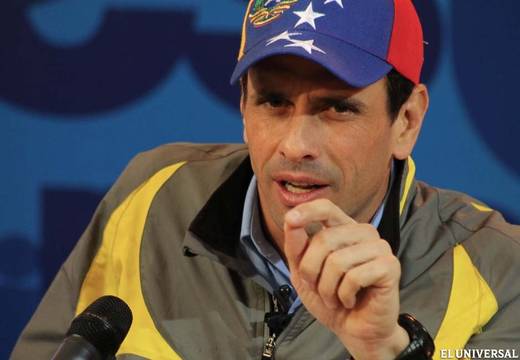
capriles.520.360 e1377285185692 In Case You Missed It…Articles Roundup Week of 8/23/13

Courtesy of: El Universal

This week: Nicolás Maduro tries to pass an Enabling Law, which would grant him increased decree powers in his alleged fight against corruption; and Henrique Capriles says that if they law was somehow passed, Venezuelans would disregard it. The Venezuelan government hurls anti-gay slurs at the opposition as part of their “war on corruption,” while continuing to preach social inclusion; eight senior journalists quit Venezuela’s former opposition news channel, Globovisión, in protest of government manipulation; and due to increasing government control of the media, Venezuelan officials are communicating first through Twitter, not TV or radio. PSUV members are angry at Maduro for skipping the grassroots election preceding December’s municipal election; infighting and corruption in Maduro’s party threaten Hugo Chávez’s socialist legacy in Venezuela;   the Central Bank issues more bonds to curb liquidity and attempts to boost the failing economy by auctioning $300 million in the currency exchange system; and Venezuelan doctors demand that the government declare a health emergency in the county.

Showdown looms in Venezuela over decree powers plan, Reuters

Venezuelan politicians traded insults over the weekend with a showdown looming in the National Assembly over President Nicolas Maduro’s plans to ask for fast-track decree powers he says he needs to combat corruption. Maduro, who narrowly won an April election to replace his late mentor Hugo Chavez, says he is ready to change “all the laws” if necessary to stamp out widespread graft that is denting his popularity with some core supporters.

Capriles: “If passed, Venezuelans would disregard the Enabling Law”, El Universal

“I say responsibly to the country that if they (pro-government officials) want to pass an Enabling Law throughout abuses and disregarding the Constitution, we, Venezuelans would disregard such law,” Henrique Capriles Radonski, Miranda state Governor and opposition leader stressed on Tuesday on his live web show Venezuela Somos Todos (“Venezuela is all of us”) as he commented that President Nicolás Maduro would request special legislative powers via an Enabling Law to the National Assembly in order to allegedly fight against corruption.

Venezuela Government Under Fire for Anti-Gay Slurs, Wall Street Journal

Venezuela’s leftist government, which often touts its social inclusion and antidiscrimination policies, is under fire from rights groups after a tirade of antigay slurs in the National Assembly, prompting President Nicolas Maduro to take to the airwaves waving a conciliatory gay-pride flag—before continuing to attack his political opponents. Lawmakers from Mr. Maduro’s United Socialist Party of Venezuela released photos that appeared to be from a private gathering in which a top aide to the opposition’s former presidential candidate is seen hugging other men and, in others, mugging for the camera while wearing a shawl and a feathered head piece.

Journalists Quit Venezuela TV News Channel in Censorship Protest, Bloomberg

Eight senior journalists quit Venezuela’s main television news channel Globovision in the past week in protest at alleged government manipulation of coverage. “We have progressively seen changes and unacceptable conditions to the free exercise of our profession,” the anchors and reporters at the broadcaster said in a joint e-mailed statement late yesterday. The journalists resigned in solidarity with director Leopoldo Castillo, who announced his exit from Globovision on Aug. 16 after 12 years at the channel.

Latin American presidents and their often love affair with Twitter, Associated Press

Whenever Argentina’s President Cristina Fernandez uses Twitter, controversy often follows. Although tweet discussions range in content and frequency, there’s never a lack of debate. Fernandez, who almost never gives interviews or takes questions from reporters, often uses her official Twitter account, https://twitter.com/CFKArgentina , which claims more than 2.2 million followers, to have a direct connection to the people.

Maduro’s explanation for skipping grassroots election is rebutted, El Universal

Since its foundation in 2007, the ruling United Party of Venezuela (Psuv) has gone through at least four grassroots elections in preparation of  several municipal, state and parliamentary polls, even for the election of Psuv authorities. This is not the case for the municipal election to be held next December 8. This time, top authorities took care of it. The decision, ultimately in the hands of the High Political Command of the Revolution, was justified recently by Venezuelan President Nicolás Maduro.

Hugo Chávez: His legacy at stake, Financial Times

When almost 500 families invaded the estate owned by the Santa Teresa rum company in 2000, Alberto Vollmer decided that using brute force to expel them would be futile. Hugo Chávez had just won the presidency and was encouraging Venezuelans to squat on private land. So instead, Mr Vollmer devised a plan to allow some families to remain, so long as the government paid for their housing.

Venezuela Opens Bidding Process for Latest Dollar Auction, Wall Street Journal

Venezuela authorities began accepting bids Wednesday for the government’s latest hard currency auction, which will offer for the first time dollar-denominated bonds issued last year among the $330 million slated to be injected into the import-heavy economy. The central bank will take bids until Thursday from companies in the food sector, those importing goods for the holiday season in December and firms looking to buy textiles and chemicals, among a limited group of permitted participants.

Venezuelan Doctors Say Country Faces Health Emergency, Latin American Herald Tribune

The president of the Venezuelan Medical Association asked the Venezuelan government Tuesday to declare a health emergency and take steps to address serious problems with the Andean nation’s healthcare system. “We demand… a healthcare emergency be declared here in Venezuela,” Dr. Douglas Leon said during a press conference in Caracas.
 
Aug
12
2013
Posted by
admin
Comments

ICYMI: Venezuela Opposition Comes Under Siege

Wall Street Journal
August 9, 2013
By José de Córdoba and Ezequiel Minaya

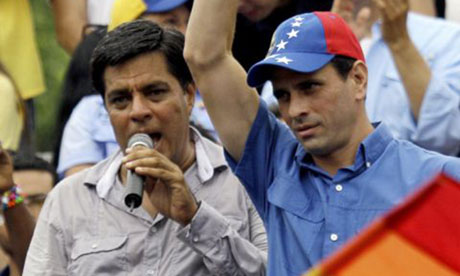
Oscar Lopez left adviser 010 ICYMI: Venezuela Opposition Comes Under Siege

Courtesy of: Associated Press

CARACAS—Venezuela’s President Nicolás Maduro, the political heir to late populist Hugo Chávez, is ratcheting up intimidation of his political foes as his government prepares for key municipal elections amid a deteriorating economy.

Oscar López, a senior aide to former opposition presidential candidate Henrique Capriles, was in hiding Friday after a government legislator said a warrant had been issued for the aide’s arrest. Days earlier, the apartment of Mr. López, Mr. Capriles’s chief of staff, was searched by military-intelligence agents, according to opposition officials.

“He doesn’t know what this circus is all about so he is taking care of himself” by going into hiding, said Julio Borges, a legislator and national coordinator of Venezuela’s leading opposition party, Justice First.

Mr. Capriles himself faces possible arrest after the Supreme Court on Wednesday rejected his challenge to Venezuela’s April presidential election, which Mr. Maduro won by a sliver but which was marred by allegations of fraud. The court went on to fine Mr. Capriles $1,700 for what it said was a “disrespectful” filing and said the opposition leader should be prosecuted for trying to undermine the election.

“It’s a way to attack Henrique and his movement,” Mr. Borges said.

A senior U.S. official said Washington is worried about developments in Venezuela. “The Venezuelan government is increasingly taking legal actions against the opposition, a development the United States finds profoundly worrying,” the official said. The wave of actions against opposition leaders like Mr. Capriles “raises legitimate and urgent concerns,” the official said.

Venezuela’s Attorney General’s Office declined to comment as did Venezuela’s Information Ministry.

Venezuelans go to the polls in December to contest some 335 mayors’ posts throughout the country, as well as hundreds of other local offices. The elections will be the first gauge of Mr. Maduro’s popularity since his win in April’s election.

In the run-up to the vote, Venezuela’s economy has shown signs of increasing stress after years of ramped-up public spending under Mr. Chávez, who died in March. The country’s inflation is north of 42%, common consumer goods like toilet paper are scarce, and despite high oil prices, Venezuela just defaulted on the payment of a $100 million bond of a nationalized steel company, spooking bond buyers. Divisions in the Chavista movement, nominally led by Mr. Maduro, are deep.

“This is clearly a wounded government as far as its mandate and its internal dynamics. And like any wounded animal, it can be dangerous. It is taking very severe steps to consolidate power,” said Christopher Sabatini, senior director of policy at the Americas Society and Council of the Americas.

Also this week, authorities jailed and froze the assets of the editor of a small independent paper and website, Leocenis García of Sexto Poder, who has published detailed reports of alleged government corruption. On Thursday, a judge fined two opposition newspapers—including El Nacional, the country’s most influential daily—1% of their 2009 income for showing a photograph of deteriorated conditions in a morgue. The judge said showing the photo was harmful to the welfare of children.

In Caracas, Juan Carlos Zapata, an author and political analyst, said the escalating repression shows a clear government intention to frighten the opposition. “They want to dismantle the opposition, they want Capriles’s aides to flee the country, and for Capriles to throw in the towel before elections,” said Mr. Zapata. “It’s an orchestrated plan to scare off the opposition.”

The Maduro government has said that it is simply rooting out corruption, regardless of political affiliation. Soon after taking office, Mr. Maduro launched an antigraft initiative that has resulted in the arrest of a handful of mid-level state officials.

The latest government moves follow last week’s stripping of parliamentary immunity by government deputies of a popular opposition congressman, by less than the constitutionally required two-thirds majority. Richard Mardo, who has built up a large following in the Chavista state of Aragua, now must face charges of alleged corruption.

Legal moves by the government against its foes are common in Venezuela. A study by Human Rights Watch found that as of May 2012, Venezuela’s Comptroller General’s Office had temporarily disqualified some 800 people, most of them Chávez foes, from running for office due to accusations of corruption—even though charges hadn’t been filed against them. About 300 people are still barred from running for office.

During his time in office Mr. Chavez routinely brushed aside international criticism as attempts to meddle with domestic affairs and plots to topple his government.

Meanwhile, the opposition is struggling to get out its message to ordinary Venezuelans. Globovisión, once a feisty opposition TV channel—and the only one that gave Mr. Capriles significant airtime—was sold earlier this year, and its coverage of Mr. Capriles has fallen sharply. News about Mr. Capriles is now relegated to a recently opened Web channel dubbed “Capriles TV.” Mr. Borges said that the opposition would have to work hard to get its message out by taking a “grass-roots” approach.

Opposition figures as well as analysts say the repressive wave points to the deep divisions in Mr. Chávez’s movement following his death. “Chávez was a kind of crazy glue that was able to keep different elements together,” says Mr. Borges.

Mr. Borges sees different power groups within the government fighting for influence and control. Within these groups are groups of powerful businessmen and executives who control different sectors of the economy such as the state oil industry, food imports, and the country’s other basic industries. “There are no institutions anymore, just different clans balancing each other,” Mr. Borges said. “Maduro is not president of the country, he is the boss of one of these groups.”

Analysts foresee a difficult time ahead for Venezuela. “It’s a disaster in the making because nobody is in charge,” says Riordan Roett, the head of Latin American studies at Johns Hopkins University.

Many analysts believe the most powerful faction is led by Diosdado Cabello, the president of the National Assembly. Mr. Cabello, a burly and bull-necked former army lieutenant who took part in Mr. Chávez’s failed 1992 coup, has close ties to the country’s armed forces and has reportedly built up a considerable personal fortune.

In late April, Mr. Cabello presided over the congress as a number of opposition legislators were beaten in the congressional chamber. At the time, Mr. Cabello didn’t allow opposition deputies to take the floor to speak until they recognized Mr. Maduro’s victory. Mr. Cabello has ruled the chamber with an iron fist ever since.

Javier Corrales, an expert on Venezuelan politics at Amherst College says that while Mr. Maduro has shown some signs of moderation—such as meeting with top businessmen, Mr. Cabello is openly confrontational. “This crackdown seems to come from Diosdado,” he said. “His instinct appears to be brute force.”

Mr. Cabello couldn’t be reached to comment.

To read this article at the Wall Street Journal, please click here.