Aug
12
2013
Posted by
admin
Comments

ICYMI: Venezuela Opposition Comes Under Siege

Wall Street Journal
August 9, 2013
By José de Córdoba and Ezequiel Minaya
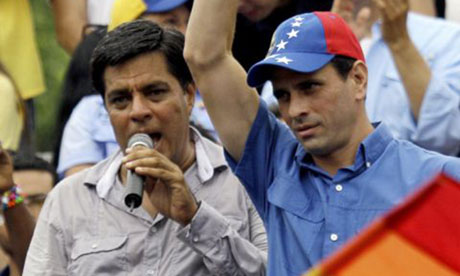
Oscar Lopez left adviser 010 ICYMI: Venezuela Opposition Comes Under Siege

Courtesy of: Associated Press

CARACAS—Venezuela’s President Nicolás Maduro, the political heir to late populist Hugo Chávez, is ratcheting up intimidation of his political foes as his government prepares for key municipal elections amid a deteriorating economy.

Oscar López, a senior aide to former opposition presidential candidate Henrique Capriles, was in hiding Friday after a government legislator said a warrant had been issued for the aide’s arrest. Days earlier, the apartment of Mr. López, Mr. Capriles’s chief of staff, was searched by military-intelligence agents, according to opposition officials.

“He doesn’t know what this circus is all about so he is taking care of himself” by going into hiding, said Julio Borges, a legislator and national coordinator of Venezuela’s leading opposition party, Justice First.

Mr. Capriles himself faces possible arrest after the Supreme Court on Wednesday rejected his challenge to Venezuela’s April presidential election, which Mr. Maduro won by a sliver but which was marred by allegations of fraud. The court went on to fine Mr. Capriles $1,700 for what it said was a “disrespectful” filing and said the opposition leader should be prosecuted for trying to undermine the election.

“It’s a way to attack Henrique and his movement,” Mr. Borges said.

A senior U.S. official said Washington is worried about developments in Venezuela. “The Venezuelan government is increasingly taking legal actions against the opposition, a development the United States finds profoundly worrying,” the official said. The wave of actions against opposition leaders like Mr. Capriles “raises legitimate and urgent concerns,” the official said.

Venezuela’s Attorney General’s Office declined to comment as did Venezuela’s Information Ministry.

Venezuelans go to the polls in December to contest some 335 mayors’ posts throughout the country, as well as hundreds of other local offices. The elections will be the first gauge of Mr. Maduro’s popularity since his win in April’s election.

In the run-up to the vote, Venezuela’s economy has shown signs of increasing stress after years of ramped-up public spending under Mr. Chávez, who died in March. The country’s inflation is north of 42%, common consumer goods like toilet paper are scarce, and despite high oil prices, Venezuela just defaulted on the payment of a $100 million bond of a nationalized steel company, spooking bond buyers. Divisions in the Chavista movement, nominally led by Mr. Maduro, are deep.

“This is clearly a wounded government as far as its mandate and its internal dynamics. And like any wounded animal, it can be dangerous. It is taking very severe steps to consolidate power,” said Christopher Sabatini, senior director of policy at the Americas Society and Council of the Americas.

Also this week, authorities jailed and froze the assets of the editor of a small independent paper and website, Leocenis García of Sexto Poder, who has published detailed reports of alleged government corruption. On Thursday, a judge fined two opposition newspapers—including El Nacional, the country’s most influential daily—1% of their 2009 income for showing a photograph of deteriorated conditions in a morgue. The judge said showing the photo was harmful to the welfare of children.

In Caracas, Juan Carlos Zapata, an author and political analyst, said the escalating repression shows a clear government intention to frighten the opposition. “They want to dismantle the opposition, they want Capriles’s aides to flee the country, and for Capriles to throw in the towel before elections,” said Mr. Zapata. “It’s an orchestrated plan to scare off the opposition.”

The Maduro government has said that it is simply rooting out corruption, regardless of political affiliation. Soon after taking office, Mr. Maduro launched an antigraft initiative that has resulted in the arrest of a handful of mid-level state officials.

The latest government moves follow last week’s stripping of parliamentary immunity by government deputies of a popular opposition congressman, by less than the constitutionally required two-thirds majority. Richard Mardo, who has built up a large following in the Chavista state of Aragua, now must face charges of alleged corruption.

Legal moves by the government against its foes are common in Venezuela. A study by Human Rights Watch found that as of May 2012, Venezuela’s Comptroller General’s Office had temporarily disqualified some 800 people, most of them Chávez foes, from running for office due to accusations of corruption—even though charges hadn’t been filed against them. About 300 people are still barred from running for office.

During his time in office Mr. Chavez routinely brushed aside international criticism as attempts to meddle with domestic affairs and plots to topple his government.

Meanwhile, the opposition is struggling to get out its message to ordinary Venezuelans. Globovisión, once a feisty opposition TV channel—and the only one that gave Mr. Capriles significant airtime—was sold earlier this year, and its coverage of Mr. Capriles has fallen sharply. News about Mr. Capriles is now relegated to a recently opened Web channel dubbed “Capriles TV.” Mr. Borges said that the opposition would have to work hard to get its message out by taking a “grass-roots” approach.

Opposition figures as well as analysts say the repressive wave points to the deep divisions in Mr. Chávez’s movement following his death. “Chávez was a kind of crazy glue that was able to keep different elements together,” says Mr. Borges.

Mr. Borges sees different power groups within the government fighting for influence and control. Within these groups are groups of powerful businessmen and executives who control different sectors of the economy such as the state oil industry, food imports, and the country’s other basic industries. “There are no institutions anymore, just different clans balancing each other,” Mr. Borges said. “Maduro is not president of the country, he is the boss of one of these groups.”

Analysts foresee a difficult time ahead for Venezuela. “It’s a disaster in the making because nobody is in charge,” says Riordan Roett, the head of Latin American studies at Johns Hopkins University.

Many analysts believe the most powerful faction is led by Diosdado Cabello, the president of the National Assembly. Mr. Cabello, a burly and bull-necked former army lieutenant who took part in Mr. Chávez’s failed 1992 coup, has close ties to the country’s armed forces and has reportedly built up a considerable personal fortune.

In late April, Mr. Cabello presided over the congress as a number of opposition legislators were beaten in the congressional chamber. At the time, Mr. Cabello didn’t allow opposition deputies to take the floor to speak until they recognized Mr. Maduro’s victory. Mr. Cabello has ruled the chamber with an iron fist ever since.

Javier Corrales, an expert on Venezuelan politics at Amherst College says that while Mr. Maduro has shown some signs of moderation—such as meeting with top businessmen, Mr. Cabello is openly confrontational. “This crackdown seems to come from Diosdado,” he said. “His instinct appears to be brute force.”

Mr. Cabello couldn’t be reached to comment.

To read this article at the Wall Street Journal, please click here.

 
Jan
10
2013
Posted by
admin
Comments

ICYMI: Chávez, or at Least His Sash, Is Set for Venezuela Inauguration

New York Times
By William Neuman
January 9, 2013

CHAVEZ popup ICYMI: Chávez, or at Least His Sash, Is Set for Venezuela Inauguration

Courtesy of: Associated Press

CARACAS, Venezuela — President Hugo Chávez’s supporters have not ruled out swearing him in from his hospital in Havana. His detractors are calling for government investigators to go check his pulse themselves. The justices whom Mr. Chávez’s allies have named to the Supreme Court have decided that he can continue to govern in absentia.

In a country that Mr. Chávez has dominated for so long, his health crisis and the decision to proceed on Thursday with a quasi-presidential inauguration that he is unable to attend are producing a stream of bizarre developments and national angst about who is in charge.

“Who’s governing Venezuela?” Julio Borges, an opposition member of the National Assembly, said during a noisy legislative debate this week on the biggest issue facing the country, overshadowing other urgent matters like pressures for a painful currency devaluation, stagnant oil production and chronic shortages of food and other staples on store shelves.

Mr. Chávez has long said, “I am the people,” a mantra that his supporters are invoking as they plan to don the sash the president would have worn had he been able to attend his inauguration, symbolically becoming presidents themselves.

“Anyone who has a sash, bring it along, because tomorrow the people will be invested as president of the republic, because the people are Chávez,” Diosdado Cabello, the president of the National Assembly, said Wednesday. “All of us here are Chávez, the people in the street are Chávez, the lady who cooks is Chávez, the comrade who works as a watchman is Chávez, the soldier is Chávez, the woman is Chávez, the farmer is Chávez, the worker is Chávez; we’re all Chávez.”

To no one’s surprise, the Supreme Court, full of Chávez loyalists, ruled on the eve of the ceremony that Mr. Chávez’s inauguration could be postponed and that his team of advisers could smoothly move, in his absence, from one term to the next.

The court declined to set a time limit for the swearing in, raising the possibility that the country’s deepening uncertainty could go on for weeks or months. And it did nothing to clear up the stubborn mystery of the president’s condition.

Luisa Estella Morales, the president of the Supreme Court, said Wednesday at a news conference that there was no need at this time for a delegation to go to Cuba and report back on the condition of Mr. Chávez, 58. Asked if the swearing in could occur in Havana, she said the time and place of the ceremony had not been determined.

Ms. Morales said the Supreme Court’s ruling was meant to uphold the results of October’s presidential election.

“It’s one of the most important values that we should preserve as a constitutional court,” Ms. Morales said. “The sovereign Venezuelan people have expressed through their vote their desire to continue being governed by President Hugo Rafael Chávez Frías.”

The government has been opaque for months, acknowledging that he suffered from a relapse of cancer in the pelvic area, but not specifying the type of cancer or detailing his prognosis.

The lack of information has left Venezuela tied in knots. Mr. Chávez has loomed so large for so long — with speeches that have lasted for hours, frequent Twitter posts and his outsized singing, ranting, poetry-reciting and foe-bashing personality — that his sudden silence has created a sizable vacuum.

“We don’t have a president,” lamented Estela Martínez, 63, a nurse who has supported Mr. Chávez throughout his 14 years in office. She said she was afraid that the public was not getting the full truth about the president’s condition and that there was far more shouting than clarity from political leaders. “Someone has to take the reins of the country.”

Henrique Capriles Radonski, the opposition candidate who lost to Mr. Chávez in October, criticized the Supreme Court’s decision endorsing a delay in the inauguration. “Institutions should not respond to the interests of a government,” he said.

The State Department in Washington, which has been cautious about getting involved in the contentious political back-and-forth, said Wednesday that it would be eager to improve relations with Venezuela, which have long been strained.

Victoria Nuland, the State Department spokeswoman, confirmed that Roberta S. Jacobson, assistant secretary of state for Western Hemisphere affairs, had spoken in November to Vice President Nicolás Maduro about more engagement.

“Regardless of what happens politically in Venezuela, if the Venezuelan government and if the Venezuelan people want to move forward with us, we think there is a path that’s possible,” she said, according to Reuters. “It’s just going to take two to tango.”

Mr. Maduro said last Friday that Venezuela’s ambassador to the Organization of American States, Roy Chaderton Matos, had held meetings with American officials starting in November that included discussions on the criteria for “normalized” relations between their countries, but he emphasized that the two sides continued to have significant differences. He also said Mr. Chávez had approved the talks. Before he left for Cuba in December, Mr. Chávez indicated that he wanted Mr. Maduro to succeed him should he be too ill to govern. But that proclamation, designed to quell a succession battle, has done little to calm the frayed country.

Neither did Mr. Maduro’s letter on Tuesday announcing that Mr. Chávez’s doctors had recommended that he not attend the inauguration and instead continue recuperating in bed. That led some of the president’s critics to wonder why the voluble Mr. Chávez was not telling them himself.

“If the president is in full command of his faculties, why didn’t he sign the letter?” said José Gregorio Graterol, an opposition lawmaker.

And for those Venezuelans who bitterly resent the influence that the Cuban leaders Fidel and Raúl Castro have over Mr. Chávez — especially given Cuba’s dependence on Venezuelan oil shipments on preferential terms — the president’s long stay in Cuba and the constant traveling back and forth to the island of top Venezuelan officials, the letter emanating from Havana was simply too much.

“How do we know that letter isn’t from the hand of Raúl Castro and the Cuban advisers?” Mr. Graterol said.

In the constitutional fight that has ensued over whether Mr. Chávez can legally start a new term without showing up for the scheduled swearing in, both sides in Venezuela have at times seemed to stake out shifting constitutional ground as they have angled for political advantage. The opposition is arguing that the Constitution calls for the head of the National Assembly, Mr. Cabello, to become the caretaker president in Mr. Chávez’s absence.

Mr. Cabello, a staunch ally of Mr. Chávez, is normally reviled by the opposition, and its position seems designed to foment dissension among Chavistas, as Mr. Chávez’s backers are known.

The government’s most recent reports on Mr. Chávez’s health had him fighting a severe lung infection and having difficulty breathing, and it was not known if he would be able to watch television to see the thousands of supporters who will attend the rally in his name. But the show must go on, as Mr. Chávez said in a moment of adversity last year, only this time without him, although with a roster of foreign leaders on hand.

“Crisis?” asked Jorge Rodríguez, a Chávez stalwart who is the mayor of a section of Caracas, according to El Universal newspaper, dismissing the notion that anything was amiss. “Where is the crisis?”

María Iguarán and María Eugenia Díaz contributed reporting.

To read this article on the New York Times, please click here.

 
Jun
26
2012
Posted by
admin
Comments

Venezuelan opposition looks in Spain for a shortcut to observation on 10/7

Members of the Unified Democratic Panel met with Senators in Madrid

El Universal
June 26, 2012

unidad260911leoramirezafp.jpg.520.360 Venezuelan opposition looks in Spain for a shortcut to observation on 10/7

Courtesy of: El Universal

The Venezuelan opposition coalition known as Unified Democratic Panel (MUD) and the Spanish Senate pledged in Madrid to find some formula so that Spanish lawmakers can witness the election for the Venezuelan president slated for October 7.

A delegation of the opposition Unified Democratic Panel held a meeting on Monday with members of the Committee of Ibero-American Affairs of the Spanish Upper House.

“These polls are particularly important, yet an attempt would be made to go right away, not the day before the election, to check whether there is opportunism, or whether the access to media is equal for everyone,” Senator for the Nationalist Party Vasco Iñaki Anasagasti averred during the meeting, Efe quoted.

The MUD delegation included Ramón Guillermo Aveledo, the executive secretary of the coalition; Omar Barboza, the head of political Un Nuevo Tiempo (UNT) party; Julio Borges, the national coordinator of political Primero Justicia (PJ) party, and Henry Ramos Allup, the secretary general of political Acción Democrática (AD) party.

To read this article on El Universal, please click here.