Jul
31
2012
Posted by
admin
Comments

Capriles visits 100 villages in 29 days of electoral campaign

The opposition presidential candidate called upon Venezuelans to post their proposals for the country via Facebook on http://hayuncamino.com/tupropones/

El Universal
July 31, 2012
Sara Carolina Díaz and María de Lourdes Vásquez
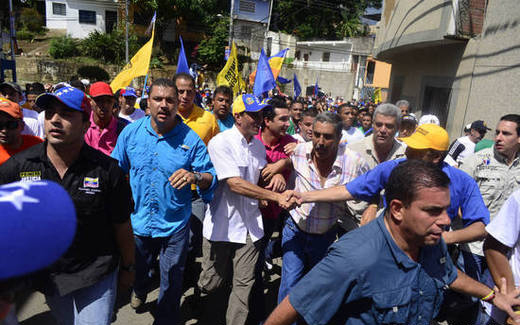
Capriles visits 100 village Capriles visits 100 villages in 29 days of electoral campaign

Henrique Capriles Radonski, the presidential hopeful for opposition alliance Unified Democratic Panel (MUD), visited five villages in central Aragua state (Courtesy of: G. Suárez)

Villa de Cura, in central Aragua state, became the 100th village visited by Henrique Capriles Radonski, the presidential candidate of opposition umbrella group Unified Democratic Panel (MUD), in 29 days of electoral campaign.

The candidate arrived in Villa de Cura from the villages of Barbacoa, Camatagua, San Casimiro and San Sebastián. At the end of the day, Capriles said that he is set to visit more than 300 villages by September. He added that he is determined to meet people eyeball-to-eyeball to convey his message of progress.

Capriles seized the opportunity to send “affective and respectful” greetings to public employees, and to the military officers commissioned in Aragua state, as well as to their families.

“I know that these towns are not visited by those who want to remain in power. They do not come here. They only visit the big cities. The difference lies in coming to towns, such as Camatagua, and listen to people,” said the candidate of the opposition.

He stated that “there is a battle of David versus Goliath in the country: Our only weapon are the votes.”

In Camatagua, he participated in a people’s assembly where he pointed out that the government priorities are not the same as those of the Venezuelan population. People posed five questions to the candidate, most of which were related to high crime rates in Venezuela.

He called upon people not to resign themselves to the situation of criminal violence hitting the country: “Many prisoners are between 18 and 19 years old. This means that they were five years old when this government began, but they took the path of violence anyway. This government talks as if the country was right, but the reality is very different from what they say on TV.”

Additionally, he pointed out that his Security Plan involves the promotion of sports and education, as well as arms control. “Have you seen the government seeking disarmament? No. They protect the weapons because they know where the weapons are.” He stated that the government officials lost connection with reality.

In Villa de Cura, he expressed concern about issues such as the lack of adequate education institutions, repeated power blackouts and lack of jobs, as a consequence of the dismantlement of the economic and production system.

“I have been told that many young people here are forced to leave their homes and depart for Guárico state to study because they have no universities (…) I tell you that we are going to build universities in all Venezuelan villages,” he stated.

He refused to answer to President Hugo Chávez’s insults, and said that his mother taught him “to respect the elderly.”

The opposition presidential candidate called upon Venezuelans to post their proposals for the country via Facebook on http://hayuncamino.com/tupropones/.

Translated by Karina Salas

To read this article on El Universal, please click here.

 
Jul
21
2012
Posted by
admin
Comments

Chávez boasts his own importance while Capriles speaks of teamwork

Even though the official sector undermines Capriles Radonski’s message, expert believe that the red party does see him as a threat

El Universal
Pedro Pablo Peñaloza

11773351 copia.jpg.520.360 Chávez boasts his own importance while Capriles speaks of teamwork

Courtesy of: The Capriles Campaign

One gloats with being able to ramble on for endless hours. The other retorts, saying that actions speak louder than words. Two contrasting styles, one common goal: winning the elections.

In dissecting the rhetoric of candidates Hugo Chávez and Henrique Capriles Radonski, psychologist Axel Capriles found that both the incumbent president and his intended successor base their respective messages on five key points.

Me, myself and I

In Chávez’s case, according to Axel Capriles, the foundation for his speech is “himself.” “Chávez as an embodiment of the people, expressing their desires and interests, an indispensable leader to secure the continuity of the revolution.”

The psychologist points out that “he poses as the heart and soul of a political movement founded on the cult of personality.”

Capriles identifies the second point as the “struggle for independence” as opposed to the slavery allegedly instilled by the Empire and bourgeois. “In fact, Chávez launched his campaign comparing it to a new Battle of Carabobo in which Venezuela fought for its independence,” he adds.

The third element is already a staple for Chávez. Fourthly, he will seek “to disqualify his opponent” and, then, he will attempt to tweak the past. “The fifth point is a tireless counter image’, buttressed by old age and illness, fostering novelty in his proposals,” he claims.

The team

The representative of the opposition Unified Democratic Panel boasts five different priorities. “First, he seeks unity and inclusion for all Venezuelans,” points out Capriles.

The second point is his “deep” knowledge of the issues ailing the nation, as a result of direct contact with voters.

“The third component is the programmatic proposal of specific policies and practices aimed at solving problems,” notes Capriles. The other two points emphasized are “the strength of a candidate who represents the youth of the people and the proposal of a non-charismatic, achievement-driven, teamwork-focused leadership.”

Axel Capriles believes that Chávez’s side “attempts to feed off Venezuelans’ love for songbirds whereas Capriles Radonski bets on his own “concise speech as an example of the need to be pragmatic and to pursue actions, not words.”

Virtues and flaws

Colette Capriles, a professor of Political Theory at Simón Bolívar University, believes that “the message of the opposition candidate is aimed at reinforcing the belief that a change in government is the key to wellbeing whereas the president remains conservative, that is, he strives to preserve his clientele and avoid shifts in allegiance to the democratic side, mocking the former and labeling him as threat to the artificial Venezuelan identity Chávez’s sector has attempted to install.”

Even though the official sector undermines Capriles Radonski’s message, the expert believes that the red party does see him as a threat.

“Chavezism is worried that the contrast between an agile candidate on the move and a candidate that endlessly repeats the same anecdotes does not favor the latter. What once seemed as a positive attribute, powerful storytelling,’ now begins to rub off the wrong way. That is why there is emphasis on shining a positive light on verbosity.”

The researcher believes that “the government must have been exposed to evidence that the huge gap between the president’s endless and repetitive narrative and the actual accomplishments during his tenure is perceived by people as a negative thing.”

Capriles sees the fact that the opposition candidate is “setting the agenda” as “unprecedented” and believes that the government is being compelled to come up with answers “in a highly improvised and aggressive manner.”

Just how new is new’?

In his first press conference as a candidate for reelection, and in reply to a journalist’s question, Hugo Chávez attempted to explain the “new” aspects of his proposal. The Venezuelan head of state proceeded to talk about communal councils, works in progress and public-banking dividends as his “novelties.”

Axel Capriles says that “the only new thing I have found is that Chávez is on the defensive for the first time, claiming that he does not stand for the old or outdated.”

The psychologist believes that “this campaign, more than any others, is seeing Chávez resort to rational elements like defending the accomplishments of his administration and the programs to be implemented.”

Colette Capriles, however, finds that Chávez is mixing traditional formulae with different elements.

“Tactically, it is the same old rhetoric: announcements about public expenditures, promises of love and restoring identity and insults to his counterparts. The possibly new element is the identity melodrama’: an emotional plea in which the self-focused Chávez dissolves into the adoring and adulating masses. This emphasis on identity is key because the inherent message is that no matter how ill I may be or how bad my government has done, the truly important thing is that I have shown you who you are and how you fit into my world.”

[email protected]

Translated by Félix Rojas Alva

To read this article on El Universal, please click here.
 
Jun
26
2012
Posted by
admin
Comments

Capriles plans to go around the country three more times

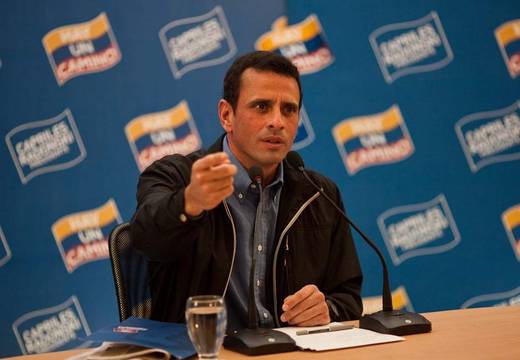
Henrique Capriles Radonski, the candidate for the opposition Unified Democratic Panel (MUD) held a press conference on Tuesday afternoon for Venezuelan and foreign media

El Universal
June 26, 2012

capriles efe12383094.jpg.520.360 Capriles plans to go around the country three more times

Courtesy of: EFE

Henrique Capriles Radonski, the candidate for the opposition Unified Democratic Panel (MUD), promised electioneering based on “respect, without offenses.” He prepares to go around the country three more times to introduce his country plan.

“I am here to listen to all of you; I am not here to divide anybody,” he asserted during a press conference held on Tuesday afternoon for Venezuelan and foreign media.

The hopeful commented that his visits house by house was an experience to learn about Venezuelans’ problems and learning “in order not to promise without listening to the people.”

The challenger advocated “equal footing” in the election campaign. “The government ought to comply with the election rules.”

To read this article on El Universal, please click here.