Oct
3
2012
Posted by
admin
Comments

Will Venezuelans Oust Chavez? Miracles Do Happen

Bloomberg
October 3, 2012
By Enrique Krauze

i6afTBb119I8 Will Venezuelans Oust Chavez? Miracles Do Happen

Illustration by Forest

If Henrique Capriles Radonski triumphs in Venezuela’s elections on Oct. 7, it will be a democratic feat without precedent in Latin American history.

It is possible that an opposition candidate has never faced a force like that represented by Hugo Chavez. His government doesn’t employ physical violence as a state policy, but it exercises another kind of coercive and menacing violence, manifold and oppressive. Its power comes from the ballot box under the tight control of arms — his arms.

When democracy finally edged out dictatorships in Argentina, Uruguay and Chile, the military establishment — because of public repudiation of its genocidal acts — found itself in irreversible retreat.

At the other end of the ideological spectrum, perhaps the only case of an authoritarian leftist regime democratically overturned was that of the Sandinistas in Nicaragua in 1990. But the difficulties then weren’t as great as those involved in the Venezuelan process, for the very reason that the Sandinista government — already in decline at the end of the 1980s — wasn’t democratic, nor did it pretend to be.

Either way, whether against the militarist right or the revolutionary left, democracy wasn’t obliged to retrace a path, but to forge it.

Reclaiming Democracy

In Venezuela, the democrats must go back to before the beginning: They must restore true meaning to what has become a corrupted democracy. Chavez’s explicit aim has been to rule until at least 2030, when he will be 76 (and if he makes it to 76, there is no question he will want to continue). But unlike Fidel Castro of Cuba (and the Sandinistas or the old South American dictators such as Jose Gaspar Rodriguez de Francia of Paraguay or Juan Vicente Gomez of Venezuela), Chavez has astutely used democracy to do away with democracy.

He has accomplished this step by step, institution by institution, imposing his designs and spokesmen on the Legislature, the judiciary, the fiscal and electoral bodies. If he hasn’t finished his demolition work, it is because a broad sector of Venezuelan society hasn’t forgotten the meaning of freedom. In an unequal contest (because Chavez enjoys the private property of public resources, and uses them lavishly to his advantage), that sector has displayed an admirable spirit of unity, and it has in Capriles a young, sensitive and visionary leader. The possibilities of victory are real, but the adversary — despite (or thanks to) his illness — is formidable.

Chavez isn’t just a caudillo: He is a redeemer. To play up that twisted religious dimension, he has abused the media pulpit. For many years, he appeared on the Sunday program “Alo, Presidente,” a six-hour-long reality show in which Chavez delivered monologues, danced, sang, recited, read letters, declared his love for the people, railed at the empire and the “pitiyanquis” (or “little Yankees,” the purported allies of the U.S. within Venezuela), gave lessons on “21st-century socialism,” recalled scenes from his autobiography (which in his peculiar understanding of it is the incarnation of Venezuelan history) and issued thundering decrees.

Before his Cabinet members (all dressed in red, silent and as obedient as children in a classroom), he dictated expropriations, troop movements, diplomatic insults and public policies.

Many people in Venezuelan society rejected this spectacle. But more than half of the electorate celebrated it. For them, Chavez has been the reincarnation of Simon Bolivar and even Christ’s representative on earth, now more so than ever as Chavez has turned his grievous illness into a public calvary.

Chavez Loyalists

Beyond that incarnation is his social role. A considerable number of poor Venezuelans have been grateful to him for the “misiones” he established in 2003 (staffed mainly by Cubans, who have also taken charge of the security apparatus) with the aim of providing health care, food and education.

Though many of these programs have faced serious operational problems and are designed not to promote people’s autonomy, but rather their dependence on government, the “Chavistas” don’t see it that way. The near monopoly on public truth (which Chavez has enjoyed since he expropriated the major public-television channels) has masked reality. Millions of Venezuelans take his word as the mirror of truth, particularly if they are public employees whose income depends — or so they believe — on his munificence.

But the concealment of the truth has been massive. Will Venezuelans ever assess the incredible squandering of the almost $700 billion that passed through the coffers of Petroleos de Venezuela SA, the state-owned oil company that was once a bigger example of modernization than Brazil’s Petroleo Brasileiro SA? It’s impossible to know.

Many understand that Venezuela is in the midst of a crisis: Inflation and crime rates are among the highest in South America, and there are persistent shortages of goods. Basic services are also in chaos as a result of harassment in the private sector and because of inefficiency and corruption.

The Capriles campaign has been brave and conciliatory. His proposals seek to restore financial sense and protect social progress (real or perceived). Chavez has accused him of wanting to end the “misiones”; Capriles insists he will touch them only to improve them. Chavez points to him as the reincarnation of the political old guard of Venezuela; Capriles has shown how the bad practices of Chavismo are similar to those of the so- called Fourth Republic and pledged that his government will correct both.

Chavez has vilified him incessantly with crude insults and has committed the sacrilege of calling him a Nazi, knowing that Capriles’s great-grandparents were exterminated by the Nazis. Capriles, meanwhile, has remained unruffled.

Opposition’s Opening

Anything can happen, including an outbreak of the endemic violence that has plagued Venezuelan history. The fascination with a sick Chavez and his far-reaching control of the state apparatus may bring him victory.

If this is the case, the opposition must press on without pause or discouragement. Chavez may triumph, but it will be a hollow victory, and after his eventual death, divisions within his group as well as internal and international pressures may pave the way for a return to full democracy. Such a development would have the additional effect of precipitating the Cuban transition, drawing us nearer to the emergence — unprecedented in history — of an entirely democratic Latin America.

This outcome, which until recently would have seemed utopian, is at hand if Capriles wins. We have witnessed such a result before, in the December 2007 referendum, when Venezuelans, against all forecasts, voted down a plan for constitutional reform that would have turned the country into a new Cuba.

I have faith in that civic miracle. And I hope that such a victory will herald not only the return of democracy but something much more important and necessary: the reconciliation of the Venezuelan family, divided today by an ideological hatred that is alien to it, that has poisoned it for almost 15 years, and that has choked all possibility of harmony.

(Enrique Krauze is a historian and author of “Mexico: A Biography of Power” and of “Redeemers: Ideas and Power in Latin America.” The opinions expressed are his own. This article was translated from the Spanish by Natasha Wimmer.)

To contact the writer of this article: Enrique Krauze at [email protected].

To contact the editor responsible for this article: Katy Roberts at [email protected].

To read this article on Bloomberg, please click here.
 
Oct
1
2012
Posted by
admin
Comments

Capriles Rally Draws Thousands Against Chavez Ahead of Vote

Bloomberg News
October 01, 2012
By Nathan Crooks and Jose Orozco

henrique capriles radonski Capriles Rally Draws Thousands Against Chavez Ahead of Vote

Courtesy of: Juan Barreto / AFP / Getty Images

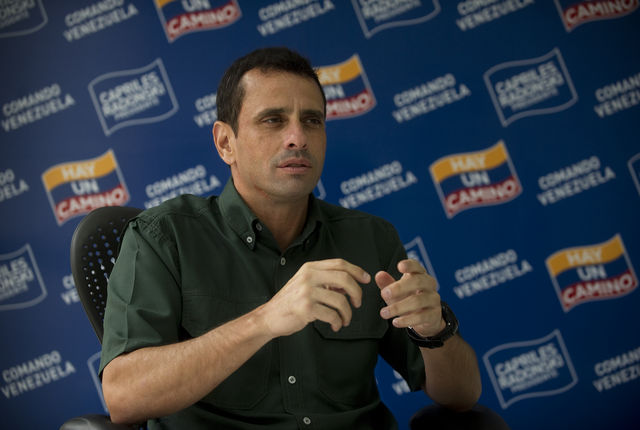
Venezuelan opposition candidate Henrique Capriles Radonski symbolically closed his Caracas campaign against President Hugo Chavez yesterday with a march attended by tens of thousands of supporters.

Capriles, dressed in a shirt styled with the three colors of Venezuela’s flag, promised to confront growing violence in the South American country after he said three supporters were shot and killed over the weekend in Barinas state. He asked voters to judge Chavez’s priorities after 13 years in power and decide if they were happy with their lives today.

“This government gives away resources to every other country,” Capriles said. “There is no gauze in the hospitals here, but they give money away to sponsor samba dancing at the carnival in Rio.”

Capriles, 40, has held large rallies across Venezuela over the past month to close his campaign and build momentum after making house-to-house visits to offer what he described as a message of unity, progress and private investment. He filled the stadium used by Chavez’s favorite baseball team on Sept. 27 in a rally to close his campaign in the central state of Carabobo.

“This has to be one of the largest marches in the history of Caracas,” Capriles said yesterday to a throng filling the length of Bolivar Avenue in downtown Caracas, a symbolic space often used by Chavez for campaign rallies, waving party flags, chanting, dancing to campaign music and blowing vuvuzelas.

Leopoldo Lopez, a member of Capriles’ campaign team, said on the Globovision television network Sept. 28 that he hoped as many as a million people would attend the march. The campaign didn’t provide an estimate on the size of the march afterward.

Three Dead

Shots were fired at a caravan of cars in eastern Barinas state on Sept. 29 when Capriles supporters tried to pass a checkpoint, the Primero Justicia political party said in a statement, adding that the barricade had been set up by “presumed” Chavez supporters.

Police have detained three suspects, the Venezuelan government said yesterday in an e-mailed statement, without providing additional details. Chavez, who spoke at a rally yesterday in western Zulia state, said the incident was “regrettable” and urged his supporters not to fall into “provocations.”

Chavez, who also spoke at a rally on Sept. 29 in central Miranda state, said he himself is one of the biggest critics of his government and that there were reasons for some people to be “discontent.”

Insecurity, Crime

“There have been failures and problems, but what is at stake on Oct. 7 is not about the small or medium problems including water or electricity problems,” said Chavez. “We’ll solve the problems of insecurity and crime.”

Andrea Thadino, who lives in Caracas slum of San Agustin where a cousin was killed by a gunfight three years ago, said she works at a street nail salon because she can’t get a job teaching at a public school after signing a petition against Chavez.

“Despite studying for five years, I have to work as a street vendor to survive,” she said in an interview at yesterday’s march while carrying her 2-year-old son. “I voted for Chavez the first time but not anymore. I think Capriles is a sincere man who is going to make a change.”

Fitness for Office

Capriles, a former governor of Miranda state, has played up his youth and fitness to offer a stark contrast to the condition of his 58-year-old opponent, who is coming off three operations related to an unknown cancer in the past 15 months. He is ahead in several polls while trailing by as much as 15 percentage points in others.

“There are two options here. One we already know and has been in power for 14 years,” Capriles said. “I lead the other option that aims to solve your problems.”

Capriles, who arrived on a truck with “Progress” written on its windshield, said Chavez had dashed the hopes of many Venezuelans.

“There was a lot of hope, wherever you went, there were rivers of people full of hope,” said Capriles, referring to the period after Chavez was first elected. “Almost 14 years later, you be the judge of who is in the process of change and who is sick with power. Because the man in Miraflores defrauded the Venezuelan people.”

After his speech, Capriles hugged his mother and tossed his trademark baseball caps with the Venezuelan colors into the crowd.

Middle Class Votes

Chavez, a self-professed socialist who is traditionally supported by the country’s poor, has spent his final days on campaign trying to attract middle class and rich voters.

“Those with a big house and two or three cars in the garage, a good job, their kids in a good school, the ones who go to the club on Friday night and take their plane to Miami or Margarita Island on Saturday, those people should vote for Chavez,” the former paratrooper said in an interview broadcast yesterday on the Televen television network. “We are the guarantee of tranquility. Think about it well. It’s not for me, it’s for you.”

Armando Briquet, head of the Capriles campaign, said the government is trying to make the vote difficult for the opposition with actions including the closing of Venezuela’s Miami consulate, which will require thousands of voters to travel to the nearest voting center in New Orleans.

“Even with all that, we are going to win by more than 10 percentage points,” Briquet said backstage after the rally, citing the campaign’s polling numbers.

“On Oct. 7, Chavez wins!” Chavez told supporters yesterday in Zulia state. “It will be a grand victory, I don’t have a doubt.”

To contact the reporters on this story: Nathan Crooks in Caracas at [email protected]; Jose Orozco in Caracas at [email protected].

To contact the editor responsible for this story: Joshua Goodman at [email protected].

To read this article on Bloomberg News, please click here.

 
Sep
27
2012
Posted by
admin
Comments

The Challenger

The New York Times – International Herald Tribune
September 27, 2012
By Francisco Toro

latitude 2709 toro blog480 The Challenger

Courtesy of: Geraldo Caso / Agence France-Presse / Getty Images

MONTREAL — Even on TV, the energy of the crowd comes through. The opposition candidate Henrique Capriles Radonski is ripping into his stump speech, and the townspeople in the city of Maturin, in Eastern Venezuela, are eating it up: “Today,” he bellows, “I want you to think about your problems, and think: Has the government brought solutions to your problems?!” The crowd shouts back: “Nooooo!”

Adoring crowds like this one have come out again and again to hear Capriles speak, and they’re far from the oligarchic rump the Chávez government likes to imagine. Since the start of the campaign, the wiry 40-year-old state governor has taken this message to over 250 towns and small cities throughout the country as part of an audacious town-by-town tour of Venezuela that’s propelled him from distant longshot to real contender for what would be a famous upset.

Capriles isn’t a naturally charismatic speaker, but he’s made up for what he lacks in personal magnetism with frenetic energy and a message of social inclusion that’s a refutation of the government’s talking points. Far from the aloof, aristocratic caricature of Capriles the Chávez government has sought to portray, the governor is in his element hanging out with everyday Venezuelans, listening to their problems and putting forward solutions.

But it isn’t just his demeanor on the stump. Capriles has also disrupted the government’s narrative by radically overhauling the opposition’s message. Setting aside the barren old debate about ideological abstractions that the opposition spent much of the last 14 years stoking, Capriles grasped the need to broaden the opposition’s base of support.

Out went the old battle cries against socialism, expropriation, the concentration of power in the presidency and Chávez’s growing abuse of power. While these are themes that obsess the small globalized middle class living in Venezuela’s three or four largest cities, they sound distant to the Venezuelans struggling to establish a foothold in the middle class in the first place.

To replace the old ideological diatribes, Capriles has built a message centered on the day-to-day issues that matter to Venezuela’s vast aspirational working class: the chronic power shortages, out-of-control crime, runaway inflation and jobs.

Capriles has been disciplined about carrying through this message reboot. On the stump, it’s hard not to notice that he hardly ever uses words ending in “-ism.” His silences are his message: this campaign isn’t an academic discussion on the relative merits of “capitalism” and “communism”; it’s about whether you can get a decent job, send your children to a decent school and live in a decent home.

This recast message allows Capriles to talk directly to struggling lower families who aspire to move into the middle class: people who’ve come to depend on government social programs but are increasingly weary of the ideological extremism, waste and corruption that hamper the chavista state’s efforts to solve their everyday problems. These are the voters that dominate outside Venezuela’s big cities, and so Capriles’s focus on rural areas is the geographic expression of this new message.

For too long, opposition leaders barely bothered going outside the country’s biggest cities or addressing the concerns of small-town voters. The result is plain to see in county-level election maps, where the blue opposition vote is tightly clustered in middle-class areas of Caracas, Maracaibo, Valencia and Barquisimeto, while virtually all of the country’s small towns and countryside make up a sea of chavista red.

For all his skill in recasting the campaign as a referendum on Chávez’s ability to address Venezuelans’ everyday problems and broadening the opposition’s base of support, Capriles remains an underdog taking on a global icon.

Two weeks out, though, two of Venezuela’s three best-regarded pollsters show him in a statistical dead-heat with the president. By crafting a message to appeal to a truly nationwide audience, he’s given himself a real fighting chance to pull off a stunning upset on Oct. 7th. The whole world will be watching.

Francisco Toro blogs about the Chávez era at CaracasChronicles.com.

To Read this article on the The New York Times – International Herald Tribune, please click here.