Aug
12
2013
Posted by
admin
Comments

ICYMI: Venezuela Opposition Comes Under Siege

Wall Street Journal
August 9, 2013
By José de Córdoba and Ezequiel Minaya
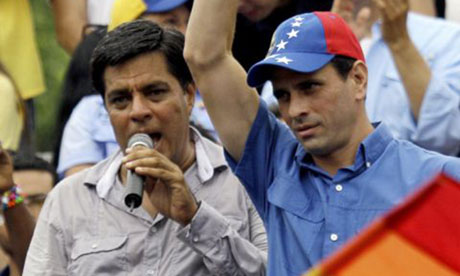
Oscar Lopez left adviser 010 ICYMI: Venezuela Opposition Comes Under Siege

Courtesy of: Associated Press

CARACAS—Venezuela’s President Nicolás Maduro, the political heir to late populist Hugo Chávez, is ratcheting up intimidation of his political foes as his government prepares for key municipal elections amid a deteriorating economy.

Oscar López, a senior aide to former opposition presidential candidate Henrique Capriles, was in hiding Friday after a government legislator said a warrant had been issued for the aide’s arrest. Days earlier, the apartment of Mr. López, Mr. Capriles’s chief of staff, was searched by military-intelligence agents, according to opposition officials.

“He doesn’t know what this circus is all about so he is taking care of himself” by going into hiding, said Julio Borges, a legislator and national coordinator of Venezuela’s leading opposition party, Justice First.

Mr. Capriles himself faces possible arrest after the Supreme Court on Wednesday rejected his challenge to Venezuela’s April presidential election, which Mr. Maduro won by a sliver but which was marred by allegations of fraud. The court went on to fine Mr. Capriles $1,700 for what it said was a “disrespectful” filing and said the opposition leader should be prosecuted for trying to undermine the election.

“It’s a way to attack Henrique and his movement,” Mr. Borges said.

A senior U.S. official said Washington is worried about developments in Venezuela. “The Venezuelan government is increasingly taking legal actions against the opposition, a development the United States finds profoundly worrying,” the official said. The wave of actions against opposition leaders like Mr. Capriles “raises legitimate and urgent concerns,” the official said.

Venezuela’s Attorney General’s Office declined to comment as did Venezuela’s Information Ministry.

Venezuelans go to the polls in December to contest some 335 mayors’ posts throughout the country, as well as hundreds of other local offices. The elections will be the first gauge of Mr. Maduro’s popularity since his win in April’s election.

In the run-up to the vote, Venezuela’s economy has shown signs of increasing stress after years of ramped-up public spending under Mr. Chávez, who died in March. The country’s inflation is north of 42%, common consumer goods like toilet paper are scarce, and despite high oil prices, Venezuela just defaulted on the payment of a $100 million bond of a nationalized steel company, spooking bond buyers. Divisions in the Chavista movement, nominally led by Mr. Maduro, are deep.

“This is clearly a wounded government as far as its mandate and its internal dynamics. And like any wounded animal, it can be dangerous. It is taking very severe steps to consolidate power,” said Christopher Sabatini, senior director of policy at the Americas Society and Council of the Americas.

Also this week, authorities jailed and froze the assets of the editor of a small independent paper and website, Leocenis García of Sexto Poder, who has published detailed reports of alleged government corruption. On Thursday, a judge fined two opposition newspapers—including El Nacional, the country’s most influential daily—1% of their 2009 income for showing a photograph of deteriorated conditions in a morgue. The judge said showing the photo was harmful to the welfare of children.

In Caracas, Juan Carlos Zapata, an author and political analyst, said the escalating repression shows a clear government intention to frighten the opposition. “They want to dismantle the opposition, they want Capriles’s aides to flee the country, and for Capriles to throw in the towel before elections,” said Mr. Zapata. “It’s an orchestrated plan to scare off the opposition.”

The Maduro government has said that it is simply rooting out corruption, regardless of political affiliation. Soon after taking office, Mr. Maduro launched an antigraft initiative that has resulted in the arrest of a handful of mid-level state officials.

The latest government moves follow last week’s stripping of parliamentary immunity by government deputies of a popular opposition congressman, by less than the constitutionally required two-thirds majority. Richard Mardo, who has built up a large following in the Chavista state of Aragua, now must face charges of alleged corruption.

Legal moves by the government against its foes are common in Venezuela. A study by Human Rights Watch found that as of May 2012, Venezuela’s Comptroller General’s Office had temporarily disqualified some 800 people, most of them Chávez foes, from running for office due to accusations of corruption—even though charges hadn’t been filed against them. About 300 people are still barred from running for office.

During his time in office Mr. Chavez routinely brushed aside international criticism as attempts to meddle with domestic affairs and plots to topple his government.

Meanwhile, the opposition is struggling to get out its message to ordinary Venezuelans. Globovisión, once a feisty opposition TV channel—and the only one that gave Mr. Capriles significant airtime—was sold earlier this year, and its coverage of Mr. Capriles has fallen sharply. News about Mr. Capriles is now relegated to a recently opened Web channel dubbed “Capriles TV.” Mr. Borges said that the opposition would have to work hard to get its message out by taking a “grass-roots” approach.

Opposition figures as well as analysts say the repressive wave points to the deep divisions in Mr. Chávez’s movement following his death. “Chávez was a kind of crazy glue that was able to keep different elements together,” says Mr. Borges.

Mr. Borges sees different power groups within the government fighting for influence and control. Within these groups are groups of powerful businessmen and executives who control different sectors of the economy such as the state oil industry, food imports, and the country’s other basic industries. “There are no institutions anymore, just different clans balancing each other,” Mr. Borges said. “Maduro is not president of the country, he is the boss of one of these groups.”

Analysts foresee a difficult time ahead for Venezuela. “It’s a disaster in the making because nobody is in charge,” says Riordan Roett, the head of Latin American studies at Johns Hopkins University.

Many analysts believe the most powerful faction is led by Diosdado Cabello, the president of the National Assembly. Mr. Cabello, a burly and bull-necked former army lieutenant who took part in Mr. Chávez’s failed 1992 coup, has close ties to the country’s armed forces and has reportedly built up a considerable personal fortune.

In late April, Mr. Cabello presided over the congress as a number of opposition legislators were beaten in the congressional chamber. At the time, Mr. Cabello didn’t allow opposition deputies to take the floor to speak until they recognized Mr. Maduro’s victory. Mr. Cabello has ruled the chamber with an iron fist ever since.

Javier Corrales, an expert on Venezuelan politics at Amherst College says that while Mr. Maduro has shown some signs of moderation—such as meeting with top businessmen, Mr. Cabello is openly confrontational. “This crackdown seems to come from Diosdado,” he said. “His instinct appears to be brute force.”

Mr. Cabello couldn’t be reached to comment.

To read this article at the Wall Street Journal, please click here.
 
Jul
26
2013
Posted by
admin
Comments

In Case You Missed It…Articles Roundup Week of 7/26/13

ob xv412 pd0613 g 20130613101301 e1374873855883 In Case You Missed It...Articles Roundup Week of 7/26/13

Courtesy of: Zuma Press

This week: Maduro responded to Samantha Power’s negative comments on Venezuela by halting efforts to improve U.S.-Venezuela relations; the United States leaves door open to improve relations but it does not rectify Power’s statements; Venezuelan Chargé d’Affaires to the United States affirms that the effort to restore relations was ‘suspended’ but that the government is willing to have a “friendly” bilateral relations with Washington; and Venezuela-Colombia relations are improving with country leaders meeting and discussing their responsibility of working together. The Eclac forecasts that Venezuela will have a 1 percent gross domestic product growth in 2013, the lowest in Latin America; Venezuela seeks $5 billion loan with China to finance a state investment fund that was recently involved in a $85 million embezzlement fraud; Venezuela’s dollar auction is seen by analysts as too little of an effort to revamp the price distortions in the economy; and Ferrominera workers halt the state-owned iron company in rejection of the militarization of the firm. Authentic leaked audio recording describes the highest levels of the Venezuelan government as gripped by rivalries and corruption; almost a dozen state institutions were hacked by groups of cyber pirates demanding Maduro’s resignation; Cabello stated that he will make public hard evidence of assassination attempts that were targeted against himself and president Maduro; and medical associations declare a state of emergency in Venezuela’s health system.

Venezuela Stops Efforts to Improve U.S. Relations, New York Times

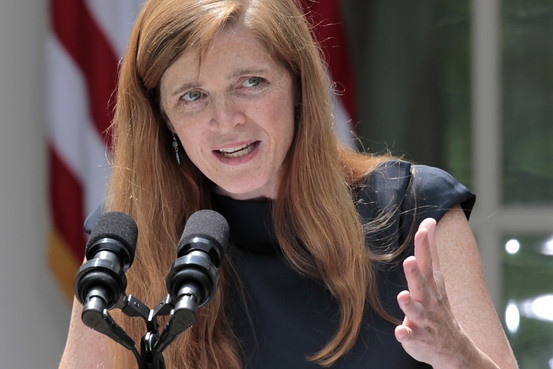
The nominee for US ambassador to the United Nations, Samantha Power, spoke before a Senate committee last Wednesday and said that one of her roles as an ambassador would be to challenge a “crackdown on civil society” in several countries, including Venezuela. These statements were first lashed out by Nicolás Maduro on Thursday, and late on Friday the Foreign Ministry said it was terminating efforts to improve relations with the US.

US leaves “door open” to Venezuela, says no apologies, El Universal

The US confirmed on Wednesday that the door was open to improve relations with Venezuela, but avoided any sort of rectification as requested by President Nicolas Maduro, who announced the end of discussions to restore relations after the statements issued recently  by the US ambassador nominee to the United Nations, Samantha Power.

Venezuela willing to have friendly relations with the United States, El Universal

Venezuelan Chargé d’Affaires to the United States Calixto Ortega stated on Thursday that a bilateral rapprochement launched in June to restore relations between the US and Venezuela has been “suspended,” but stressed that Nicolás Maduro’s Administration is willing to have “friendly” bilateral relations with Washington.

Venezuela, Colombia Resume Relations After Spat, Latin American Herald Tribune

Venezuela and Colombia renewed relations after two months of Maduro accusing Santos of destabilizing political harmony by meeting with Venezuelan opposition leader Capriles. Santos acknowledged that there are things the two parties don’t agree on, but that the obligation and responsibility of providing prosperity to their countries will enable them to work together.

Venezuela to experience the lowest economic growth in Latin America, El Universal

Venezuela is the country with the lowest forecast gross domestic product growth in Latin America for 2013. In fact, The Economic Commission for Latin America and the Caribbean (Eclac) estimated that Venezuelan economic growth would hit only 1% this year, below El Salvador, with 2%.

Venezuela seeks $5 billion China loan for scandal-plagued fund, Reuters

Venezuela is seeking a loan of up to $5 billion from China to finance a state investment fund that was recently the victim of an embezzlement scheme by the fund’s own employees involving millions of dollars. Eight people were arrested for appropriating $84 million from the fund, which has received two $4 billion tranches from the China Development Bank since its inception in 2007.

Venezuela’s Revamped Dollar Auctions Seen as Too Little, Wall Street Journal

Venezuela revived its system of auctions for putting more hard currency into the hands of importers and travelers, but analysts say the effort is falling short of addressing distortions caused by the country’s restrictive foreign exchange policies.

Venezuela’s Ferrominera comes to a halt amid militarization, El Universal

A group of workers with Venezuelan state-owned iron company CVG Ferrominera on Thursday blocked both the gate seven and the railways leading to the plant, in rejection of the militarization of the firm on Wednesday evening. Demonstrators explained that the company’s board suspended the transport service on Wednesday evening and troops blocked the gates as part of a contingency plan to restart the plant with National Guard troops.

Venezuelan Newspaper: Probe Says Leaked Audio Describing Corruption Is Authentic, Wall Street Journal

And audio recording allegedly describes the highest levels of the government as gripped by rivalries and corruption. Mr. Silva discussed with a Cuban intelligence officer a rivalry between Diosdado Cabello, the head of the national legislature, and recently elected President Nicolas Maduro. The man said to be Mr. Silva also accuses Mr. Cabello of raiding the government’s international reserves through the use of shady import companies.

Massive cyber attack against Maduro’s Venezuelan, Miami Herald 

From the stock market to the army, the air force and the national guard, web pages of almost a dozen Venezuelan state institutions were hacked by groups of cyber pirates demanding Nicolás Maduro’s resignation from a presidency they called fraudulent. The groups Anonymous Venezuela and Venezuelan Hackers claimed joint responsibility for the attacks launched Tuesday night. The targets include web pages of government agencies, ministries, municipalities…

“Overwhelming” Evidence of Plot to Assassinate Venezuela’s Maduro, Global Research

Head of Venezuela’s National Assembly Diosdado Cabello has stated that he will make public “hard evidence of assassination attempts” targeting himself and President Nicolas Maduro “in due course”. Cabello told legislators “We know who they are, what they are, what they want, and we will find them.”

Medical associations on state of emergency in Venezuela, El Universal

The Network of Medical and Scientific Associations declared a state of emergency in the Venezuelan health system and rejected the scale of charges drafted without including health federations, professional associations, private hospitals and other relevant entities. “We declare a state of emergency for multiple reasons. We cannot ignore how serious it would be regulating, over the use of force, charges arising out of clinical services or closing private health centers based in the country

 
Jul
8
2013
Posted by
admin
Comments

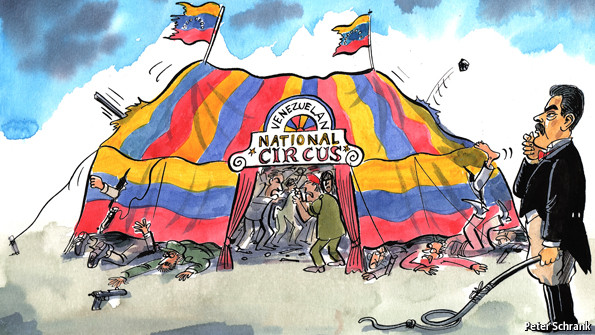
ICYMI: A circus without a ringmaster

The Economist
July 6, 2013

20130706 AMD001 0 e1373308466257 ICYMI: A circus without a ringmaster

Courtesy of: The Economist/Peter Schrank

During the presidency of Hugo Chávez, who ruled from 1999 until his death from cancer in March, the domineering personality of the comandante left no doubt as to who was in charge of Venezuela. By contrast Chávez’s successor, Nicolás Maduro, a former foreign minister, has yet to convince people that he is the one running the show. His disputed, razor-thin election victory on April 14th undermined his legitimacy (indeed, the supreme court has yet to resolve the opposition’s claim of fraud). Now the president faces problems within the ranks of the ruling coalition, and in particular his United Socialist Party of Venezuela (PSUV). In the absence of Chávez, there are worries that the PSUV will turn out to be held together, as the colourful Venezuelan metaphor has it, “with parrot spit”.

Fourteen years of chavismo have left the country in a mess. Despite the high price of oil, growth this year will be minimal or negative. Thousands of private companies have gone under, dragged down by regulations and threatened with fines, temporary closure or expropriation. Others have switched from production to importing. Even that is losing its appeal, now that foreign-exchange control mechanisms have seized up and dollars are scarce. Mr Maduro has sought to deal with the concerns of ordinary Venezuelans, as well as striking radical poses to please hard-core chavistas. Crime, poor public services, corruption and food-scarcity have been targeted with loudly trumpeted initiatives. But actually solving these problems will mean confronting powerful interests, and here Mr Maduro has little room for manoeuvre.

Moderates were encouraged when early in his presidency Mr Maduro sidelined Jorge Giordani, Chávez’s Marxist finance minister, and brought in Nelson Merentes, a former governor of the Central Bank who is seen as more ideologically flexible. But subsequent appointments seem designed to appease other interests. Amid talks with the private sector on how to get the wheels of commerce turning again, Mr Maduro last month reappointed Eduardo Samán head of the powerful consumer-protection body, a post he held under Chávez. A self-proclaimed “ultra-radical”, Mr Samán believes that inflation (heading for 40% a year) and empty supermarket shelves are caused by private-sector hoarding and speculation. “Humanity”, he has written, “will succeed in solving the food crisis only with the end of capitalism.”

Tentative efforts to tame corruption have also been undermined by a need to stay on friendly terms with the Chávez clan. On June 12th Argenis Chávez, the late president’s crafty youngest brother, was appointed head of the body that controls the administration of the justice system. On his brother’s watch, the younger Chávez had led the electricity ministry as well as Corpoelec, the graft-riddled state-run electricity giant. On becoming president, Mr Maduro quickly booted him out of both jobs. His return to office demonstrates the enduring power of the Chávez clan, as well as Mr Maduro’s willingness to subordinate the justice system to his political requirements.

Managing these rival factions has forced the PSUV to suspend internal party democracy. Grass-roots chavista radicals had backed Mr Samán’s bid to stand for mayor of Caracas. But party leaders, who see Mr Samán as a loose cannon, ruled out holding a primary that he might have won. Now the PSUV has cancelled all the primaries that were to have been held ahead of local elections, which have been postponed until December 8th. It remains to be seen whether choosing candidates by executive fiat will ruffle fewer feathers than the primaries would have done.

Our man in Havana

Rumours swirl that Mr Maduro could face a more immediate challenge to his own leadership. In a recorded conversation that was leaked on May 20th Mario Silva, the presenter of a state-television talk-show called “The Razor Blade”, was heard apparently passing information to a Cuban intelligence officer. In the recording Mr Silva warned the spy that Diosdado Cabello, the speaker of the National Assembly, wanted to overthrow Mr Maduro. It was a matter of urgency, he said, to cut off Mr Cabello’s sources of income, including the tax authority, which is run by his brother, José David Cabello. A few weeks later police arrested members of an alleged gang within the customs agency, which is part of the tax authority.

A former lieutenant who took part in a failed coup by Chávez in 1992, Mr Cabello has powerful friends in the army. The annual round of military promotions, due to be announced as The Economist went to press, may strengthen his hand. Henrique Capriles, the leader of the opposition, jeers that Mr Maduro’s role is confined to signing the promotions list. “Nicolás, you’re a laughing stock in the armed forces,” Mr Capriles tweeted.

During the presidential election campaign, Mr Maduro was seen as the favoured candidate not just of his predecessor but also of Cuba, Venezuela’s closest ally. A month ago, however, Mr Cabello made a three-day visit to Havana, holding meetings with President Raúl Castro and his brother, Fidel. The trip came shortly after the leaking of the Silva recording. No one knows what sort of deal the Cubans may have struck with Mr Cabello. For the moment, he and Mr Maduro are locked in a macho Latin embrace, of the kind some say was devised as a way for each man to frisk the other for weapons.

To read this article at The Economist, please click here.