Jul
8
2013
Posted by
admin
Comments

ICYMI: A circus without a ringmaster

The Economist
July 6, 2013
20130706 AMD001 0 e1373308466257 ICYMI: A circus without a ringmaster

Courtesy of: The Economist/Peter Schrank

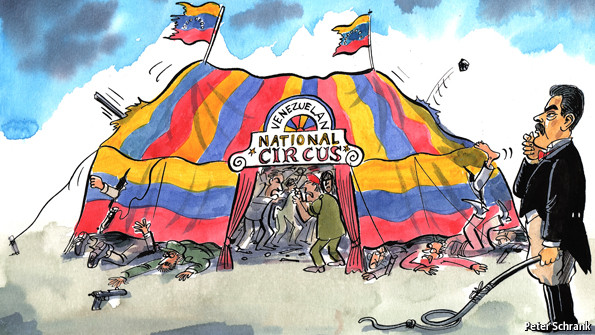
During the presidency of Hugo Chávez, who ruled from 1999 until his death from cancer in March, the domineering personality of the comandante left no doubt as to who was in charge of Venezuela. By contrast Chávez’s successor, Nicolás Maduro, a former foreign minister, has yet to convince people that he is the one running the show. His disputed, razor-thin election victory on April 14th undermined his legitimacy (indeed, the supreme court has yet to resolve the opposition’s claim of fraud). Now the president faces problems within the ranks of the ruling coalition, and in particular his United Socialist Party of Venezuela (PSUV). In the absence of Chávez, there are worries that the PSUV will turn out to be held together, as the colourful Venezuelan metaphor has it, “with parrot spit”.

Fourteen years of chavismo have left the country in a mess. Despite the high price of oil, growth this year will be minimal or negative. Thousands of private companies have gone under, dragged down by regulations and threatened with fines, temporary closure or expropriation. Others have switched from production to importing. Even that is losing its appeal, now that foreign-exchange control mechanisms have seized up and dollars are scarce. Mr Maduro has sought to deal with the concerns of ordinary Venezuelans, as well as striking radical poses to please hard-core chavistas. Crime, poor public services, corruption and food-scarcity have been targeted with loudly trumpeted initiatives. But actually solving these problems will mean confronting powerful interests, and here Mr Maduro has little room for manoeuvre.

Moderates were encouraged when early in his presidency Mr Maduro sidelined Jorge Giordani, Chávez’s Marxist finance minister, and brought in Nelson Merentes, a former governor of the Central Bank who is seen as more ideologically flexible. But subsequent appointments seem designed to appease other interests. Amid talks with the private sector on how to get the wheels of commerce turning again, Mr Maduro last month reappointed Eduardo Samán head of the powerful consumer-protection body, a post he held under Chávez. A self-proclaimed “ultra-radical”, Mr Samán believes that inflation (heading for 40% a year) and empty supermarket shelves are caused by private-sector hoarding and speculation. “Humanity”, he has written, “will succeed in solving the food crisis only with the end of capitalism.”

Tentative efforts to tame corruption have also been undermined by a need to stay on friendly terms with the Chávez clan. On June 12th Argenis Chávez, the late president’s crafty youngest brother, was appointed head of the body that controls the administration of the justice system. On his brother’s watch, the younger Chávez had led the electricity ministry as well as Corpoelec, the graft-riddled state-run electricity giant. On becoming president, Mr Maduro quickly booted him out of both jobs. His return to office demonstrates the enduring power of the Chávez clan, as well as Mr Maduro’s willingness to subordinate the justice system to his political requirements.

Managing these rival factions has forced the PSUV to suspend internal party democracy. Grass-roots chavista radicals had backed Mr Samán’s bid to stand for mayor of Caracas. But party leaders, who see Mr Samán as a loose cannon, ruled out holding a primary that he might have won. Now the PSUV has cancelled all the primaries that were to have been held ahead of local elections, which have been postponed until December 8th. It remains to be seen whether choosing candidates by executive fiat will ruffle fewer feathers than the primaries would have done.

Our man in Havana

Rumours swirl that Mr Maduro could face a more immediate challenge to his own leadership. In a recorded conversation that was leaked on May 20th Mario Silva, the presenter of a state-television talk-show called “The Razor Blade”, was heard apparently passing information to a Cuban intelligence officer. In the recording Mr Silva warned the spy that Diosdado Cabello, the speaker of the National Assembly, wanted to overthrow Mr Maduro. It was a matter of urgency, he said, to cut off Mr Cabello’s sources of income, including the tax authority, which is run by his brother, José David Cabello. A few weeks later police arrested members of an alleged gang within the customs agency, which is part of the tax authority.

A former lieutenant who took part in a failed coup by Chávez in 1992, Mr Cabello has powerful friends in the army. The annual round of military promotions, due to be announced as The Economist went to press, may strengthen his hand. Henrique Capriles, the leader of the opposition, jeers that Mr Maduro’s role is confined to signing the promotions list. “Nicolás, you’re a laughing stock in the armed forces,” Mr Capriles tweeted.

During the presidential election campaign, Mr Maduro was seen as the favoured candidate not just of his predecessor but also of Cuba, Venezuela’s closest ally. A month ago, however, Mr Cabello made a three-day visit to Havana, holding meetings with President Raúl Castro and his brother, Fidel. The trip came shortly after the leaking of the Silva recording. No one knows what sort of deal the Cubans may have struck with Mr Cabello. For the moment, he and Mr Maduro are locked in a macho Latin embrace, of the kind some say was devised as a way for each man to frisk the other for weapons.

To read this article at The Economist, please click here.

 
Apr
23
2013
Posted by
admin
Comments

Amid Accusations of Fraud, Venezuela’s Officials Allow Vote Audit

gty capriles vote wg e1366725586108 Amid Accusations of Fraud, Venezuela’s Officials Allow Vote Audit

Courtesy of: Getty Photos

Political uncertainty was reignited in Venezuela last week after electoral authorities stunned the country by announcing Hugo Chávez’s handpicked successor as the winner of the election, but with a razor-thin margin of victory. The underperformance of Nicolás Maduro – combined with daily protests, allegations of fraud, international pressure and the numerous economic and social problems within the country – have descended Venezuela into significant tension and uncertainty.

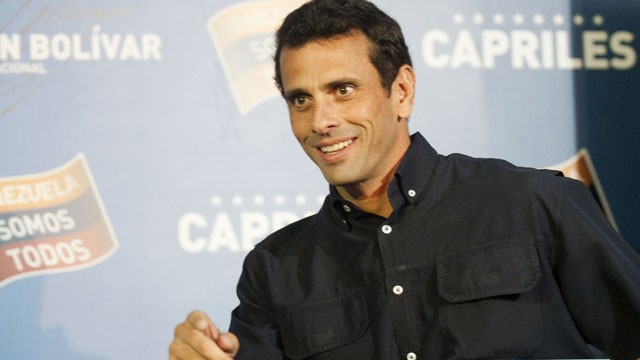
Citing irregularities in the election process, opposition leader Henrique Capriles refused to recognize the election’s validity, demanding a full manual recount of the votes. Numerous international actors, including the United States, Spain and the Organization of American States sided with the opposition, declaring the recount an important and necessary step to instill confidence in the results. Denied the recount at first, opposition supporters around the country banged pots and pans in a traditional sign of protest. A large march to the Election Council was canceled, however, after Maduro ominously vowed to come down with a “firm hand” on opposition supporters.

After days of protests – and just hours before Nicolás Maduro’s swearing-in – the government announced on Friday that it would allow a full “audit” of the vote. Venezuela uses electronic voting machines to record votes that provide a printed receipt which is placed into a sealed ballot box. As is protocol, electoral authorities initially audited 54 percent of the electronic votes. Now, they have conceded to audit the remaining 46 percent. Though the expanded audit is not a full manual recount as originally requested, Capriles accepted the election authority’s ruling. The audit will involve counting the paper ballots in 12,000 voting machines at random stations to ensure they are consistent with the machine-tallied results.

Capriles has cited significant evidence for why a full recount must be undertaken. The opposition has asserted that among the irregularities, there were 535 malfunctioning voting machines, election monitors were forcibly removed from 286 centers and 564 centers evidenced government-assisted voting. Even more peculiar was that Maduro received more votes than Chávez in 1,176 polling stations, with some precincts seeing Maduro surpass the beloved leader by nearly 1,000 percent. In addition, more than 100,000 Venezuelans who turned 18 in the past six months were not given an opportunity to register to vote, while more than 500,000 Venezuelans living in exile have been denied voter registration. Given that Capriles only lost by approximately 200,000 votes, verification of fraud in any of these instances could reveal information that may reverse the final results or necessitate a partial repeat of the election.

The audit is expected to begin sometime this week, but will likely take approximately one month to complete. However, despite the Election Council’s decision to review the results, Maduro was formally sworn in on Friday. Analysts compared the event to a rally held in January on the day Chávez was to be sworn in, but unable to attend. Despite their leader’s absence, tens of thousands of people showed up to take the oath of office on his behalf. Maduro did not enjoy such treatment, however. While thousands of people showed up on Friday to welcome their new president, the crowd was a far cry from the one in January – another clear example that he lacks the charisma and popularity of “el Comandante.”

On Sunday, Maduro went even further, announcing his new cabinet. He showed little variation from Chávez, recycling former ministers into new positions and bringing current and former military officers to top administrative jobs. The greatest surprise was the change in the leadership of the Finance Ministry. Jorge Giordani, a declared Marxist and Chávez long-time ally who is often credited as the architect of the socialist economic policies and controls, will retain his post as planning minister but will no longer oversee the Finance Ministry.

Though tensions simmered after the Election Committee vowed to audit the results, both camps have yet to agree on its true meaning. While Maduro builds his government and begins to instill orders, a near majority of the country hopefully awaits the recount, desperately hoping for a new day in Venezuela.

 
Feb
11
2013
Posted by
admin
Comments

ICYMI: Venezuela Devalues Currency Amid Shortages and Inflation

The New York Times
February 8, 2013
By William Neuman

i9PEnScXh8Xg e1360609789680 ICYMI: Venezuela Devalues Currency Amid Shortages and Inflation

Courtesy of: Bloomberg News

CARACAS, Venezuela — Venezuela announced Friday that it was devaluing its currency, a step that had long been deemed necessary but could push the spiking inflation even higher.

The devaluation, which lowered the currency’s value against the dollar by nearly a third, was aimed at solidifying government finances and easing a tight market for dollars that has choked back imports and led to shortages of basic goods.

The move had been widely anticipated, but it had been unclear whether officials would make what could be a politically risky decision with President Hugo Chávez still out of the country after undergoing cancer surgery in Cuba on Dec. 11.

If Mr. Chávez were to die or were too ill to continue as president, a special election would have to be called, and many analysts thought that the government might try to postpone a devaluation until after that occurred.

“It is a sign of pragmatism that they carry out a devaluation even though we’re all aware there is some likelihood of a presidential election being held soon,” said Francisco Rodríguez, an economist with Bank of America Merrill Lynch. “This shows that they’re willing to correct basic economic distortions.”

The currency, the bolívar, will be set at 6.3 to the dollar. It had been set at 4.3.

Venezuela’s finance minister, Jorge Giordani, said that Mr. Chávez, who has not been seen or heard in public for more than eight weeks, had approved the measures.

“Here is the president’s signature if you want to recognize it or if you still have doubts,” Mr. Giordani said, holding up a document during a televised news conference.

The devaluation will help the government balance its books by giving it more bolívars for the dollars it earns selling oil on the world market. Venezuela’s economy is highly dependent on oil, with petroleum sales making up about 95 percent of total exports. The country is the fourth-largest foreign oil supplier to the United States.

Government spending soared last year during the campaign to re-elect Mr. Chávez, leading to a large deficit, even though, at more than $100 a barrel, the price of oil is very high.

Pressure to devalue had been building for months, as the black market exchange rate rose to more than four times the official rate. The imbalance was evident in the prices of many goods. A Big Mac at McDonald’s costs 70 bolívars, or $16.27, at the official pre-devaluation rate.

But the devaluation will also make imported goods more expensive, which will probably make inflation worse. Inflation for the 12 months ended on Jan. 31 was 22.2 percent, one of the highest rates in Latin America.

Surging inflation could cause political problems for the government. But the exchange rate had reduced the dollars available to importers, leading to shortages of goods like sugar, chicken and toilet paper. Many analysts believe that voters blame the government more for shortages than for inflation.

To read this article at The New York Times, please click here.