Jul
8
2013
Posted by
admin
Comments

ICYMI: A circus without a ringmaster

The Economist
July 6, 2013
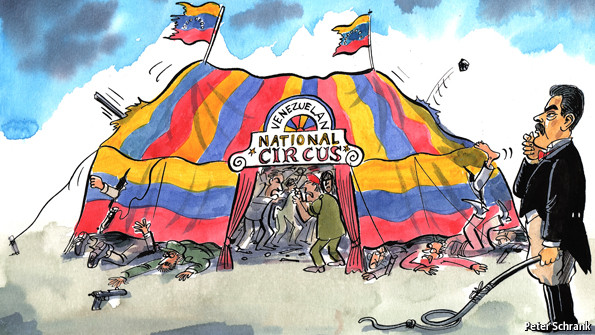
20130706 AMD001 0 e1373308466257 ICYMI: A circus without a ringmaster

Courtesy of: The Economist/Peter Schrank

During the presidency of Hugo Chávez, who ruled from 1999 until his death from cancer in March, the domineering personality of the comandante left no doubt as to who was in charge of Venezuela. By contrast Chávez’s successor, Nicolás Maduro, a former foreign minister, has yet to convince people that he is the one running the show. His disputed, razor-thin election victory on April 14th undermined his legitimacy (indeed, the supreme court has yet to resolve the opposition’s claim of fraud). Now the president faces problems within the ranks of the ruling coalition, and in particular his United Socialist Party of Venezuela (PSUV). In the absence of Chávez, there are worries that the PSUV will turn out to be held together, as the colourful Venezuelan metaphor has it, “with parrot spit”.

Fourteen years of chavismo have left the country in a mess. Despite the high price of oil, growth this year will be minimal or negative. Thousands of private companies have gone under, dragged down by regulations and threatened with fines, temporary closure or expropriation. Others have switched from production to importing. Even that is losing its appeal, now that foreign-exchange control mechanisms have seized up and dollars are scarce. Mr Maduro has sought to deal with the concerns of ordinary Venezuelans, as well as striking radical poses to please hard-core chavistas. Crime, poor public services, corruption and food-scarcity have been targeted with loudly trumpeted initiatives. But actually solving these problems will mean confronting powerful interests, and here Mr Maduro has little room for manoeuvre.

Moderates were encouraged when early in his presidency Mr Maduro sidelined Jorge Giordani, Chávez’s Marxist finance minister, and brought in Nelson Merentes, a former governor of the Central Bank who is seen as more ideologically flexible. But subsequent appointments seem designed to appease other interests. Amid talks with the private sector on how to get the wheels of commerce turning again, Mr Maduro last month reappointed Eduardo Samán head of the powerful consumer-protection body, a post he held under Chávez. A self-proclaimed “ultra-radical”, Mr Samán believes that inflation (heading for 40% a year) and empty supermarket shelves are caused by private-sector hoarding and speculation. “Humanity”, he has written, “will succeed in solving the food crisis only with the end of capitalism.”

Tentative efforts to tame corruption have also been undermined by a need to stay on friendly terms with the Chávez clan. On June 12th Argenis Chávez, the late president’s crafty youngest brother, was appointed head of the body that controls the administration of the justice system. On his brother’s watch, the younger Chávez had led the electricity ministry as well as Corpoelec, the graft-riddled state-run electricity giant. On becoming president, Mr Maduro quickly booted him out of both jobs. His return to office demonstrates the enduring power of the Chávez clan, as well as Mr Maduro’s willingness to subordinate the justice system to his political requirements.

Managing these rival factions has forced the PSUV to suspend internal party democracy. Grass-roots chavista radicals had backed Mr Samán’s bid to stand for mayor of Caracas. But party leaders, who see Mr Samán as a loose cannon, ruled out holding a primary that he might have won. Now the PSUV has cancelled all the primaries that were to have been held ahead of local elections, which have been postponed until December 8th. It remains to be seen whether choosing candidates by executive fiat will ruffle fewer feathers than the primaries would have done.

Our man in Havana

Rumours swirl that Mr Maduro could face a more immediate challenge to his own leadership. In a recorded conversation that was leaked on May 20th Mario Silva, the presenter of a state-television talk-show called “The Razor Blade”, was heard apparently passing information to a Cuban intelligence officer. In the recording Mr Silva warned the spy that Diosdado Cabello, the speaker of the National Assembly, wanted to overthrow Mr Maduro. It was a matter of urgency, he said, to cut off Mr Cabello’s sources of income, including the tax authority, which is run by his brother, José David Cabello. A few weeks later police arrested members of an alleged gang within the customs agency, which is part of the tax authority.

A former lieutenant who took part in a failed coup by Chávez in 1992, Mr Cabello has powerful friends in the army. The annual round of military promotions, due to be announced as The Economist went to press, may strengthen his hand. Henrique Capriles, the leader of the opposition, jeers that Mr Maduro’s role is confined to signing the promotions list. “Nicolás, you’re a laughing stock in the armed forces,” Mr Capriles tweeted.

During the presidential election campaign, Mr Maduro was seen as the favoured candidate not just of his predecessor but also of Cuba, Venezuela’s closest ally. A month ago, however, Mr Cabello made a three-day visit to Havana, holding meetings with President Raúl Castro and his brother, Fidel. The trip came shortly after the leaking of the Silva recording. No one knows what sort of deal the Cubans may have struck with Mr Cabello. For the moment, he and Mr Maduro are locked in a macho Latin embrace, of the kind some say was devised as a way for each man to frisk the other for weapons.

To read this article at The Economist, please click here.


Sep
26
2012
Posted by
admin
Comments

ICYMI: Chávez Rival Rises in Venezuela Polls

The Wall Street Journal
September 25, 2012
By Ezequiel Minaya and David Luhnow

WO AL212 VENEZU G 20120925184402 ICYMI: Chávez Rival Rises in Venezuela Polls

Courtesy of: Zuma Press

CARACAS—Venezuelan opposition politician Henrique Capriles is gaining ground on President Hugo Chávez two weeks before a presidential election in this highly polarized country.

A pair of surveys published Tuesday showed a tighter race for the Oct. 7 election than many had expected. Local pollster Varianzas had Mr. Chávez, who has been in power nearly 14 years and seeks a new six-year term, with a 49.7% to 47.7% lead, within the poll’s margin of error.

Datanálisis, one of Venezuela’s most respected pollsters, showed Mr. Chávez with a larger 10-point lead—47% to 37%. But even in the Datanálisis poll, which has a margin of error of 2.4%, Mr. Chávez’s lead may not be as safe as it sounds. Since April, Mr. Capriles has closed the gap to 10 points from 17 points, suggesting the 40-year-old state governor is winning over undecided voters.

The Datanálisis survey showed as many as 15% of the electorate still undecided—a margin bigger than Mr. Chávez’s lead. If that group turns out to vote on Election Day, and favors Mr. Capriles—two big ifs—the gap virtually disappears.

“The chances of a victory for the opposition are higher than what the market is pricing,” wrote Alejandro Grisanti, an analyst for Barclays, in a note to clients following the Datanálisis poll results. Investors in the past week have bid down the price of Venezuela’s 10-year bonds, anticipating a Chávez win.

For much of the past year, Mr. Chávez, 58 years old, has held a commanding lead in most polls. His government has ramped up social spending and used its control of most television and radio to flood the airwaves with ads.

But the race has tightened thanks to an intensive door-to-door campaign from Mr. Capriles, a center-left candidate who has worked hard to reassure Venezuela’s poor majority that he will keep Mr. Chávez’s popular social programs intact.

“Capriles is the best candidate the opposition has put up against Chávez,” said Luis Vicente Leon, head of Datanálisis.

Mr. Chávez, meanwhile, has been much less active on the campaign trail. The Venezuelan leader is hampered by health concerns after a yearlong battle with cancer, and his government hasn’t disclosed the cancer type or its prognosis. Mr. Chávez claims he is cured.

“He is sick or he was,” Mr. Leon said. “What is clear is that he does not have [Capriles's] vitality.”

Meanwhile, another big local pollster, Consultores 21, had Mr. Capriles ahead by two percentage points in a recent poll. The poll registered only 5% undecided voters. “The important number to look at is support for Chávez, and virtually all polls agree that he is just under 50%,” said Luis Christiansen, the company’s pollster. “As long as he’s under that level, he’s very vulnerable.”

A close election provides an opportunity for Venezuela to end the rule of Mr. Chávez, a former army tank commander who has nationalized much of the economy, used high oil prices to ramp up public spending on the poor, and critics say polarized Venezuelans by pitting the poor against the middle and upper classes—what Mr. Chávez calls “los escualidos,” or “the squalid ones.”

But a contested election also raises risks of instability in the country with the world’s largest oil reserves that is a major oil exporter to the U.S. Some analysts wonder whether Mr. Chávez or his impassioned supporters would be willing to give up power in the case of a narrow loss.

“Listen, if Chávez loses, then I’m taking to the streets,” said Felicita Gerome, a 77-year-old retiree in the 23 de Enero neighborhood, which is home to pro-Chávez militias.

During the campaign, Chávez supporters have on occasion tried to physically prevent the Capriles campaign from entering poor neighborhoods, known as “barrios.” On a recent day in the coastal town of Puerto Cabello, Chávez supporters burned several trucks belonging to the Capriles camp.

Mr. Chávez hasn’t publicly mentioned the periodic clashes between his supporters and the opposition. He does say his government is the only hope for stability and peace for Venezuela.

Despite the narrowing race, Mr. Leon suggests Mr. Chávez still has the upper hand. In an interview before the latest results, Mr. Leon said that in past presidential elections, many of the undecided voters in polls stayed at home—giving Mr. Chávez comfortable victories.

In slums surrounding Caracas, the capital, it is easy to find support for the president. Jesus Alberto Mijares, a 57 year-old bus driver, said he was voting for Mr. Chávez because of social programs like Barrio Adentro, which provides free basic health care in small clinics staffed by Cuban doctors. “Before Chávez, we never saw doctors in the barrios. The Cubans even make house calls,” said Mr. Mijares, who says he has been treated several times for ulcers.

In many barrios, however, there is also a growing sense that it is time for a change, even among those who have voted for Mr. Chávez in the past.

“Someone in power too long becomes accustomed to power, and becomes a dictator,” said Darleny Osorio, a 56-year-old teacher in the Ruiz Pineda barrio. She said she has always voted for Mr. Chávez—but no longer.

Write to Ezequiel Minaya at [email protected] and David Luhnow at [email protected].

To read this article on The Wall Street Journal, please click here.

 
Sep
25
2012
Posted by
admin
Comments

Chávez Rival Rises in Venezuela Polls

The Wall Street Journal
September 25, 2012
By Ezequiel Minaya and David Luhnow

WO AL212 VENEZU G 20120925184402 Chávez Rival Rises in Venezuela Polls

Courtesy of: Zuma Press

CARACAS—Venezuelan opposition politician Henrique Capriles is gaining ground on President Hugo Chávez two weeks before a presidential election in this highly polarized country.

A pair of surveys published Tuesday showed a tighter race for the Oct. 7 election than many had expected. Local pollster Varianzas had Mr. Chávez, who has been in power nearly 14 years and seeks a new six-year term, with a 49.7% to 47.7% lead, within the poll’s margin of error.

Datanálisis, one of Venezuela’s most respected pollsters, showed Mr. Chávez with a larger 10-point lead—47% to 37%. But even in the Datanálisis poll, which has a margin of error of 2.4%, Mr. Chávez’s lead may not be as safe as it sounds. Since April, Mr. Capriles has closed the gap to 10 points from 17 points, suggesting the 40-year-old state governor is winning over undecided voters.

The Datanálisis survey showed as many as 15% of the electorate still undecided—a margin bigger than Mr. Chávez’s lead. If that group turns out to vote on Election Day, and favors Mr. Capriles—two big ifs—the gap virtually disappears.

“The chances of a victory for the opposition are higher than what the market is pricing,” wrote Alejandro Grisanti, an analyst for Barclays, in a note to clients following the Datanalysis poll results. Investors in the past week have bid down the price of Venezuela’s 10-year bonds, anticipating a Chávez win.

For much of the past year, Mr. Chávez, 58 years old, has held a commanding lead in most polls. His government has ramped up social spending and used its control of most television and radio to flood the airwaves with ads.

But the race has tightened thanks to an intensive door-to-door campaign from Mr. Capriles, a center-left candidate who has worked hard to reassure Venezuela’s poor majority that he will keep Mr. Chávez’s popular social programs intact.

“Capriles is the best candidate the opposition has put up against Chávez,” said Luis Vicente Leon, head of Datanálisis.

Mr. Chávez, meanwhile, has been much less active on the campaign trail. The Venezuelan leader is hampered by health concerns after a yearlong battle with cancer, and his government hasn’t disclosed the cancer type or its prognosis. Mr. Chávez claims he is cured.

“He is sick or he was,” Mr. Leon said. “What is clear is that he does not have [Capriles's] vitality.”

Meanwhile, another big local pollster, Consultores 21, had Mr. Capriles ahead by two percentage points in a recent poll. The poll registered only 5% undecided voters. “The important number to look at is support for Chávez, and virtually all polls agree that he is just under 50%,” said Luis Christiansen, the company’s pollster. “As long as he’s under that level, he’s very vulnerable.”

A close election provides an opportunity for Venezuela to end the rule of Mr. Chávez, a former army tank commander who has nationalized much of the economy, used high oil prices to ramp up public spending on the poor, and critics say polarized Venezuelans by pitting the poor against the middle and upper classes—what Mr. Chávez calls “los escualidos,” or “the squalid ones.”

But a contested election also raises risks of instability in the country with the world’s largest oil reserves that is a major oil exporter to the U.S. Some analysts wonder whether Mr. Chávez or his impassioned supporters would be willing to give up power in the case of a narrow loss.

“Listen, if Chávez loses, then I’m taking to the streets,” said Felicita Gerome, a 77-year-old retiree in the 23 de Enero neighborhood, which is home to pro-Chávez militias.

During the campaign, Chávez supporters have on occasion tried to physically prevent the Capriles campaign from entering poor neighborhoods, known as “barrios.” On a recent day in the coastal town of Puerto Cabello, Chávez supporters burned several trucks belonging to the Capriles camp.

Mr. Chávez hasn’t publicly mentioned the periodic clashes between his supporters and the opposition. He does say his government is the only hope for stability and peace for Venezuela.

Despite the narrowing race, Mr. Leon suggests Mr. Chávez still has the upper hand. In an interview before the latest results, Mr. Leon said that in past presidential elections, many of the undecided voters in polls stayed at home—giving Mr. Chávez comfortable victories.

In slums surrounding Caracas, the capital, it is easy to find support for the president. Jesus Alberto Mijares, a 57 year-old bus driver, said he was voting for Mr. Chávez because of social programs like Barrio Adentro, which provides free basic health care in small clinics staffed by Cuban doctors. “Before Chávez, we never saw doctors in the barrios. The Cubans even make house calls,” said Mr. Mijares, who says he has been treated several times for ulcers.

In many barrios, however, there is also a growing sense that it is time for a change, even among those who have voted for Mr. Chávez in the past.

“Someone in power too long becomes accustomed to power, and becomes a dictator,” said Darleny Osorio, a 56-year-old teacher in the Ruiz Pineda barrio. She said she has always voted for Mr. Chávez—but no longer.

Write to Ezequiel Minaya at [email protected] and David Luhnow at [email protected].

To read this article on The Wall Street Journal, please click here.