Mar
29
2013
Posted by
admin
Comments

In Case You Missed It… Articles Roundup Week of 3/29/13

 In Case You Missed It… Articles Roundup Week of 3/29/13

Courtesy of: Reuters

This week:  With the presidential elections nearing, Venezuela’s “precampaign” season is off to a roaring start, with Interim President Nicolás Maduro enjoying uncontrolled access to state media; on the campaign trail and beyond, Maduro’s gimmicks reach a new level of absurdity, even for Venezuelan politics; opposition leader Henrique Capriles casts this election a war between “good vs. evil,” as he is faced with the underdog label; and Transparency International continues to document the continued  abuse of state resources for political purposes in Venezuela. Despite government promises that vigorous growth would take place in Venezuela, the economy  showed signs of slowdown in 2012; Venezuelan state oil company PDVSA’s 2012 revenue slips 0.2 percent, despite an increase in oil prices; surrounded by secrecy, the Venezuelan government offers $200 million during its first auction on a new foreign currency system; however, the nation’s failure to disclose exchange rate in Venezuela currency auction prompts Barclays Capital to suggest a strong devaluation of the local currency for the second time in two months; and Maduro threatens creators of a popular website that provides transparency about currency exchange rates, ordering their indictment and jailing. Mismatches between UNESCO figures and “education miracles” claimed by the Venezuelan government are revealed; at the UN Human Rights Council, Maduro is the sole leader to side with the Syrian Government of Bashar Al-Assad; Alfredo Romero, a human rights advocate, reports that around 4,500 people have been killed under the 100 day rule of Maduro; and in a effort to further inject the name and legacy of Chávez into the upcoming election, a Venezuelan-run TV station releases an ad of Chávez in heaven.

Venezuela’s precampaign season off to a roaring start, The Christian Science Monitor

Let’s recap of the first seven days of non-campaign campaigning, or in criollo doublespeak: pre-campaña.

Venezuela’s presidential campaign is devolving into a spectacle, Foreign Policy

Nicolás Maduro, the interim president of Venezuela, held a campaign rally the other night, where his supporters held up an oversized check — similar to those used on game shows — symbolically made out to “the people of Venezuela.”

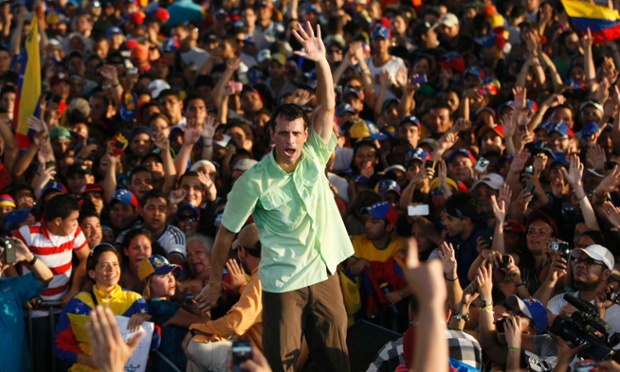
Capriles: Venezuela campaign a war of good vs evil, AFP

Venezuelan opposition candidate Henrique Capriles raised the rhetorical stakes Sunday, casting his campaign against interim president Nicolas Maduro as a spiritual struggle of good versus evil.

Venezuela: The State as Election Campaign Headquarters, Transparency International

When is a presidential election free and fair?  During the 2012 presidential campaign in Venezuela, the Alerta Electoral bulletin recorded numerous instances of public resources being used to support the president’s successful election campaign.

Venezuelan economy shows signs of slowdown, El Universal

After the Venezuelan economy gained 5.5% over the last quarter of 2012, the economic cabinet promised that throughout this year, vigorous growth would take place, but actual results are flashing warning signs.

Venezuela’s PDVSA revenue slips on domestic fuel sales, Reuters

Venezuelan state oil company PDVSA’s 2012 revenue slipped 0.2 percent from the year before despite an increase in oil prices as the company sold more fuel on the subsidized domestic market, the oil minister said Friday.

Venezuela launches first auction of new forex system, Reuters

Venezuela offered $200 million to local businesses on Monday in the first auction of a new foreign currency system that will bring another partial devaluation of the bolivar.

Barclays Capital: Blinding Sicad exchange rate hints strong devaluation, El Universal

Venezuela’s Ministry of Planning and Finance briefed on Wednesday on the outcome of the first foreign currency auction through the Ancillary Foreign Currency Administration System (Sicad).

Venezuela interim president Maduro takes on currency exchange website, Miami Herald

Venezuela’s interim president, Nicolás Maduro, came out Tuesday fighting the acute depreciation of the bolivar against the U.S. dollar by ordering the indictment and jailing of the creators of lechuga.com, a popular website that thousands of Venezuelans consult everyday to check currency exchange quotes in the parallel market.

Mismatch between actual figures and “education miracles” claimed by gov’t, El Universal

On Saturday, March 16, during the posthumous tribute to President Hugo Chavez by groups involved in government-sponsored welfare programs, known as missions, Vice-President of the Social Area and Minister of University Education Yadira Córdoba announced that the Robinson Mission had been a pathway to literacy for 1,756,250 people.

Nicolás Maduro and the Gorillas, Latin American Herald Tribune

Venezuela just showed off spectacularly at the United Nations Human Rights Council: It cast the only vote, out of 47 members comprising the entity, to side with the Syrian Government of Bashar Al-Assad, the most repudiated genocidal leader for having led his country to a civil war with a death toll of over 70,000 dead people, hundreds of thousands wounded and a far-reaching physical and economic devastation.

HR advocate: 4,500 people killed in Venezuela under Nicolás Maduro, El Universal

Lawyer and human rights advocate Alfredo Romero underscored that some 4,500 people have been killed in the first 100 days of acting President Nicolás Maduro’s government.

Venezuelan state-run TV shows Chávez in the afterlife, The Miami Herald

Venezuela’s Hugo Chávez may be gone but he’s among revolutionary friends. An animated spot being broadcast on state-run television shows the socialist firebrand, who died March 5, looking morose as he walks through a grassy field.

 
Sep
26
2012
Posted by
admin
Comments

ICYMI: Chávez Rival Rises in Venezuela Polls

The Wall Street Journal
September 25, 2012
By Ezequiel Minaya and David Luhnow

WO AL212 VENEZU G 20120925184402 ICYMI: Chávez Rival Rises in Venezuela Polls

Courtesy of: Zuma Press

CARACAS—Venezuelan opposition politician Henrique Capriles is gaining ground on President Hugo Chávez two weeks before a presidential election in this highly polarized country.

A pair of surveys published Tuesday showed a tighter race for the Oct. 7 election than many had expected. Local pollster Varianzas had Mr. Chávez, who has been in power nearly 14 years and seeks a new six-year term, with a 49.7% to 47.7% lead, within the poll’s margin of error.

Datanálisis, one of Venezuela’s most respected pollsters, showed Mr. Chávez with a larger 10-point lead—47% to 37%. But even in the Datanálisis poll, which has a margin of error of 2.4%, Mr. Chávez’s lead may not be as safe as it sounds. Since April, Mr. Capriles has closed the gap to 10 points from 17 points, suggesting the 40-year-old state governor is winning over undecided voters.

The Datanálisis survey showed as many as 15% of the electorate still undecided—a margin bigger than Mr. Chávez’s lead. If that group turns out to vote on Election Day, and favors Mr. Capriles—two big ifs—the gap virtually disappears.

“The chances of a victory for the opposition are higher than what the market is pricing,” wrote Alejandro Grisanti, an analyst for Barclays, in a note to clients following the Datanálisis poll results. Investors in the past week have bid down the price of Venezuela’s 10-year bonds, anticipating a Chávez win.

For much of the past year, Mr. Chávez, 58 years old, has held a commanding lead in most polls. His government has ramped up social spending and used its control of most television and radio to flood the airwaves with ads.

But the race has tightened thanks to an intensive door-to-door campaign from Mr. Capriles, a center-left candidate who has worked hard to reassure Venezuela’s poor majority that he will keep Mr. Chávez’s popular social programs intact.

“Capriles is the best candidate the opposition has put up against Chávez,” said Luis Vicente Leon, head of Datanálisis.

Mr. Chávez, meanwhile, has been much less active on the campaign trail. The Venezuelan leader is hampered by health concerns after a yearlong battle with cancer, and his government hasn’t disclosed the cancer type or its prognosis. Mr. Chávez claims he is cured.

“He is sick or he was,” Mr. Leon said. “What is clear is that he does not have [Capriles's] vitality.”

Meanwhile, another big local pollster, Consultores 21, had Mr. Capriles ahead by two percentage points in a recent poll. The poll registered only 5% undecided voters. “The important number to look at is support for Chávez, and virtually all polls agree that he is just under 50%,” said Luis Christiansen, the company’s pollster. “As long as he’s under that level, he’s very vulnerable.”

A close election provides an opportunity for Venezuela to end the rule of Mr. Chávez, a former army tank commander who has nationalized much of the economy, used high oil prices to ramp up public spending on the poor, and critics say polarized Venezuelans by pitting the poor against the middle and upper classes—what Mr. Chávez calls “los escualidos,” or “the squalid ones.”

But a contested election also raises risks of instability in the country with the world’s largest oil reserves that is a major oil exporter to the U.S. Some analysts wonder whether Mr. Chávez or his impassioned supporters would be willing to give up power in the case of a narrow loss.

“Listen, if Chávez loses, then I’m taking to the streets,” said Felicita Gerome, a 77-year-old retiree in the 23 de Enero neighborhood, which is home to pro-Chávez militias.

During the campaign, Chávez supporters have on occasion tried to physically prevent the Capriles campaign from entering poor neighborhoods, known as “barrios.” On a recent day in the coastal town of Puerto Cabello, Chávez supporters burned several trucks belonging to the Capriles camp.

Mr. Chávez hasn’t publicly mentioned the periodic clashes between his supporters and the opposition. He does say his government is the only hope for stability and peace for Venezuela.

Despite the narrowing race, Mr. Leon suggests Mr. Chávez still has the upper hand. In an interview before the latest results, Mr. Leon said that in past presidential elections, many of the undecided voters in polls stayed at home—giving Mr. Chávez comfortable victories.

In slums surrounding Caracas, the capital, it is easy to find support for the president. Jesus Alberto Mijares, a 57 year-old bus driver, said he was voting for Mr. Chávez because of social programs like Barrio Adentro, which provides free basic health care in small clinics staffed by Cuban doctors. “Before Chávez, we never saw doctors in the barrios. The Cubans even make house calls,” said Mr. Mijares, who says he has been treated several times for ulcers.

In many barrios, however, there is also a growing sense that it is time for a change, even among those who have voted for Mr. Chávez in the past.

“Someone in power too long becomes accustomed to power, and becomes a dictator,” said Darleny Osorio, a 56-year-old teacher in the Ruiz Pineda barrio. She said she has always voted for Mr. Chávez—but no longer.

Write to Ezequiel Minaya at [email protected] and David Luhnow at [email protected].

To read this article on The Wall Street Journal, please click here.

 
Sep
25
2012
Posted by
admin
Comments

Chávez Rival Rises in Venezuela Polls

The Wall Street Journal
September 25, 2012
By Ezequiel Minaya and David Luhnow

WO AL212 VENEZU G 20120925184402 Chávez Rival Rises in Venezuela Polls

Courtesy of: Zuma Press

CARACAS—Venezuelan opposition politician Henrique Capriles is gaining ground on President Hugo Chávez two weeks before a presidential election in this highly polarized country.

A pair of surveys published Tuesday showed a tighter race for the Oct. 7 election than many had expected. Local pollster Varianzas had Mr. Chávez, who has been in power nearly 14 years and seeks a new six-year term, with a 49.7% to 47.7% lead, within the poll’s margin of error.

Datanálisis, one of Venezuela’s most respected pollsters, showed Mr. Chávez with a larger 10-point lead—47% to 37%. But even in the Datanálisis poll, which has a margin of error of 2.4%, Mr. Chávez’s lead may not be as safe as it sounds. Since April, Mr. Capriles has closed the gap to 10 points from 17 points, suggesting the 40-year-old state governor is winning over undecided voters.

The Datanálisis survey showed as many as 15% of the electorate still undecided—a margin bigger than Mr. Chávez’s lead. If that group turns out to vote on Election Day, and favors Mr. Capriles—two big ifs—the gap virtually disappears.

“The chances of a victory for the opposition are higher than what the market is pricing,” wrote Alejandro Grisanti, an analyst for Barclays, in a note to clients following the Datanalysis poll results. Investors in the past week have bid down the price of Venezuela’s 10-year bonds, anticipating a Chávez win.

For much of the past year, Mr. Chávez, 58 years old, has held a commanding lead in most polls. His government has ramped up social spending and used its control of most television and radio to flood the airwaves with ads.

But the race has tightened thanks to an intensive door-to-door campaign from Mr. Capriles, a center-left candidate who has worked hard to reassure Venezuela’s poor majority that he will keep Mr. Chávez’s popular social programs intact.

“Capriles is the best candidate the opposition has put up against Chávez,” said Luis Vicente Leon, head of Datanálisis.

Mr. Chávez, meanwhile, has been much less active on the campaign trail. The Venezuelan leader is hampered by health concerns after a yearlong battle with cancer, and his government hasn’t disclosed the cancer type or its prognosis. Mr. Chávez claims he is cured.

“He is sick or he was,” Mr. Leon said. “What is clear is that he does not have [Capriles's] vitality.”

Meanwhile, another big local pollster, Consultores 21, had Mr. Capriles ahead by two percentage points in a recent poll. The poll registered only 5% undecided voters. “The important number to look at is support for Chávez, and virtually all polls agree that he is just under 50%,” said Luis Christiansen, the company’s pollster. “As long as he’s under that level, he’s very vulnerable.”

A close election provides an opportunity for Venezuela to end the rule of Mr. Chávez, a former army tank commander who has nationalized much of the economy, used high oil prices to ramp up public spending on the poor, and critics say polarized Venezuelans by pitting the poor against the middle and upper classes—what Mr. Chávez calls “los escualidos,” or “the squalid ones.”

But a contested election also raises risks of instability in the country with the world’s largest oil reserves that is a major oil exporter to the U.S. Some analysts wonder whether Mr. Chávez or his impassioned supporters would be willing to give up power in the case of a narrow loss.

“Listen, if Chávez loses, then I’m taking to the streets,” said Felicita Gerome, a 77-year-old retiree in the 23 de Enero neighborhood, which is home to pro-Chávez militias.

During the campaign, Chávez supporters have on occasion tried to physically prevent the Capriles campaign from entering poor neighborhoods, known as “barrios.” On a recent day in the coastal town of Puerto Cabello, Chávez supporters burned several trucks belonging to the Capriles camp.

Mr. Chávez hasn’t publicly mentioned the periodic clashes between his supporters and the opposition. He does say his government is the only hope for stability and peace for Venezuela.

Despite the narrowing race, Mr. Leon suggests Mr. Chávez still has the upper hand. In an interview before the latest results, Mr. Leon said that in past presidential elections, many of the undecided voters in polls stayed at home—giving Mr. Chávez comfortable victories.

In slums surrounding Caracas, the capital, it is easy to find support for the president. Jesus Alberto Mijares, a 57 year-old bus driver, said he was voting for Mr. Chávez because of social programs like Barrio Adentro, which provides free basic health care in small clinics staffed by Cuban doctors. “Before Chávez, we never saw doctors in the barrios. The Cubans even make house calls,” said Mr. Mijares, who says he has been treated several times for ulcers.

In many barrios, however, there is also a growing sense that it is time for a change, even among those who have voted for Mr. Chávez in the past.

“Someone in power too long becomes accustomed to power, and becomes a dictator,” said Darleny Osorio, a 56-year-old teacher in the Ruiz Pineda barrio. She said she has always voted for Mr. Chávez—but no longer.

Write to Ezequiel Minaya at [email protected] and David Luhnow at [email protected].

To read this article on The Wall Street Journal, please click here.