Jul
18
2012
Posted by
admin
Comments

Capriles: Abuse of power will be defeated on the election day

Opposition presidential candidate Henrique Capriles said that the government “stopped liking the Constitution and laws a while ago” and the “abuse of power” continues, especially in the election campaign

El Universal
July 18, 2012

Capriles 300x199 Capriles: Abuse of power will be defeated on the election day

Courtesy of: Reuters/Carlos Garcia Rawlins

Opposition presidential candidate Henrique Capriles said that the “abuse of power” during the election campaign, under the form of mandatory nationwide radio and television broadcasts and the use of public funds for the government’s candidate electioneering, will be punished by the people next October 7, in the presidential election.

“Mandatory radio and television broadcasts are not intended to inform about the government’s works and accomplishments, but for electioneering. There exists a regulation governing this: I am entitled only to three minutes of airtime on mass media each day. Therefore, the national public media and the mandatory radio and television broadcasts should not be used for political propaganda,” said Capriles.

“We will defeat opportunism and abuse of power on October 7. We have the key to open the door to the future,” he added.

To read this article on El Universal, please click here.

 
Jun
29
2012
Posted by
admin
Comments

In Case You Missed It… Articles Roundup Week of 6/29/12

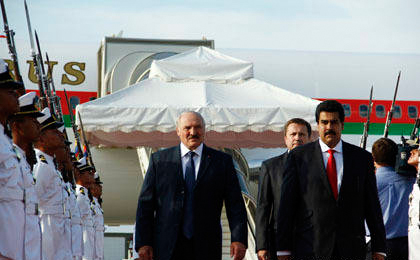
lukashenko with maduro 300x185 In Case You Missed It… Articles Roundup Week of 6/29/12

Courtesy of: El Universal

This week: With the Venezuelan presidential election campaign to officially start this Sunday, a new poll shows that Hugo Chávez holds only a slight lead over opposition candidate Henrique Capriles; Chávez claims that he has completed his cancer treatments; the opposition criticizes Chávez for his mandatory national broadcasts during the campaign; the television station Globovision, known for its refusal to kowtow to PSUV propaganda, is in danger of being closed after the Venezuelan Supreme Court freezes its assets. Meanwhile, the presidents of Iran and Belarus visit Chávez to strengthen ties between their countries; falling oil prices lead a cash-strapped Venezuela to lobby OPEC for controls on the price of oil; and controversy continues over the decision not to make a voting center available to Venezuelans in Miami, a decision which has led some expatriate Venezuelans to plan to file a complaint against Chávez before the International Criminal Court.

Venezuela poll shows tight race for Chavez, Reuters

A new poll shows Venezuelan President Hugo Chavez only slightly ahead of challenger Henrique Capriles in the October 7 presidential election, welcome news for the opposition following numerous surveys showing Chavez with a wide lead.

Venezuela’s Chavez sees no more cancer treatment on horizon, The Chicago Tribune

Venezuelan President Hugo Chavez said on Tuesday he sees no need for further treatment for the cancer that struck him last year just weeks after he had said medical tests showed him in good health.

Venezuela opposition presidential hopeful says Chavez’s on-air talks should be limited, The Washington Post

Venezuelan presidential candidate Henrique Capriles is demanding election officials prevent President Hugo Chavez from taking over the airwaves of the nation’s TV and radio stations for lengthy speeches while campaigning for re-election.

Venezuela court orders embargo on channel’s assets, CBS Money Watch

Venezuela’s Supreme Court on Thursday ordered an embargo on nearly $5.7 million in assets belonging to a television channel that takes a critical line against President Hugo Chavez’s government.

Lukashenko starts visit to Venezuela to strengthen cooperation, El Universal

Alexander Lukashenko, the president of Belarus, arrived Monday in Caracas to meet with President Hugo Chávez as part of his tour of Latin America.

Venezuela’s Chavez hosts close ally Ahmadinejad, AFP

Venezuelan President Hugo Chavez and his Iranian counterpart Mahmoud Ahmadinejad pledged Friday to stand together to battle “imperialism,” with Chavez criticizing tough sanctions on Tehran.

Chavez: Drop in oil price will not stop Venezuela development , Fox News Latino

President Hugo Chavez said Monday that the drop in oil prices will not affect government plans for Venezuelan development.

Exclusive: Venezuela wants OPEC price band restored, Reuters

Venezuela wants OPEC to restore an oil price band, with a range of between $80 and $120 a barrel, to control global market volatility, Energy Minister Rafael Ramirez told Reuters.

87% of Venezuelans living in Miami prepares to vote in Louisiana, El Universal

Pedro Mena, executive director of opposition Unified Democratic Panel (MUD) in Miami, State of Florida, is certain that 87% of Venezuelan residents in Miami will head for the Consulate of New Orleans to cast their ballot in the presidential election of next October 7.

Dissenters to sue Chávez at the International Criminal Court, El Universal

Venezuelan dissenters living in Miami on Wednesday described as a “crime against humanity” President Hugo Chávez’s decision to close Venezuela’s consulate in Florida, and said they are going to file a lawsuit against the Venezuelan president at the International Criminal Court in The Hague.

 
Jun
28
2012
Posted by
admin
Comments

The Gap Between Words and Deeds

By Petardo de Petare

pic11 150x150 The Gap Between Words and Deeds

Petardo de Petare

Two weeks ago, Venezuelans witnessed two remarkable occurrences. First, on June 10, MUD nominee Henrique Capriles jogged more than 6 miles to Venezuela’s electoral headquarters (as we call it, the CNE) to formally register his candidacy for president. He was followed by thousands of supporters, marching alone the avenues of Caracas as they chatted avidly about brighter days ahead for Venezuela—it was the picture of an opposition movement that genuinely believes they can win. His speech soared with idealistic rhetoric about a Venezuela with less violence, a more vibrant economy, and a political culture that respects, not demonizes, those who disagree. “On October 7th,” said Capriles, “I’ll be the next president of all Venezuelans.”

The very next day, a weakened but still feisty Hugo Chávez arrived at the electoral headquarters himself. Chávez had his supporters as well—to claim otherwise would be a lie—but the difference between his and Capriles’ entrance could not have been starker. While Capriles strode proudly at the head of a throng of supports, Chávez was deposited at the CNE by truck. Cameras were not permitted to witness the manner of his ascent to the podium, leading many to question whether the president, currently battling from an undisclosed type of cancer, could even make it to the stage under his own strength. He did his best to rouse the crowd with his speech. And while he delivered flashes of his old, charismatic self, any adult Venezuelan could see that this was not the same Chávez who rose to power on a wave of idealism more than a decade. The words of his oration were familiar, rife with obsolete rhetoric, promises to take care of the poor and his characteristic ad hominem insults of the opposition. However, for many, the speech itself fell flat.

The two appearances give us a metaphor worth considering. Some of the more free-thinking commentators in my country – along with many in the international media – have claimed that Capriles, represents Venezuela’s future, and Chávez the weight of her past. Of course, the tricky thing about the future is that it hasn’t happened yet…

13 years of Hugo Chávez has made many Venezuelans weary and distrustful of the promises of politicians. Make no mistake: the ideals Chávez espouses at times sound beautiful. Who doesn’t wish to see Venezuela produce enough food for its entire populace? Who doesn’t support Chávez’s stated “mission” to build millions of houses for the people who need it? Who wouldn’t want to see an oil-rich nation like Venezuela use its abundant resources to provide for its citizens?

However, the past 13 years have often taught us that there is a difference between priorities and reality. Chávez promised Venezuela food sovereignty; yet today our shortages are worse than ever. Chávez often says that “capitalists” and “the bourgeois” were the reason for our country’s ills, but his constant expropriations and currency manipulation have done nothing but drag our economy down by the waist. Chávez has often bellowed about his “Great Housing Mission;” yet these promises offer little comfort to the millions of Venezuelans who remain homeless. Indeed, within eyeshot of the CNE stood an office building-turned-refugee camp, where many Venezuelans who lost their homes in floods continue to wait for Chávez’s aid.

I do not doubt that Chávez’s supporters ardently believe in the president. But the sad fact is that so many of these Venezuelans have never really been given a choice. For more than a decade Venezuelans have been inundated by PSUV propaganda. Barely two weeks ago I turned on VTV (our largest television network) and saw an hour-long PSUV infomercial proclaiming the glory of the government. And now Chávez has refused to debate Capriles, depriving Venezuelans of their one true opportunity to compare the candidates on a level playing field. Indeed, if I did not seek and find truths about Venezuela through independent media and conversations with my neighbors, I might be volunteering for Chávez’s campaign myself!

So I return to my original point. Capriles may represent Venezuela’s future, but in a nation whose president has held power for more than a decade and whose government controls nearly all mainstream media, the “future” is a much more speculative proposition than in most countries. Many sheltered Venezuelans do not understand just how poorly their countrymen have fared in recent years. Others remain true Bolivarian believers, and genuinely trust Chávez and the PSUV to rescue Venezuela from problems of their own making. And still others are part of the large segment of the electorate employed by the government, as it continues to expand its list of state-owned industries. These individuals, essentially employed by the PSUV, are required to march with and support Chavez, or risk retaliation in the form of their own firing.

But for the growing number of Venezuelans who feel in our bones that the time has come for a change, voting for the opposition this fall means waging an uphill fight.

Let us be clear: if Henrique Capriles wins this fall, it will be with the Venezuelan media stifling him every step of the way. I am not naïve enough to wish for the Venezuelan media to cover this election evenly. I simply hope that the energetic Capriles—already renowned for the stamina exhibited on his “house to house” campaign across the country—can reach enough Venezuelans in person to make up the difference.