Aug
2
2012
Posted by
admin
Comments

Venezuela’s opposition wants to scrap preferential oil deals

Reuters
August 1, 2012
By Marianna Parraga

Capriles in Anzoategui state Venezuelas opposition wants to scrap preferential oil deals

Courtesy of: Reuters / Carlos Garcia Rawlins

Venezuelan opposition leader Henrique Capriles said on Wednesday he would scrap preferential oil deals with foreign allies if he defeats socialist President Hugo Chavez in an October election to lead the South American OPEC member.

Chavez has sought to boost his influence abroad by offering crude deals to nations in Asia, Latin America and the Caribbean — Venezuela’s state oil company PDVSA was not paid directly for almost half the crude it pumped last year.

In Capriles’ first major speech on his future oil policy, the 40-year-old said stopping Chavez’s deals for crude on credit or in exchange for other goods would save $6.7 billion annually, which would be invested in new social programs.

“To have a friend, you don’t need to buy him,” Capriles said during a campaign stop a few kilometers from the Puerto La Cruz refinery. “From … 2013, not a single free barrel of oil will leave to other countries.”

The youthful former state governor named Belarus, Cuba, Jamaica, Dominican Republic, Uruguay and Argentina as countries that would stop receiving oil on preferential terms.

In 2011, PDVSA — the fiscal motor of Chavez’s socialist policies — was not paid directly for 43 percent of its barrels of crude and oil products, rising from 36.5 percent in 2010 and 32 percent in 2009.

Many of the agreements are criticized by his opponents, especially those signed over the last decade with China, Cuba, Argentina, Uruguay, and the more than a dozen countries that are members of Venezuela’s Petrocaribe supply program.

Chavez — who underwent three operations for cancer over the last year — is seeking re-election for a third term on October 7 to extend his self-styled socialist “revolution” and is spending heavily to beat Capriles.

Most opinion polls give him a double-digit lead.

‘NO LEGAL CHANGES PLANNED’

Capriles is seeking to tap into pent-up frustration among many voters weary of high crime, inefficient public services and high prices. He has been on a months-long “house-by-house tour” through Venezuela meant to win over Chavez supporters and draw a comparison with the recovering president.

Capriles — who frequently cites Norway as an example of a nation that has used its oil wealth properly to diversify the economy — said he planned no legal changes to the oil industry, although there would be more supervision of the activities of public and private companies that are partners of PDVSA.

Chavez ordered the nationalization of dozens of crude projects in 2006 and 2007, but Venezuela has still managed to attract partners from Russia, Vietnam, Belarus and Malaysia to join PDVSA-led projects.

Companies including U.S. major Chevron, Spain’s Repsol and Italy’s ENI have also been drawn by the world’s biggest crude reserves, which are mostly located in the Andean country’s Orinoco Belt.

Oil accounts for more than 90 percent of Venezuela’s exports.

Capriles promised to use the extra resources from stopping preferential deals, plus money from a planned doubling of production between 2013 and 2020, to fund programs such as raising benefits for pensioners, scholarships for mothers of handicapped children, and education.

“Where will all these resources go? Not to tanks, not to a hospital in Nicaragua, not as donations,” Capriles said.

(Writing by Jack Kimball; Editing by Daniel Wallis and M.D. Golan)

To read this article on Reuters, please click here.

 
Jul
12
2012
Posted by
admin
Comments

Chavez Hits Campaign Trail in Bid to Prove He’s Cancer-Free

Bloomberg
July 12, 2012
By Charlie Devereux

presidente Venezuela Hugo Chavez AFP ECMIMA20120712 0097 4 Chavez Hits Campaign Trail in Bid to Prove He’s Cancer Free

Courtesy of: AFP

Venezuela‘s President Hugo Chavez is hitting the campaign trail today in an attempt to persuade voters his battle with cancer hasn’t diminished his vitality ahead of what’s shaping up to be his toughest election.

Chavez will attend a rally today in the oil producing state of Anzoategui on Venezuela’s northeastern coast and plans to hold a similar event in Barquisimeto in central Lara state July 14. The rallies are the first since the former tank commander marked the official start of campaigning July 1 with a caravan and speech in Maracay, 50 miles west of Caracas.

Chavez, 57, said July 9 that he’s “totally free” of a cancer whose exact type and location he’s refused to reveal. The comment echoes similar remarks in October 2011 that he later retracted after the discovery of a second tumor in February saw him travel to Cuba for surgery and radiation treatment.

“He’s definitely still going to have to prove it,” said Gregory Weeks, director of Latin American studies at the University of North Carolina in Charlotte. ‘He’s going to have to show by his actions that he’s healthy.”

His challenger, Henrique Capriles Radonski, a 40-year-old former governor of Miranda state, has sought to mark a contrast with Chavez by visiting remote towns on a daily basis, preaching the need to unite the polarized country and saying that the economy is stagnant after 13 years of socialist government rule.

Public Spending

Venezuela’s economy grew 5.6 percent in the first quarter from a year ago, the fastest rate in nearly four years, as the government increases public spending and imports ahead of the elections. The country’s money supply has risen 53 percent in the last 12 months on the back of outlays, while annual inflation stood at 21.3 percent in June.

Venezuela’s jobless rate fell to 7.4 percent last month, the lowest in June since Chavez took power in 1999, the National Statistics Institute said today in an e-mailed report.

The percentage of export revenue derived from oil has risen to 95 percent from 80 percent when Chavez took office in 1999, according to central bank data. The price for

Venezuela’s oil export basket has averaged $106.90 this year, according to the Oil Ministry.

Capriles has sought to accentuate the contrast between himself and Chavez by highlighting his youth and vigor in day- long, house-by-house visits across the country. He has taunted Chavez by saying the campaign will be a battle between Wile E. Coyote and The Road Runner, a reference to the Warner Bros. Entertainment Inc. cartoon created in 1948.

Forgotten Villages

“I’m going to go to those villages that have been forgotten by those in power,” Capriles said July 2 in comments carried on Globovision. Capriles toured Cojedes state today.

Since returning from Cuba in May, Chavez has gradually increased the frequency and duration of his public appearances through televised events in which he’s hosted foreign leaders such as Iranian President Mahmoud Ahmadinejad and Belarus’ President Aleksandr Lukashenko and promoted military officers. The former paratrooper said last week that his presidential duties have kept him too busy to campaign until now and that he’ll need to juggle his schedule.

“We’re starting the campaign and will travel throughout the country not just to do the tours, but to explain our new six-year government plan,” Chavez said yesterday on state television. “We’re going to seek to guarantee our votes on October 7 and achieve the great victory that’s already been written but which we have to work for every day.”

Varying Polls

Recent opinion polls have varied widely. Chavez had 45.9 percent support against 45.8 percent for Capriles in a Consultores 21 poll of 1,000 people taken between June 15 and June 26. The survey had a margin of error of 3.2 percentage points. In a June poll by Caracas-based Datanalisis, Chavez had a 14 percentage-point lead.

Chavez first revealed in June 2011 that doctors had removed a tumor from his pelvic area that he later described as baseball-sized. He returned from a fourth bout of chemotherapy treatment in Cuba Oct. 20 and declared himself “free of illness.” In the months that followed he resumed some of his daily rhythm, even speaking for more than 9 hours in an address to the National Assembly in January, before announcing he would need further surgery after doctors discovered a second 2- centimeter (0.8-inch) tumor in the same area.

Trips to Cuba

His subsequent absences from the public spotlight as he shuttled back and forth between Cuba and Venezuela to receive several rounds of radiation treatment sparked a rally in Venezuelan bonds as investors speculated that Chavez’s battle with cancer would accelerate a change in government that would reverse his capital controls and nationalization policies.

Venezuelan dollar bonds have returned 17 percent year-to- date, the most among emerging markets after the Ivory Coast and Belarus, according to JPMorgan Chase & Co.’s EMBI Global index.

The yield on Venezuela’s benchmark 9.25 percent securities due in 2027 rose two basis points, or 0.02 percentage point, to 11.69 percent at 1:30 p.m. in Caracas, according to data compiled by Bloomberg. The price fell 0.11 cents to 82.81 cents on the dollar.

“Thank God I’m feeling better every day, and I don’t believe that physical limitations, as you put it, will be a factor in the campaign,” Chavez said July 9 during a press conference when asked if his illness could affect his re- election bid.

Chavez’s latest declarations on his health “take the wind out of the sails” of reports that have predicted his imminent death, said Weeks. While any sign that his cancer has worsened would damage his prospects of winning in October, Venezuelans will give him some leeway as he recuperates and won’t expect him to campaign with the same vigor as in the past, he said.

“People understand he had treatment for cancer so they’re not expecting the Chavez of the past who is giving 8-hour presentations and singing and dancing,” Weeks said.

To contact the reporter on this story: Charlie Devereux in Caracas at [email protected].

To read this article on Bloomberg, please click here.

 
Jun
29
2012
Posted by
admin
Comments

In Case You Missed It… Articles Roundup Week of 6/29/12

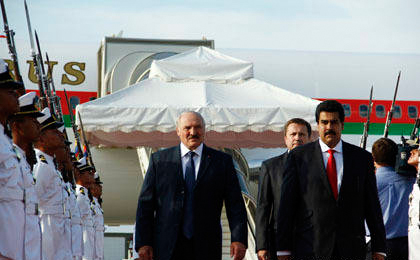
lukashenko with maduro 300x185 In Case You Missed It… Articles Roundup Week of 6/29/12

Courtesy of: El Universal

This week: With the Venezuelan presidential election campaign to officially start this Sunday, a new poll shows that Hugo Chávez holds only a slight lead over opposition candidate Henrique Capriles; Chávez claims that he has completed his cancer treatments; the opposition criticizes Chávez for his mandatory national broadcasts during the campaign; the television station Globovision, known for its refusal to kowtow to PSUV propaganda, is in danger of being closed after the Venezuelan Supreme Court freezes its assets. Meanwhile, the presidents of Iran and Belarus visit Chávez to strengthen ties between their countries; falling oil prices lead a cash-strapped Venezuela to lobby OPEC for controls on the price of oil; and controversy continues over the decision not to make a voting center available to Venezuelans in Miami, a decision which has led some expatriate Venezuelans to plan to file a complaint against Chávez before the International Criminal Court.

Venezuela poll shows tight race for Chavez, Reuters

A new poll shows Venezuelan President Hugo Chavez only slightly ahead of challenger Henrique Capriles in the October 7 presidential election, welcome news for the opposition following numerous surveys showing Chavez with a wide lead.

Venezuela’s Chavez sees no more cancer treatment on horizon, The Chicago Tribune

Venezuelan President Hugo Chavez said on Tuesday he sees no need for further treatment for the cancer that struck him last year just weeks after he had said medical tests showed him in good health.

Venezuela opposition presidential hopeful says Chavez’s on-air talks should be limited, The Washington Post

Venezuelan presidential candidate Henrique Capriles is demanding election officials prevent President Hugo Chavez from taking over the airwaves of the nation’s TV and radio stations for lengthy speeches while campaigning for re-election.

Venezuela court orders embargo on channel’s assets, CBS Money Watch

Venezuela’s Supreme Court on Thursday ordered an embargo on nearly $5.7 million in assets belonging to a television channel that takes a critical line against President Hugo Chavez’s government.

Lukashenko starts visit to Venezuela to strengthen cooperation, El Universal

Alexander Lukashenko, the president of Belarus, arrived Monday in Caracas to meet with President Hugo Chávez as part of his tour of Latin America.

Venezuela’s Chavez hosts close ally Ahmadinejad, AFP

Venezuelan President Hugo Chavez and his Iranian counterpart Mahmoud Ahmadinejad pledged Friday to stand together to battle “imperialism,” with Chavez criticizing tough sanctions on Tehran.

Chavez: Drop in oil price will not stop Venezuela development , Fox News Latino

President Hugo Chavez said Monday that the drop in oil prices will not affect government plans for Venezuelan development.

Exclusive: Venezuela wants OPEC price band restored, Reuters

Venezuela wants OPEC to restore an oil price band, with a range of between $80 and $120 a barrel, to control global market volatility, Energy Minister Rafael Ramirez told Reuters.

87% of Venezuelans living in Miami prepares to vote in Louisiana, El Universal

Pedro Mena, executive director of opposition Unified Democratic Panel (MUD) in Miami, State of Florida, is certain that 87% of Venezuelan residents in Miami will head for the Consulate of New Orleans to cast their ballot in the presidential election of next October 7.

Dissenters to sue Chávez at the International Criminal Court, El Universal

Venezuelan dissenters living in Miami on Wednesday described as a “crime against humanity” President Hugo Chávez’s decision to close Venezuela’s consulate in Florida, and said they are going to file a lawsuit against the Venezuelan president at the International Criminal Court in The Hague.