May
8
2013
Posted by
admin
Comments

Nicolás Maduro off to an inauspicious start as Venezuela’s dubiously-elected president

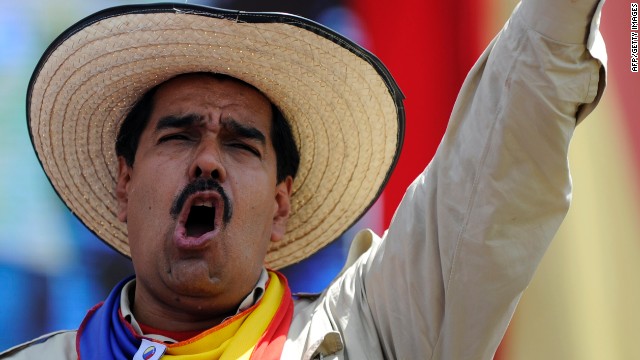
Nicolas Maduro e1368042661461 Nicolás Maduro off to an inauspicious start as Venezuela’s dubiously elected president

Courtesy of: Agence France Presse

Almost immediately after Venezuela’s partisan electoral authority declared Nicolás Maduro the winner of last month’s presidential election, he and his ruling PSUV party faced a choice that may yet define Venezuela’s future for years to come. Reports of thousands of irregularities in the voting process, including suspicions of fraud, sparked fears about the election’s legitimacy. The actions of Maduro – who first consented to the opposition’s calls for a full and transparent recount, later issued a hasty retraction, and then began a crackdown on peaceful opposition protestors – has only deepened those fears.

Maduro’s desperation is perhaps well-founded: a poll today found that a majority of Venezuelans believe the country is on the wrong track and, if given the chance, most would now choose Henrique Capriles for president over Maduro. The uncertainty and repression surrounding the Venezuelan election has grown so egregious that President Obama has abstained from recognizing Maduro as the winner. The President observed that the “entire hemisphere has been watching the violence, the protests, the crackdowns on the opposition.” ABC reports:

President Barack Obama avoided recognizing the government of Venezuela during an interview with Univision, explaining that he was concerned about recent “crackdowns” against members of the Venezuelan opposition. He also said that recent reports suggest that basic principles of democracy and human rights are not being fully observed by Venezuela’s government.

Obama and the U.S. State Department are among a growing chorus calling for a full and transparent recount of the Venezuelan election, a chorus that now includes the Organization of American States, former Colombian president Alvaro Uribe, and internationally-respected human rights watchdog groups. Though Maduro may lack Hugo Chávez’s charisma and support among Venezuelans, he evinces the same contempt for the international community.  That contempt, combined with Maduro’s increasingly flagrant repression of his own people, mean that recent weeks for Venezuela have been turbulent indeed.

It’s hard to deny that Maduro’s “election” lacks legitimacy, before the eyes of both Venezuelans and the world. The partial audit the government agreed to is viewed as little more than a public relations gesture, and hardly sufficient to investigate the serious voting irregularities that led many to wonder whether Capriles was the election’s true winner.

As those doubts grow, Maduro has flexed the government’s authoritarian muscle to stifle dissent and cow the opposition into obedience. The state-run media – which recently tightened its grip on the airwaves by purchasing the previously-independent TV station Globovision – has dutifully propagandized on behalf of Maduro; the government recently severed the video feed of a Capriles speech, preventing the opposition leader from making his case to Venezuelans.

Such tactics haven’t prevented the opposition from making their voice heard. The din of “Cacerola” protests resounds throughout the country. Capriles has filed an official protest with the country’s Supreme Court which, comprised of Maduro’s political allies, is unlikely to intervene. Maduro and the PSUV have met these peaceful expressions of dissent, however, with strongman tactics. Capriles called off an opposition March after the government issued a veiled-threat of violence against the protestors. Opposition lawmakers have been barred from speaking in the National Assembly. And a bloody brawl in the National Assembly injured 17 opposition lawmakers. Now the government has intimated it may throw Capriles in jail.

Such tactics, though they fly in the face of democracy and human rights, at least demonstrate that Maduro is feeling the pressure. The Economist opined after the election that “without Chávez at the helm, chavismo, a noxious cocktail of populism, incompetence and repression, is a far less potent force.” Nicolas Maduro cannot strong-arm his way to legitimacy. But that hasn’t stopped him trying.
 
Oct
1
2012
Posted by
admin
Comments

Panel: Superior Capriles Campaign negates Unlevel Playing Field

South Americas October Surpise Panel: Superior Capriles Campaign negates Unlevel Playing Field

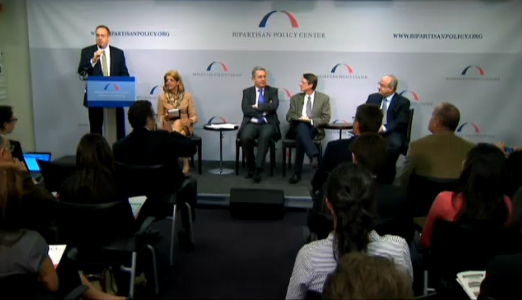
Screen Capture: Bipartisan Policy Center - South Americas October Surpise

Venezuela under Chávez does not meet the standards for a real democracy, according to statements made by former Colombian President Álvaro Uribe. The former leader told an audience at Washington’s Bipartisan Policy Center (BPC) that Chávez has failed to protect the security and freedoms of Venezuelan citizens during his rule and has not allowed their active participation in government.

Uribe participated in a BPC panel last week focusing on recent developments in Venezuela and Colombia, which include Venezuela’s tight presidential election, entitled “South America’s October Surprise?” The former Colombian president was joined by Dan Fisk of the International Republican Institute and Michael Shifter of the Inter-American Dialogue.

The panel discussed whether Venezuela’s upcoming elections can be considered fair as well as the likelihood that opposition candidate Henrique Capriles will defeat Chávez. Participants also tried to predict how the president will respond if he loses.

“There was a hemispheric consensus that elections [are] how you judge a democracy,” Fisk said of Venezuela’s upcoming vote. But he added that Chávez has manipulated the system to provide the appearance of a democracy while suppressing citizens’ democratic rights. “A lot of people have given [Chávez] credit that you can take away people’s freedom through a series of democratic processes.”

Uribe, though, had much stronger words. “I am against the Chávez dictatorship with or without elections,” he said. He further criticized the Chávez administration for failing to pursue the narco-terrorist organization FARC in Venezuelan territory. That failure has bled across Venezuela’s borders, undermining the stability of Colombia that the government of president Uribe worked hard to attain.

Fisk said that while the technical voting process in Venezuela appears to be fair, the real disparity – and the threat to democracy – lies in the campaign itself.

“The problem is not the machinery, it is the campaign process,” Fisk said. Venezuelan law allows the president to call mandatory national broadcasts, known as cadenas, at any time, and Chávez has abused this power to saturate Venezuela with campaign propaganda. Meanwhile, Capriles must pay for airtime, and lacks the resources to match the reach of the state media.

Chávez has also used the resources of the government, supplied by the country’s vast oil reserves, to finance his campaign. “In many ways PDVSA is the lubricant of the Chávez campaign,” Fisk said. Chávez has increased social spending, and then trumpeted that increased spending in his campaign rhetoric, giving Venezuelans the impression that it is he, not the government, who is giving them these benefits.

Despite all of this, Fisk says that this is the most competitive race that Chávez has ever faced. It remains to be seen if all of the electoral advantages Chávez enjoys can blunt the impact of his economic mismanagement, which has led to severe shortages and skyrocketing inflation, or make Venezuelans forget the recent refinery fires and one of the world’s highest crime rates.

Shifter added that the opposition has run an excellent campaign, and Capriles has refused to fall for tactics and provocations of Chávez. The opposition has stumbled in the past and has its best chance yet, in part because it has unified itself into one group. In addition, he did join the concerns of the other panelists, adding that “there is not a level playing field.”

In an encouraging bit of consensus, the panelists for the most part dismissed worries that Chávez would reject the results if the opposition wins. “It would be very hard in terms of politics in Venezuela and international pressure to deny [an opposition victory],” Shifter said. He warned, however, that the process may not be smooth. “We should be prepared for some amount of violence and instability. We have seen that in campaign stops in the past couple of days,” alluding to recent Chavista-incited violence at Capriles rallies.

Fisk added that the United States should be prepared to accept the results if the election appears credible, and that he believes that Venezuelans will peacefully accept the results as well.

 
May
15
2012
Posted by
admin
Comments

Capriles tells Uribe to not get involved in Venezuela’s elections

Colombia Reports
Adriaan Alsema
May 15, 2012

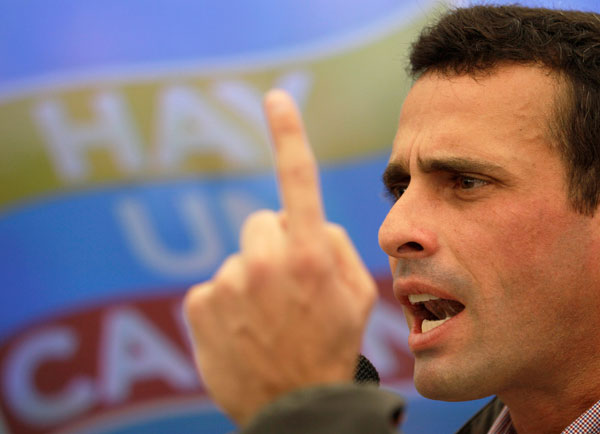
henrique capriles encuestas 300x217 Capriles tells Uribe to not get involved in Venezuelas elections

Courtesy of: Star Media

Venezuelan opposition candidate Henrique Capriles told Colombian ex-President Alvaro Uribe Monday to not interfere in the country’s election race.

Uribe has been meeting with Venezuelan opposition leaders since last year and has increasingly opened the attack on sitting President Hugo Chavez with whom the Colombian former head of state had frequent clashes while still in power.

“I am telling ex-President Uribe, like President Santos, like any other head of state or former president, do not interfere with Venezuela’s electoral process, because we Venezuelans will solve our own problems and do not want the interference of any country,” Capriles said at a rally Monday.

The call came hours after Uribe dedicated most his Twitter account to verbal attacks against Venezuela’s socialist president, who he accused of being a dictator and covering up soaring homicide rates.

Uribe responded to Capriles’ statement tweeting ”as long as there is dictatorship and the protection of terrorists we will express our opinion on Venezuela every day.”

The Venezuelan opposition candidate has been running behind Chavez in the polls and according to some pollsters has lost ground to the socialist leader over the past few months.

Venezuela will take to the polls on October 7.

To read the original article from Colombia Reports, please click here.