Oct
1
2013
Posted by
admin
Comments

ICYMI: With Accusations of Sabotage, Venezuela Expels 3 US Embassy Officials

The New York Times
September 30, 2013
By William Neuman
VENEZ articleLarge e1380645570814 ICYMI: With Accusations of Sabotage, Venezuela Expels 3 US Embassy Officials

Courtesy of: Agence France Presse

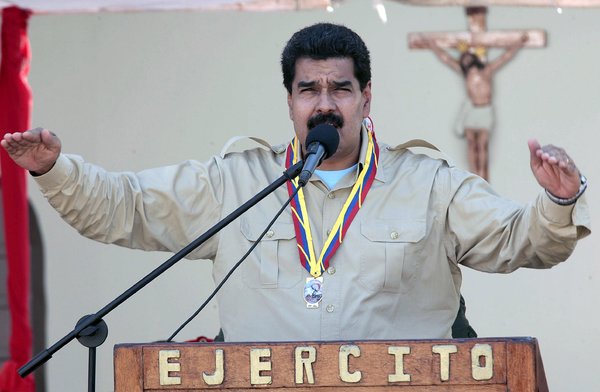
CARACAS, Venezuela — Stepping up hostilities with the United States, President Nicolás Maduro of Venezuela expelled the top American diplomat and two other embassy officials from the country on Monday, accusing them of supporting plots to sabotage the country’s electrical grid and the economy.

“Get out of Venezuela! Yankee go home!” Mr. Maduro shouted as he announced the expulsions at a military event to commemorate the bicentennial of a battle in Venezuela’s war of independence.

“We have detected a group of officials of the United States Embassy in Caracas, in Venezuela, and we have been tracking them for several months,” Mr. Maduro said during a live television broadcast. “These officials spend their time meeting with the Venezuelan extreme right wing, financing them and encouraging them to take actions to sabotage the electrical system, to sabotage the Venezuelan economy.”

The expulsions were the latest diplomatic swipe at Washington by Mr. Maduro since he took over for the country’s longtime president, Hugo Chávez, who died in March. Late last year, as Mr. Chávez grew increasingly ill, the two nations held informal talks aimed at improving the long-strained relations between them, and there was some optimism on the American side that Mr. Maduro, a former foreign minister sometimes described as pragmatic, would be amenable to a thaw.

But it quickly became clear that Mr. Maduro intended to stick closely to Mr. Chávez’s example, painting the United States as an imperialist aggressor out to undermine his government. Early on, he accused the Obama administration of plotting against him, and hours before he announced the death of Mr. Chávez on March 5, he kicked out two American military attachés, saying they had tried to recruit Venezuelan military personnel to conspire against the government.

The diplomats expelled on Monday included Kelly Keiderling, the chargé d’affaires, who runs the embassy in the absence of an ambassador here. The United States has not had an ambassador in Caracas since 2010, when Mr. Chávez refused to accept the new one proposed by Washington because of remarks that Mr. Chávez said were disrespectful.

Mr. Chávez had already expelled the American ambassador, Patrick Duddy, in 2008, saying that his government had discovered an American-supported plot by military officers to topple him. Mr. Duddy was later allowed to return to Caracas.

Another one of the diplomats expelled on Monday was Elizabeth Hoffman, an official in the embassy’s political section, whom Mr. Maduro had publicly accused at least as early as April of meeting with opposition figures to plot sabotage of the electrical system. He said at the time that he had proof but took no action until Monday. The third official being expelled is David Moo, the vice consul.

Foreign Minister Elías Jaua later said on television that the evidence against the American diplomats included meetings held in recent weeks with democracy advocates, union members and elected officials belonging to the political opposition, whom he accused of planning to destabilize the country.

Mr. Maduro said the officials had 48 hours to leave the country.

“We completely reject the Venezuelan government’s allegations of U.S. government involvement in any type of conspiracy to destabilize the Venezuelan government,” the American Embassy said in a statement. It called the meetings held by the officials “normal diplomatic engagements,” adding, “We maintain regular contacts across the Venezuelan political spectrum.”

Ever since he was elected by a narrow margin in April in a special election to replace Mr. Chávez, Mr. Maduro has struggled with intense economic woes and a deeply divided populace. He has often accused plotters and saboteurs of being responsible for a variety of the nation’s ills, including electrical blackouts and the deadly explosion at the national oil company’s enormous Amuay refinery.

“He needs diversions and distractions,” said Michael Shifter, president of the Inter-American Dialogue, a policy group in Washington. “The situation is so dire in Venezuela that he needs to find a scapegoat, and it’s convenient and politically so tempting to kick out U.S. diplomats.”

But Mr. Shifter said that describing the United States as the source of the country’s problems might not have the same effect it did for Mr. Chávez, who was beloved by many of his supporters. Mr. Maduro does not inspire nearly the same devotion, and the country’s economic woes are getting worse, with inflation over 45 percent a year and shortages of many basic foods and goods, including toilet paper.

“I doubt that it has the resonance it used to have,” Mr. Shifter said of the diplomatic expulsions.

To read this article at The New York Times, please click here.
 
Oct
1
2012
Posted by
admin
Comments

Panel: Superior Capriles Campaign negates Unlevel Playing Field

South Americas October Surpise Panel: Superior Capriles Campaign negates Unlevel Playing Field

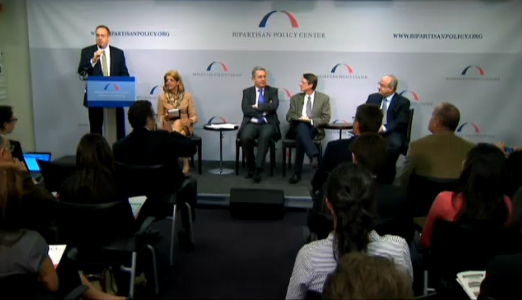
Screen Capture: Bipartisan Policy Center - South Americas October Surpise

Venezuela under Chávez does not meet the standards for a real democracy, according to statements made by former Colombian President Álvaro Uribe. The former leader told an audience at Washington’s Bipartisan Policy Center (BPC) that Chávez has failed to protect the security and freedoms of Venezuelan citizens during his rule and has not allowed their active participation in government.

Uribe participated in a BPC panel last week focusing on recent developments in Venezuela and Colombia, which include Venezuela’s tight presidential election, entitled “South America’s October Surprise?” The former Colombian president was joined by Dan Fisk of the International Republican Institute and Michael Shifter of the Inter-American Dialogue.

The panel discussed whether Venezuela’s upcoming elections can be considered fair as well as the likelihood that opposition candidate Henrique Capriles will defeat Chávez. Participants also tried to predict how the president will respond if he loses.

“There was a hemispheric consensus that elections [are] how you judge a democracy,” Fisk said of Venezuela’s upcoming vote. But he added that Chávez has manipulated the system to provide the appearance of a democracy while suppressing citizens’ democratic rights. “A lot of people have given [Chávez] credit that you can take away people’s freedom through a series of democratic processes.”

Uribe, though, had much stronger words. “I am against the Chávez dictatorship with or without elections,” he said. He further criticized the Chávez administration for failing to pursue the narco-terrorist organization FARC in Venezuelan territory. That failure has bled across Venezuela’s borders, undermining the stability of Colombia that the government of president Uribe worked hard to attain.

Fisk said that while the technical voting process in Venezuela appears to be fair, the real disparity – and the threat to democracy – lies in the campaign itself.

“The problem is not the machinery, it is the campaign process,” Fisk said. Venezuelan law allows the president to call mandatory national broadcasts, known as cadenas, at any time, and Chávez has abused this power to saturate Venezuela with campaign propaganda. Meanwhile, Capriles must pay for airtime, and lacks the resources to match the reach of the state media.

Chávez has also used the resources of the government, supplied by the country’s vast oil reserves, to finance his campaign. “In many ways PDVSA is the lubricant of the Chávez campaign,” Fisk said. Chávez has increased social spending, and then trumpeted that increased spending in his campaign rhetoric, giving Venezuelans the impression that it is he, not the government, who is giving them these benefits.

Despite all of this, Fisk says that this is the most competitive race that Chávez has ever faced. It remains to be seen if all of the electoral advantages Chávez enjoys can blunt the impact of his economic mismanagement, which has led to severe shortages and skyrocketing inflation, or make Venezuelans forget the recent refinery fires and one of the world’s highest crime rates.

Shifter added that the opposition has run an excellent campaign, and Capriles has refused to fall for tactics and provocations of Chávez. The opposition has stumbled in the past and has its best chance yet, in part because it has unified itself into one group. In addition, he did join the concerns of the other panelists, adding that “there is not a level playing field.”

In an encouraging bit of consensus, the panelists for the most part dismissed worries that Chávez would reject the results if the opposition wins. “It would be very hard in terms of politics in Venezuela and international pressure to deny [an opposition victory],” Shifter said. He warned, however, that the process may not be smooth. “We should be prepared for some amount of violence and instability. We have seen that in campaign stops in the past couple of days,” alluding to recent Chavista-incited violence at Capriles rallies.

Fisk added that the United States should be prepared to accept the results if the election appears credible, and that he believes that Venezuelans will peacefully accept the results as well.

 
Feb
13
2012
Posted by
admin
Comments

In Primary, Capriles Meets Expectations, Voters Exceed Them

As expected, Henrique Capriles Radonski won Venezuela’s first-ever presidential primary yesterday, garnering 62 percent of the vote. However, Venezuela’s voters exceeded expectations, as nearly three million of the nation’s 18 million registered voters participated in the election. Opposition officials were characterizing a turnout of two million voters as successful. Long lines formed at polling stations throughout the country, even in neighborhoods that have traditionally been strongholds of President Hugo Chávez.

After more than 1.8 million Venezuelans cast their vote in support of the Governor of Miranda, Capriles addressed a crowd of thousands outside his campaign headquarters on Sunday night. In a show of unity rare in modern Venezuelan politics, Capriles’s four rivals eased any doubt that the opposition would fracture by joining him on stage at the victory celebration.

His unity-focused victory speech remained consistent with campaign rhetoric from recent months.

“I aim to be the president of all Venezuelans,” the young governor of Miranda state told the crowd. “It isn’t the time of lefts or rights. It’s the time of all Venezuelans…In union there’s strength!”

Capriles, who is considered a moderate, promised to salve ills such as 27 percent inflation and one of the highest murder rates in Latin America. The enormity of the turnout suggests mounting frustration by Venezuelans, as the country remains plagued by these and other issues, such as high unemployment and excessive poverty.

He has committed to keeping the more popular of Chávez’s anti-poverty policies while gradually repealing some of his most contentious measures, including price controls and the expropriation of private sector companies.

Internationally, Capriles has indicated he will keep Venezuela away from alliances with controversial governments such as Iran and Syria. He professed respect for the “modern left” of Brazil’s political system, which has combined activist social programs with a respect for private enterprise to lift tens of millions of citizens out of poverty.

Capriles supporters expressed hope that Sunday’s results will herald a victory in the fall. “Venezuela needs to change,” said community organizer Lelia Sutil. “We can beat Chávez if we lose our fear,” Alexis Fernandez of Petare explained. Perhaps the most ringing endorsement, however, came from the primary runner-up Pablo Pérez, who told Capriles, “My friend, you are going to be Venezuela’s next president.”

Despite a unified opposition and the better-than-expected turnout, Capriles will face an uphill battle against Chávez this October. The president controls most of Venezuela’s media and has already ramped up government spending to try and ensure a victory. Nevertheless, commentators believe that the litany of problems facing the nation have left the president in his weakest political position in years.

Michael Shifter, president of the Washington-based Inter-American Dialogue, summed up the political landscape: “Chávez has never been more vulnerable, and the opposition never more united… But the question is whether it will be enough to defeat Chávez.”

Capriles and the opposition have nine months to answer that question.