May
8
2013
Posted by
admin
Comments

Nicolás Maduro off to an inauspicious start as Venezuela’s dubiously-elected president

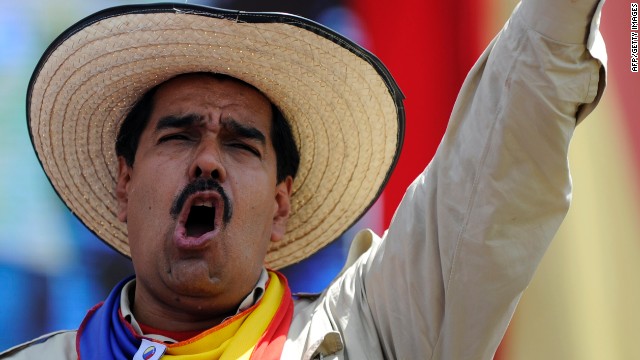
Nicolas Maduro e1368042661461 Nicolás Maduro off to an inauspicious start as Venezuela’s dubiously elected president

Courtesy of: Agence France Presse

Almost immediately after Venezuela’s partisan electoral authority declared Nicolás Maduro the winner of last month’s presidential election, he and his ruling PSUV party faced a choice that may yet define Venezuela’s future for years to come. Reports of thousands of irregularities in the voting process, including suspicions of fraud, sparked fears about the election’s legitimacy. The actions of Maduro – who first consented to the opposition’s calls for a full and transparent recount, later issued a hasty retraction, and then began a crackdown on peaceful opposition protestors – has only deepened those fears.

Maduro’s desperation is perhaps well-founded: a poll today found that a majority of Venezuelans believe the country is on the wrong track and, if given the chance, most would now choose Henrique Capriles for president over Maduro. The uncertainty and repression surrounding the Venezuelan election has grown so egregious that President Obama has abstained from recognizing Maduro as the winner. The President observed that the “entire hemisphere has been watching the violence, the protests, the crackdowns on the opposition.” ABC reports:

President Barack Obama avoided recognizing the government of Venezuela during an interview with Univision, explaining that he was concerned about recent “crackdowns” against members of the Venezuelan opposition. He also said that recent reports suggest that basic principles of democracy and human rights are not being fully observed by Venezuela’s government.

Obama and the U.S. State Department are among a growing chorus calling for a full and transparent recount of the Venezuelan election, a chorus that now includes the Organization of American States, former Colombian president Alvaro Uribe, and internationally-respected human rights watchdog groups. Though Maduro may lack Hugo Chávez’s charisma and support among Venezuelans, he evinces the same contempt for the international community.  That contempt, combined with Maduro’s increasingly flagrant repression of his own people, mean that recent weeks for Venezuela have been turbulent indeed.

It’s hard to deny that Maduro’s “election” lacks legitimacy, before the eyes of both Venezuelans and the world. The partial audit the government agreed to is viewed as little more than a public relations gesture, and hardly sufficient to investigate the serious voting irregularities that led many to wonder whether Capriles was the election’s true winner.

As those doubts grow, Maduro has flexed the government’s authoritarian muscle to stifle dissent and cow the opposition into obedience. The state-run media – which recently tightened its grip on the airwaves by purchasing the previously-independent TV station Globovision – has dutifully propagandized on behalf of Maduro; the government recently severed the video feed of a Capriles speech, preventing the opposition leader from making his case to Venezuelans.

Such tactics haven’t prevented the opposition from making their voice heard. The din of “Cacerola” protests resounds throughout the country. Capriles has filed an official protest with the country’s Supreme Court which, comprised of Maduro’s political allies, is unlikely to intervene. Maduro and the PSUV have met these peaceful expressions of dissent, however, with strongman tactics. Capriles called off an opposition March after the government issued a veiled-threat of violence against the protestors. Opposition lawmakers have been barred from speaking in the National Assembly. And a bloody brawl in the National Assembly injured 17 opposition lawmakers. Now the government has intimated it may throw Capriles in jail.

Such tactics, though they fly in the face of democracy and human rights, at least demonstrate that Maduro is feeling the pressure. The Economist opined after the election that “without Chávez at the helm, chavismo, a noxious cocktail of populism, incompetence and repression, is a far less potent force.” Nicolas Maduro cannot strong-arm his way to legitimacy. But that hasn’t stopped him trying.

 
Jan
6
2012
Posted by
admin
Comments

In Case You Missed It… Articles Roundup Week of 1/6/12

In this week’s roundup…ICSID rules on ExxonMobil’s arbitration claim against Venezuela; Inflation tops 27% in 2011 in Venezuela, while experts warn that President Chávez’s election-year spending spree may make that number even higher in 2012; Chávez continues his “Gold Rush;” Venezuela’s inability to develop its natural gas industry will result in more imports; and The Economist urges Chávez to come clean about his health.

Panel Deals a Setback to Exxon in Venezuela, The Wall Street Journal

An international arbitration panel awarded Exxon Mobil Corp. about $908 million in a verdict over oil assets nationalized by Venezuelan President Hugo Chávez in 2007, the company said late Saturday.

The payout was substantially lower than the $7 billion that Exxon was seeking in restitution and is likely to be a boon for Venezuela’s leftist government, which in recent years has embarked on a nationalization campaign to centralize control over key economic sectors. State oil company Petróleos de Venezuela SA said Monday it will pay Exxon a total of $255 million—after subtracting existing debt—over the next 60 days.

Heavy spending by Chavez in election year could boost 27 percent inflation in Venezuela, AP

President Hugo Chavez’s government is likely to spend heavily this year to rev up the economy during his re-election bid, and that could worsen one of Venezuela’s biggest problems: 27-percent annual inflation that is already close to the highest in the world. Chavez has started ramping up spending ahead of the October vote, and economists warn that more money injected into the economy will jolt prices. The government predicts 22 percent inflation in 2012, but the investment bank Barclays Capital projects that it could top 36 percent.

Venezuela to Leave 15 Tons of its Gold Reserves in Foreign Banks, Bloomberg

Venezuela will leave 15 tons of gold reserves in banks outside the country, Central Bank president Nelson Merentes said today. Venezuela held about 211 tons of its gold in Europe, Canada and Switzerland before it started repatriating the reserves last year, Merentes said on national radio. “It wasn’t necessary to have that much gold abroad for financial transactions,” Merentes said. “We’re going to keep bringing it back. Soon we will have the majority of our reserves in the Central Bank vault.”

Development problems force Venezuela to extend natural gas imports, Platts

Venezuela’s inability to develop its natural gas industry as planned has forced it to revise and extend a deal with Colombia’s state-controlled Ecopetrol and Chevron involving gas imports from the partners’ Guajira gas field in northeastern Colombia, a Caracas-based consultant said Wednesday.Since a 225-km binational gas pipeline was inaugurated in late 2007, Ecopetrol and Chevron have exported up to 250 million cubic feet of gas daily to mainly industrial clients in and around Maracaibo in western Venezuela’s Zulia state. Shipments in recent months have averaged 200 million cubic feet per day.

Cancer and the body politic, The Economist

Even by the standards of one of the world’s great conspiracy theorists, it was wacky stuff. On hearing the news that Argentina’s Cristina Fernández had become the fifth left-of-centre Latin American leader to be diagnosed with cancer in the past three years, Venezuela’s Hugo Chávez, himself unlucky enough to be one of them, mused that the United States might have developed technology to “induce cancer” in its political foes. “I don’t want to make any reckless accusation,” Mr. Chávez said disingenuously, “but it’s very, very, very strange.”


Sep
13
2010
Posted by
admin
Comments

Venezuela on the Brink

This article was originally posted by Commentary

Venezuela goes to the polls on Sept. 26 in a parliamentary election that opponents of President Hugo Chavez see as “a chance to turn the tide,” as Reuters news service puts it. Chavez may be taking on more authoritarian powers, but he also has to defend what the latest data show is the worst economy in the world.

The Economist magazine provides statistics weekly on 57 nations, from the United States to Estonia. Its most recent report forecasts that gross domestic product in Venezuela will decline by 5.5 percent in 2010. Next worst is Greece, with a 3.9 percent decline. Greece, of course, came close to defaulting on its debt earlier this year, and analysts at Morgan Stanley worry that Venezuela is moving in the same direction.

“Our new baseline of at least three years of economic contraction suggests the risks to Venezuela’s ability to honor its international financial commitments may be on the rise,” wrote Daniel Volberg and Giuliana Pardelli in a June report, at the same time predicting that GDP will fall by 6.2 percent in 2010. “While most of Latin America, in line with the globe, has been in recovery mode since last year, Venezuela has seen an intensifying downturn in activity,” they added.

Read More