May
16
2013
Posted by
admin
Comments

ICYMI: Venezuela is Running Out of Toilet Paper

Associated Press
May 16, 2013
By Fabiola Sanchez and Karl Ritter
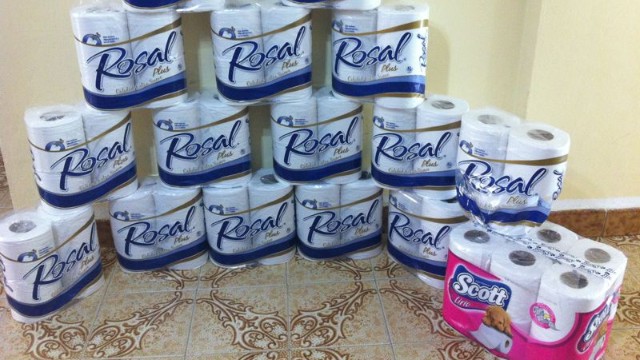
130515171546 toilet paper caracas story top e1368722217422 ICYMI: Venezuela is Running Out of Toilet Paper

Courtesy of: CNN

CARACAS, Venezuela (AP) — First milk, butter, coffee and cornmeal ran short. Now Venezuela is running out of the most basic of necessities — toilet paper.

Blaming political opponents for the shortfall, as it does for other shortages, the embattled socialist government says it will import 50 million rolls to boost supplies.

That was little comfort to consumers struggling to find toilet paper on Wednesday.

“This is the last straw,” said Manuel Fagundes, a shopper hunting for tissue in downtown Caracas. “I’m 71 years old and this is the first time I’ve seen this.”

One supermarket visited by The Associated Press in the capital on Wednesday was out of toilet paper. Another had just received a fresh batch, and it quickly filled up with shoppers as the word spread.

“I’ve been looking for it for two weeks,” said Cristina Ramos. “I was told that they had some here and now I’m in line.”

Economists say Venezuela’s shortages stem from price controls meant to make basic goods available to the poorest parts of society and the government’s controls on foreign currency.

“State-controlled prices — prices that are set below market-clearing price — always result in shortages. The shortage problem will only get worse, as it did over the years in the Soviet Union,” said Steve Hanke, professor of economics at Johns Hopkins University.

President Nicolas Maduro, who was selected by the dying Hugo Chavez to carry on his “Bolivarian revolution,” claims that anti-government forces, including the private sector, are causing the shortages in an effort to destabilize the country.

The government this week announced it would import 760,000 tons of food and 50 million rolls of toilet paper.

Commerce Minister Alejandro Fleming blamed the shortage of toilet tissue on “excessive demand” built up as a result of “a media campaign that has been generated to disrupt the country.”

“The revolution will bring the country the equivalent of 50 million rolls of toilet paper,” he was quoted as saying Tuesday by state news agency AVN. “We are going to saturate the market so that our people calm down.”

Finance Minister Nelson Merentes said the government was also addressing the lack of foreign currency, which has resulted in the suspension of foreign supplies of raw materials, equipment and spare parts to Venezuelan companies, disrupting their production.

“We are making progress … we have to work very hard,” Merentes told reporters Wednesday.

Many factories operate at half capacity because the currency controls make it hard for them to pay for imported parts and materials. Business leaders say some companies verge on bankruptcy because they cannot extend lines of credit with foreign suppliers.

Merentes said the government had met the U.S. dollar requests of some 1,500 small- and medium-sized companies facing supply problems, and was reviewing requests from a similar number of larger companies.

Chavez imposed currency controls a decade ago trying to stem capital flight as his government expropriated large land parcels and dozens of businesses.

Anointed by Chavez as his successor before the president died from cancer, Maduro won a close presidential election April 14 against opposition candidate Henrique Capriles, who refused to accept the result, claiming Maduro won through fraud and voter intimidation. He filed a complaint to the Supreme Court, asking for the vote to be annulled, though that’s highly unlikely to happen since the court is packed with government-friendly justices.

Patience is wearing thin among consumers who face shortages and long lines at supermarkets and pharmacies. Last month, Venezuela’s scarcity index reached its highest level since 2009, while the 12-month inflation rate has risen to nearly 30 percent. Shoppers often spend several days looking for basic items, and stock up when they find them.

Fleming, the commerce minister, said monthly consumption of toilet paper was normally 125 million rolls, but that current demand “leads us to think that 40 million more are required.”

“We will bring in 50 million to show those groups that they won’t make us bow down,” he said.

To read this article at Associated Press, please click here.
 
Feb
25
2013
Posted by
admin
Comments

ICYMI: Living through Venezuela’s currency madness

Foreign Policy
February 22, 2013
By Juan Nagel

devaluation electronics edited 0 e1361823011751 ICYMI: Living through Venezuelas currency madness

Courtesy of: Agence France Presse

The U.S. dollar is facing competition from other currencies, but there is still one place, ironically, where the greenback is king: the streets of socialist, anti-imperialist Caracas. Everyone here wants dollars — from the importer looking to stay in business, to the mid-level professional wanting to save his Christmas bonus.

Venezuela has had a fixed exchange rate of 4.3 Bolivars (BsF) per dollar for years. By selling dollars in exchange for so few Bolivars, the local currency was severely overvalued. Propped up by oil exports (hence the term “petrodollars”), the government was effectively subsidizing imports and travel abroad. A few weeks ago, the government decided to devalue to 6.3 BsF per dollar.

But devaluation was not the only thing rocking the market. The official dollar is only available for procurement if you are buying some imports — food, medicine, airplane tickets, and the like. You can’t get them unless it’s for one of those approved purposes, leaving out many people who need them. The artificially low prices, combined with the scarcity of dollars, creates the perfect opportunity for a black market where you can buy USD at the official rate, and then sell them underhandedly at a jacked-up price for an easy profit. In the last few weeks, following the devaluation, the price of the dollar in the black market has shot up to BsF 22 per dollar, up from BsF 18 the week prior to devaluation.

Stroll through the streets of this chaotic capital, and it is not difficult to figure out how both of these events are affecting people.

I stop by a local café and order some breakfast. The owner, Aída, in her mid-50s, is in a mood to talk. She says that she doesn’t have “pastelitos,” a local pastry, because she cannot find the flour to make them. Flour, you see, is imported, and given the differential between official and black market rates, flour vendors would rather take their subsidized dollars and make money by selling them in the black market instead of using them to buy the flour they’re intended for.  Economists I’ve spoken with estimate that roughly 50 percent of the dollars approved to import basic staples end up in the black market instead.

I ask Aída if there is a black market for flour. She says she doesn’t know of any. The price of flour is controlled, so flour vendors can’t really use the black market for dollars to import flour and sell it a profit. The end result is that Aída, like thousands of other small business people, can’t sell her pastelitos. The flour is simply not there.

Devaluation supposedly means that flour prices will have to go up, as local businesses have to pass the cost increase to their customers, but the government has already signaled that prices will remain fixed. It may be weeks before flour is on the shelves again. And even if it is, there is no guarantee that the government will allow Aída to transfer the increase in the cost of flour to her customers.

Everyone who imports something has been affected. Everything from the wrappers that you use to store potato chips to the metal linings you put on the coffins you sell is affected by the government’s decision. Vendors lucky enough not to be under the government’s magnifying glass are simply jacking up prices to reflect the black market rate. Some furniture vendors, for example, will quote prices in dollars, and then will whip out a calculator to translate it to local currency at the day’s black market rate.

Ordinary chavistas say that devaluation doesn’t affect them since they do not use dollars. This, however, ignores the reality that the dollar plays in the distribution channel of most consumer goods in the country.

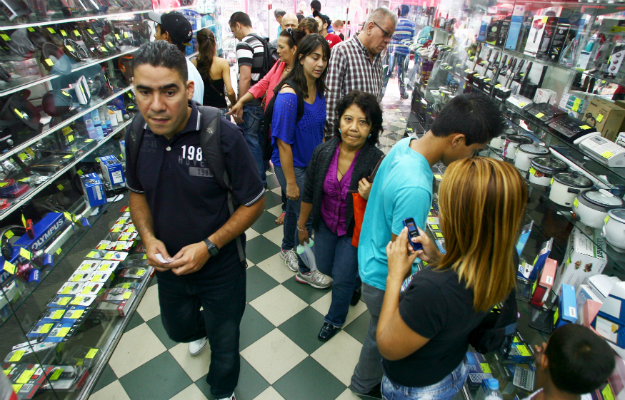
In effect, when the value of the U.S. dollar goes up compared to the BsF, what people are able to buy for their money (i.e. their wage value) goes down. The less ideologically pure are already seeing the effect of devaluation when they go to stores.(As seen in the photo above, Venezuelans are making a run to electronics stores, to buy what they can before already expensive goods become unaffordable.)

Using the black market, of course, is not an easy proposition. Selling small amounts revolves around people you trust — relatives, or friends. Selling dollars to people on the street could lead to a mugging or getting counterfeit money in return.

Finding dollars in small amounts is easier than finding them in large quantities. Multinational companies wishing to repatriate dividends, for example, have a difficult time finding people willing to sell large amounts of dollars. There are stories of “shadow traders,” companies who are able to illegally exchange large amounts of dollars at the black market rate via a complicated scheme of international transfers. Local economists say that the supply of those dollars comes from two main sources: importers with access to official dollars, and the government itself.

The dollar may be losing luster in other parts of the world, but in Venezuela it remains the benchmark for price-setting and the preferred means to store wealth. Here, green still rules.

To read this article at Foreign Policy, please click here.

 
Jan
6
2012
Posted by
admin
Comments

In Case You Missed It… Articles Roundup Week of 1/6/12

In this week’s roundup…ICSID rules on ExxonMobil’s arbitration claim against Venezuela; Inflation tops 27% in 2011 in Venezuela, while experts warn that President Chávez’s election-year spending spree may make that number even higher in 2012; Chávez continues his “Gold Rush;” Venezuela’s inability to develop its natural gas industry will result in more imports; and The Economist urges Chávez to come clean about his health.

Panel Deals a Setback to Exxon in Venezuela, The Wall Street Journal

An international arbitration panel awarded Exxon Mobil Corp. about $908 million in a verdict over oil assets nationalized by Venezuelan President Hugo Chávez in 2007, the company said late Saturday.

The payout was substantially lower than the $7 billion that Exxon was seeking in restitution and is likely to be a boon for Venezuela’s leftist government, which in recent years has embarked on a nationalization campaign to centralize control over key economic sectors. State oil company Petróleos de Venezuela SA said Monday it will pay Exxon a total of $255 million—after subtracting existing debt—over the next 60 days.

Heavy spending by Chavez in election year could boost 27 percent inflation in Venezuela, AP

President Hugo Chavez’s government is likely to spend heavily this year to rev up the economy during his re-election bid, and that could worsen one of Venezuela’s biggest problems: 27-percent annual inflation that is already close to the highest in the world. Chavez has started ramping up spending ahead of the October vote, and economists warn that more money injected into the economy will jolt prices. The government predicts 22 percent inflation in 2012, but the investment bank Barclays Capital projects that it could top 36 percent.

Venezuela to Leave 15 Tons of its Gold Reserves in Foreign Banks, Bloomberg

Venezuela will leave 15 tons of gold reserves in banks outside the country, Central Bank president Nelson Merentes said today. Venezuela held about 211 tons of its gold in Europe, Canada and Switzerland before it started repatriating the reserves last year, Merentes said on national radio. “It wasn’t necessary to have that much gold abroad for financial transactions,” Merentes said. “We’re going to keep bringing it back. Soon we will have the majority of our reserves in the Central Bank vault.”

Development problems force Venezuela to extend natural gas imports, Platts

Venezuela’s inability to develop its natural gas industry as planned has forced it to revise and extend a deal with Colombia’s state-controlled Ecopetrol and Chevron involving gas imports from the partners’ Guajira gas field in northeastern Colombia, a Caracas-based consultant said Wednesday.Since a 225-km binational gas pipeline was inaugurated in late 2007, Ecopetrol and Chevron have exported up to 250 million cubic feet of gas daily to mainly industrial clients in and around Maracaibo in western Venezuela’s Zulia state. Shipments in recent months have averaged 200 million cubic feet per day.

Cancer and the body politic, The Economist

Even by the standards of one of the world’s great conspiracy theorists, it was wacky stuff. On hearing the news that Argentina’s Cristina Fernández had become the fifth left-of-centre Latin American leader to be diagnosed with cancer in the past three years, Venezuela’s Hugo Chávez, himself unlucky enough to be one of them, mused that the United States might have developed technology to “induce cancer” in its political foes. “I don’t want to make any reckless accusation,” Mr. Chávez said disingenuously, “but it’s very, very, very strange.”