Feb
25
2013
Posted by
admin
Comments

ICYMI: Living through Venezuela’s currency madness

Foreign Policy
February 22, 2013
By Juan Nagel
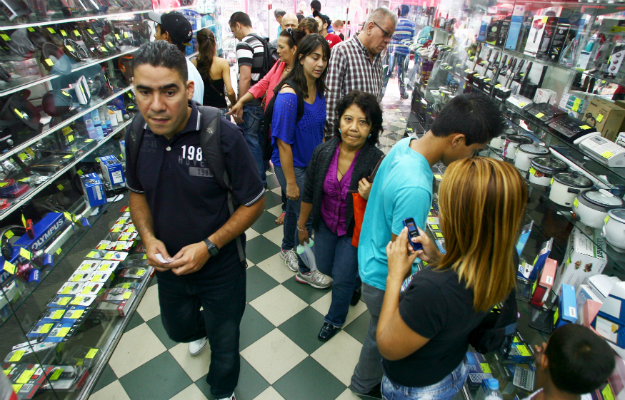
devaluation electronics edited 0 e1361823011751 ICYMI: Living through Venezuelas currency madness

Courtesy of: Agence France Presse

The U.S. dollar is facing competition from other currencies, but there is still one place, ironically, where the greenback is king: the streets of socialist, anti-imperialist Caracas. Everyone here wants dollars — from the importer looking to stay in business, to the mid-level professional wanting to save his Christmas bonus.

Venezuela has had a fixed exchange rate of 4.3 Bolivars (BsF) per dollar for years. By selling dollars in exchange for so few Bolivars, the local currency was severely overvalued. Propped up by oil exports (hence the term “petrodollars”), the government was effectively subsidizing imports and travel abroad. A few weeks ago, the government decided to devalue to 6.3 BsF per dollar.

But devaluation was not the only thing rocking the market. The official dollar is only available for procurement if you are buying some imports — food, medicine, airplane tickets, and the like. You can’t get them unless it’s for one of those approved purposes, leaving out many people who need them. The artificially low prices, combined with the scarcity of dollars, creates the perfect opportunity for a black market where you can buy USD at the official rate, and then sell them underhandedly at a jacked-up price for an easy profit. In the last few weeks, following the devaluation, the price of the dollar in the black market has shot up to BsF 22 per dollar, up from BsF 18 the week prior to devaluation.

Stroll through the streets of this chaotic capital, and it is not difficult to figure out how both of these events are affecting people.

I stop by a local café and order some breakfast. The owner, Aída, in her mid-50s, is in a mood to talk. She says that she doesn’t have “pastelitos,” a local pastry, because she cannot find the flour to make them. Flour, you see, is imported, and given the differential between official and black market rates, flour vendors would rather take their subsidized dollars and make money by selling them in the black market instead of using them to buy the flour they’re intended for.  Economists I’ve spoken with estimate that roughly 50 percent of the dollars approved to import basic staples end up in the black market instead.

I ask Aída if there is a black market for flour. She says she doesn’t know of any. The price of flour is controlled, so flour vendors can’t really use the black market for dollars to import flour and sell it a profit. The end result is that Aída, like thousands of other small business people, can’t sell her pastelitos. The flour is simply not there.

Devaluation supposedly means that flour prices will have to go up, as local businesses have to pass the cost increase to their customers, but the government has already signaled that prices will remain fixed. It may be weeks before flour is on the shelves again. And even if it is, there is no guarantee that the government will allow Aída to transfer the increase in the cost of flour to her customers.

Everyone who imports something has been affected. Everything from the wrappers that you use to store potato chips to the metal linings you put on the coffins you sell is affected by the government’s decision. Vendors lucky enough not to be under the government’s magnifying glass are simply jacking up prices to reflect the black market rate. Some furniture vendors, for example, will quote prices in dollars, and then will whip out a calculator to translate it to local currency at the day’s black market rate.

Ordinary chavistas say that devaluation doesn’t affect them since they do not use dollars. This, however, ignores the reality that the dollar plays in the distribution channel of most consumer goods in the country.

In effect, when the value of the U.S. dollar goes up compared to the BsF, what people are able to buy for their money (i.e. their wage value) goes down. The less ideologically pure are already seeing the effect of devaluation when they go to stores.(As seen in the photo above, Venezuelans are making a run to electronics stores, to buy what they can before already expensive goods become unaffordable.)

Using the black market, of course, is not an easy proposition. Selling small amounts revolves around people you trust — relatives, or friends. Selling dollars to people on the street could lead to a mugging or getting counterfeit money in return.

Finding dollars in small amounts is easier than finding them in large quantities. Multinational companies wishing to repatriate dividends, for example, have a difficult time finding people willing to sell large amounts of dollars. There are stories of “shadow traders,” companies who are able to illegally exchange large amounts of dollars at the black market rate via a complicated scheme of international transfers. Local economists say that the supply of those dollars comes from two main sources: importers with access to official dollars, and the government itself.

The dollar may be losing luster in other parts of the world, but in Venezuela it remains the benchmark for price-setting and the preferred means to store wealth. Here, green still rules.

To read this article at Foreign Policy, please click here.

 
Feb
4
2013
Posted by
admin
Comments

ICYMI: Covert Flour Deals Show Venezuela Woe

Wall Street Journal
February 3, 2013
By Kejal Vyas

WO AM587 VENSHO G 20130203181503 e1360009164793 ICYMI: Covert Flour Deals Show Venezuela Woe

Courtesy of: AFP/Getty Images

CARACAS—On any given day at the Quinta Crespo wholesale market, dozens of people lurk in the back alleys trying to get their hands on a white powder. Dealers sell it on the sly at inflated prices, careful to avoid patrolling National Guardsmen who can arrest them.

But this is no illicit substance trading hands in this grimy downtown bazaar: It is corn flour, used to make Venezuela’s staple food, the pancake arepa.

In oil-rich Venezuela, the worst food and consumer-goods shortages in nearly four years are making buying flour and other goods such as meat, sugar, cooking oil and toilet paper into a harrowing ordeal. Even medicines, like asthma inhalers, are hard to come by.

WO AM575 VENSHO G 20130203175404 ICYMI: Covert Flour Deals Show Venezuela Woe

Courtesy of: Wall Street Journal

Business leaders say the explanation is simple: Currency controls adopted in 2003 to prevent capital flight also complicate the purchase of imports, while price caps, expanded in late 2011, don’t cover production costs.

Economists say the shortages those factors created were exacerbated by President Hugo Chávez’s overspending during his re-election campaign last year.

The shortages have become the government’s latest challenge, as it deals with the political uncertainty of Mr. Chávez’s now six-week absence from Venezuela as he recovers from cancer in Cuba.

The central bank’s Scarcity Index, a measure of the percentage of products missing from store shelves, jumped to 16.3% in December, the highest level since May 2008 due to price controls that were too low, many economists say.

“Here you have to know someone, know the right people, before you can get what you want,” said Antonio González, a 22-year-old bakery worker out looking for supplies in Quinta Crespo on a recent day.

Despite neon-colored signs posted outside stores saying sugar and flour are out of stock, Mr. González said some owners sell to preferred customers ready to spend anywhere from 30% to 90% above state-regulated levels.

The ingredients are unlikely to go toward products with low state-controlled prices, such as loaves of bread that cost 3 Venezuelan bolívars (70 cents). Instead, they are likely to be used for unregulated items like breads stuffed with cheese or ham, which can command more than 20 bolívars.

In the wealthier neighborhood of Chacao, many bakeries have limited customers to buying two baguettes. Many supermarkets remind shoppers they can purchase no more than two packages of cooking oil or corn flour, products whose prices are regulated. Long lines of customers buying rationed goods are a common sight.

Venezuela’s largest food packager and distributor, Empresas Polar, said in a recent report that the cost of buying white corn, among other raw materials it uses in its popular P.A.N. brand corn flour, was 50% above price-control levels.

The government acknowledges the latest wave of shortages, but it blames an unusual January rise in food consumption, as well as hoarders and speculators that it says seek to destabilize its socialist project.

In recent weeks, state television has broadcast live searches of warehouses for hidden inventory. Food Minister Carlos Osorio recently said that more than 17,000 tons of foodstuffs had been confiscated in recent weeks as authorities cracked down on around 3,000 storage houses allegedly hoarding goods.

“There are sectors of the opposition that want you to think that there is this total lack of food,” Mr. Osorio said in televised comments.

One official from a large Venezuelan food-packaging company denied that his company was hoarding. He called the government inspections of warehouses “political theater,” adding that state regulations require companies to frequently record movement of their supplies and “they already know how much inventory we have at all times.”

Ángel García Banchs, head of local economic-research house Econometrica, said in an opinion column: “There’s only one strategy left for the government, even though it’s a failed one from my point of view: to design and execute a media campaign to blame the shortages on private national companies.”

Despite price caps, many goods are sold at unofficial, higher prices. Central bank data show an unusual 5.7% rise in the prices of foods and nonalcoholic drinks in December.

Critics say the government flooded the market with dollars last year ahead of Mr. Chávez’s successful October re-election bid. The central bank’s 2012 annual report showed imports jumped 20% on the year to $56.4 billion, the highest in 16 years.

Since the October vote, the flow of dollars to the private sector has dried up. The dollar shortage has caused the black-market rate for the dollar to nearly double to 17.5 bolívars from October.

Last month, Venezuelan authorities announced a change to the tax system that it applies on its oil partners, a move that officials said will send $2.47 billion more to the central bank, which will be able to distribute the hard currency into the local economy.

Economists say Venezuela needs to change its currency-control system. One such move could be a devaluation of the state-set exchange rate of 4.3 bolívars per dollar. That would leave more dollars to distribute in the local economy, economists say.

But a devaluation would also exacerbate already high inflation by making the cost of imports higher in bolívar terms.

With Mr. Chávez ill, his government could be wary of any move that might spark discontent.

“If this is not a sign of a looming crisis, then only god knows what it will happen,” wrote Mr. Garcia Banchs, the economist.

To read this article at the Wall Street Journal, please click here.

 
Apr
27
2012
Posted by
admin
Comments

In Case You Missed It… Articles Roundup Week of 4/27/12

This week: Venezuela’s stocks rise a staggering 99 percent on the speculation that Chávez’s health is rapidly deteriorating; Venezuelans go 11 days without a public statement or appearance by their president; Chávez, meanwhile, continues to shuttle back and forth from Cuba for treatment; he runs the government via twitter during his absences; a New York Times opinion writer reports that the Chávez executive branch had “the last word” on every judicial decision rendered by Venezuela’s Supreme Court; that, along with continuing allegation of bribery by drug lords, keeps the issue of Venezuela’s public-sector corruption in the news. Meanwhile, the World Bank director warns that Venezuela will suffer economically if and when oil prices fall; finally, inflation continues to soar and Venezuelans face shortages of even the most basic goods.

Chavez’s mysterious ailment fuels a run on Venezuelan stocks, The Washington Post

What is the hottest global market so far in 2012? How about socialist Venezuela — where stocks rose 99 percent between Jan. 1 and this week.

Chavez: he’s back! (again), The Financial Times

And… he’s back – again. But after a deafeningly silent 11-day absence in Havana, this time Hugo Chávez returned on Thursday from his radiotherapy to greater speculation than ever that his cancer is more serious than he has so far let on.

Venezuela’s Chavez returns home, CNN

Venezuelan President Hugo Chavez returned home early Thursday after receiving cancer treatments in Cuba. Before landing, Chavez released a statement about coming back to his homeland.

Venezuelan politics in 140 characters or less, Foreign Policy

“Hello Venezuela! I inform you that I approved 1.95 billion bolívars for state and local governments, coming from extraordinary income! Onward!” The above is a rough translation of a tweet written by Venezuelan president Hugo Chávez on April 17.

Hugo Chávez & The Supremes, The New York Times

It happened every week. On Friday mornings, Venezuela’s top prosecutor, the justice minister, the solicitor general, assorted Supreme Court justices, police chiefs and top officials would meet in the vice president’s office to review politically sensitive court cases and decide how they should be handled.

Venezuela’s judiciary: Whistle-blown, The Economist

An impeached judge says the courts are subservient and corrupt. When Hugo Chávez became Venezuela’s president, in 1999, he promised an overhaul of the country’s notoriously venal judiciary. But according to charges made by a recently dismissed supreme-court justice, the flaws Mr Chávez vowed to rectify are nothing compared with what has transpired under his rule.

The Colombian-Venezuelan border: Pick your poison, The Economist

Drug gangs now dominate where guerrillas once reigned. In the last days of Álvaro Uribe’s presidency in 2010, Colombia accused neighbouring Venezuela of letting the FARC and ELN, the two main leftist guerrilla groups, maintain camps along its border. In response Hugo Chávez, Venezuela’s president, recalled his ambassador and skipped the inauguration of Mr Uribe’s successor, Juan Manuel Santos.

Accused drug dealer says paid off fugitive Venezuela judge, The Chicago Tribune

An accused Venezuelan drug lord wanted by the United States said on Wednesday he made monthly payments to a former judge who recently embarrassed President Hugo Chavez with accusations of widespread manipulation in the OPEC nation’s justice system.

World Bank director: Venezuela is not prepared for a fall in oil prices, El Universal

A World Bank director warned Tuesday that not all Latin American countries are equally prepared for an eventual fall in the price of commodities, because some of them, including Venezuela, acted “like the grasshopper of the Aesop fable” and “spent their time singing in the summer.”

With Venezuelan Food Shortages, Some Blame Price Controls, The New York Times

By 6:30 a.m., a full hour and a half before the store would open, about two dozen people were already in line. They waited patiently, not for the latest iPhone, but for something far more basic: groceries. “Whatever I can get,” said Katherine Huga, 23, a mother of two, describing her shopping list. She gave a shrug of resignation.