Feb
26
2013
Posted by
admin
Comments

ICYMI: Hugo Chavez’s legacy of economic chaos; Tough times ahead for Venezuela

José Cardenas is a former senior official at the U.S. State Department, National Security Council and the U.S. Agency for International Development, where he served as Acting Assistant Administrator for Latin America and the Caribbean. He is a regular What’s Next Venezuela contributor.
Venezuela Protest e1361899707868 ICYMI: Hugo Chavezs legacy of economic chaos; Tough times ahead for Venezuela

Courtesy of: Associated Press

Washington Times
February 26, 2013
By José Cardenas

The recent return home from Cuba in the dead of night of cancer-stricken Venezuelan President Hugo Chavez is likely not a sign that his condition is improving. In fact, it is more likely that his doctors have decided there is nothing more they can do than to allow him to go home to die peacefully, surrounded by family.

That suits just fine senior Venezuelan officials and their Cuban minders, who need Mr. Chavez’s physical presence nearby to better stage-manage a chavista succession. They now can tell the Venezuelan people, with whom Mr. Chavez maintains a deeply emotional connection, that the “comandante” remains intimately involved in the process, “approving” all decisions.

It appears the only decision to be made at this point, however, is whether Mr. Chavez’s inner circle declares the ailing leader “incapacitated” or whether they wait out the inevitable before calling elections within 30 days, as the constitution mandates.

If they have their wits about them, they probably will move to “retire” the Venezuelan leader sooner rather than later. A few months down the road, they are likely to be facing a much less favorable political climate than they are enjoying today. That’s because Mr. Chavez has bequeathed to them a ticking economic time bomb, which is set to blow up in the faces of the very people Mr. Chavez has claimed to represent — the poor and working masses.

Much will be written in the coming weeks that Mr. Chavez’s legacy is that he transformed Latin American politics by giving a voice to the voiceless. Less will be focused on just what the cost will be to those very same people, as well as their children.

Once the emotion of the moment passes, Venezuelans will be left to pick up the pieces from Mr. Chavez’s gross mismanagement of the Venezuelan economy. To squander Venezuela’s vast oil wealth takes real effort, but Mr. Chavez and his profligate spending proved up to the task. In what has been an abject lesson in the perils of populist economics, his actual legacy will be soaring inflation, a bloated public sector, a crippled private one, electricity blackouts, shortages of basic goods and one of the highest homicide rates in the world.

The first sign of more difficult days ahead came on Feb. 8, when the government ordered a 46 percent devaluation of the country’s currency. Inflation, already running at 22 percent, is now expected to surge, prices of goods will increase, and shortages of items such as toilet paper and cornmeal (the staple of arepa cakes) and even automobiles will grow worse.

Of course, the burden of such economic dysfunction always falls on the poor and working classes, who devote a higher portion of their incomes to basic necessities. As a result of the devaluation, Venezuelans’ real income is expected to decrease by 20 percent this year, at the time when their purchasing power already has dropped to 1966 levels.

What’s more, it will only get worse. Analysts say another devaluation is almost inevitable, given that this latest one will not come close to balancing the government’s books. Rumors are also rampant that the government will soon introduce rationing measures for basic food items.

Nor is any relief likely to come from the private sector, which has been plagued by price and currency controls, expropriations, government interventions, legal uncertainty and oppressive labor laws. Indeed, under Mr. Chavez, the number of private companies has dropped from 14,000 to 9,000. While a decade ago, 8 out of 10 jobs were generated by the private sector, today that figure is 6 out of 10.

Neither does it appear that China is willing to continue to pay Venezuela’s bills. Having already lent Mr. Chavez $39 billion against future oil sales, it recently sent home Venezuelan Foreign Minister Elias Jaua empty-handed, with no indication that further loans were in the offing.

The fix is already in that the uncharismatic Nicolas Maduro will be entrusted with trying to keep chavismo alive without Mr. Chavez. Whether he and his Cuban advisers can successfully exploit Mr. Chavez’s image to confront formidable challenges on the horizon remains to be seen. One thing is certain, however: As opposition leader Henrique Capriles tweeted upon Mr. Chavez’s return to Venezuela, “Hopefully the president’s return means that Mr. Maduro and his ministers can get to work. There are thousands of problems to resolve.” Without a doubt.

To read this article at The Washington Times, please click here.
 
Feb
25
2013
Posted by
admin
Comments

ICYMI: Living through Venezuela’s currency madness

Foreign Policy
February 22, 2013
By Juan Nagel

devaluation electronics edited 0 e1361823011751 ICYMI: Living through Venezuelas currency madness

Courtesy of: Agence France Presse

The U.S. dollar is facing competition from other currencies, but there is still one place, ironically, where the greenback is king: the streets of socialist, anti-imperialist Caracas. Everyone here wants dollars — from the importer looking to stay in business, to the mid-level professional wanting to save his Christmas bonus.

Venezuela has had a fixed exchange rate of 4.3 Bolivars (BsF) per dollar for years. By selling dollars in exchange for so few Bolivars, the local currency was severely overvalued. Propped up by oil exports (hence the term “petrodollars”), the government was effectively subsidizing imports and travel abroad. A few weeks ago, the government decided to devalue to 6.3 BsF per dollar.

But devaluation was not the only thing rocking the market. The official dollar is only available for procurement if you are buying some imports — food, medicine, airplane tickets, and the like. You can’t get them unless it’s for one of those approved purposes, leaving out many people who need them. The artificially low prices, combined with the scarcity of dollars, creates the perfect opportunity for a black market where you can buy USD at the official rate, and then sell them underhandedly at a jacked-up price for an easy profit. In the last few weeks, following the devaluation, the price of the dollar in the black market has shot up to BsF 22 per dollar, up from BsF 18 the week prior to devaluation.

Stroll through the streets of this chaotic capital, and it is not difficult to figure out how both of these events are affecting people.

I stop by a local café and order some breakfast. The owner, Aída, in her mid-50s, is in a mood to talk. She says that she doesn’t have “pastelitos,” a local pastry, because she cannot find the flour to make them. Flour, you see, is imported, and given the differential between official and black market rates, flour vendors would rather take their subsidized dollars and make money by selling them in the black market instead of using them to buy the flour they’re intended for.  Economists I’ve spoken with estimate that roughly 50 percent of the dollars approved to import basic staples end up in the black market instead.

I ask Aída if there is a black market for flour. She says she doesn’t know of any. The price of flour is controlled, so flour vendors can’t really use the black market for dollars to import flour and sell it a profit. The end result is that Aída, like thousands of other small business people, can’t sell her pastelitos. The flour is simply not there.

Devaluation supposedly means that flour prices will have to go up, as local businesses have to pass the cost increase to their customers, but the government has already signaled that prices will remain fixed. It may be weeks before flour is on the shelves again. And even if it is, there is no guarantee that the government will allow Aída to transfer the increase in the cost of flour to her customers.

Everyone who imports something has been affected. Everything from the wrappers that you use to store potato chips to the metal linings you put on the coffins you sell is affected by the government’s decision. Vendors lucky enough not to be under the government’s magnifying glass are simply jacking up prices to reflect the black market rate. Some furniture vendors, for example, will quote prices in dollars, and then will whip out a calculator to translate it to local currency at the day’s black market rate.

Ordinary chavistas say that devaluation doesn’t affect them since they do not use dollars. This, however, ignores the reality that the dollar plays in the distribution channel of most consumer goods in the country.

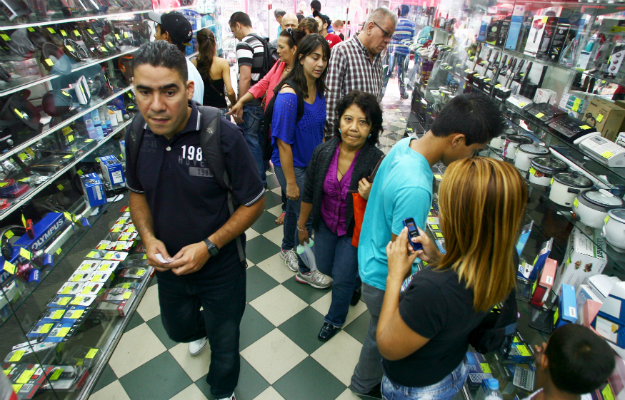
In effect, when the value of the U.S. dollar goes up compared to the BsF, what people are able to buy for their money (i.e. their wage value) goes down. The less ideologically pure are already seeing the effect of devaluation when they go to stores.(As seen in the photo above, Venezuelans are making a run to electronics stores, to buy what they can before already expensive goods become unaffordable.)

Using the black market, of course, is not an easy proposition. Selling small amounts revolves around people you trust — relatives, or friends. Selling dollars to people on the street could lead to a mugging or getting counterfeit money in return.

Finding dollars in small amounts is easier than finding them in large quantities. Multinational companies wishing to repatriate dividends, for example, have a difficult time finding people willing to sell large amounts of dollars. There are stories of “shadow traders,” companies who are able to illegally exchange large amounts of dollars at the black market rate via a complicated scheme of international transfers. Local economists say that the supply of those dollars comes from two main sources: importers with access to official dollars, and the government itself.

The dollar may be losing luster in other parts of the world, but in Venezuela it remains the benchmark for price-setting and the preferred means to store wealth. Here, green still rules.

To read this article at Foreign Policy, please click here.

 
Feb
13
2013
Posted by
admin
Comments

ICYMI: Chavez devalued

Financial Times
February 12, 2013

iNaFVRRxbFOc1 e1360787398550 ICYMI: Chavez devalued

Courtesy of: Bloomberg

Winston Churchill governed while ill, for a while. So too did Woodrow Wilson. But Hugo Chávez, Venezuela’s socialist president, has taken sickbed policy making to a whole new level – and country.

Last Friday, as most Venezuelans headed off to carnival, the cancer-ridden Mr Chávez ordered a devaluation in absentia from his hospital bed in Havana. The last person to govern Venezuela from abroad was Cipriano Castro, in the early 20th century, and that did not end well. When the “Monkey of the Andes” travelled to Germany for kidney treatment, his government was overthrown.

Mr Chávez’s devaluation will have political costs. But a similar immediate fate is unlikely for his government. Yes, the move was overdue; that was apparent in growing shortages. But the devaluation will not, by itself, correct the accumulated distortions of years of mismanagement. Nor is the 32 per cent devaluation steep enough; the black market rate remains more than three times the official one. In time-honoured tradition though, what it does do is solve a looming problem. Because Venezuela’s dollar-denominated oil revenues are now worth more in local currency, the devaluation helps plug a yawning budget deficit.

This hole in Venezuela’s government accounts opened up after the chavista machine increased spending by an extraordinary 25 per cent in the run-up to last October’s election. Now the bill has come due – although it is ordinary Venezuelans who will largely meet the cost, through high inflation. The government, by contrast, gains more money to spend. That will be handy for when Mr Chávez’s successor fights the next election.

Such politically driven spending splurges are not unique to Venezuela. Argentina also drove a 25 per cent real increase in government spending before Cristina Fernández’s re-election in 2011. Argentina now suffers a widening fiscal deficit, high inflation, and a “parallel” exchange rate 50 per cent cheaper than the official one. That is no accident. At some point, too, it will have to be addressed.

Such problems are well heeded in the region. A decade ago, Latin America was supposedly threatened by a rising “pink tide”. Instead, pragmatism has largely become the norm. True, several other countries, such as Brazil and Chile, have currency problems too. But their exchange rates are appreciating thanks to abundant capital inflows, not devaluing because of capital outflows. In short, they are suffering the problems of success, while the pink tide washes out.

To read this article at the Financial Times, please click here.