Feb
26
2013
Posted by
admin
Comments

ICYMI: Hugo Chavez’s legacy of economic chaos; Tough times ahead for Venezuela

José Cardenas is a former senior official at the U.S. State Department, National Security Council and the U.S. Agency for International Development, where he served as Acting Assistant Administrator for Latin America and the Caribbean. He is a regular What’s Next Venezuela contributor.
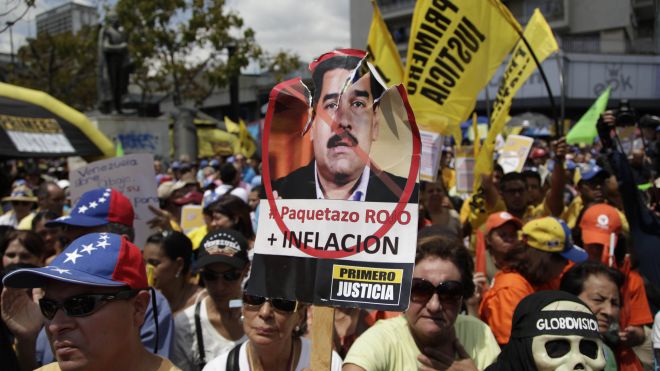
Venezuela Protest e1361899707868 ICYMI: Hugo Chavezs legacy of economic chaos; Tough times ahead for Venezuela

Courtesy of: Associated Press

Washington Times
February 26, 2013
By José Cardenas

The recent return home from Cuba in the dead of night of cancer-stricken Venezuelan President Hugo Chavez is likely not a sign that his condition is improving. In fact, it is more likely that his doctors have decided there is nothing more they can do than to allow him to go home to die peacefully, surrounded by family.

That suits just fine senior Venezuelan officials and their Cuban minders, who need Mr. Chavez’s physical presence nearby to better stage-manage a chavista succession. They now can tell the Venezuelan people, with whom Mr. Chavez maintains a deeply emotional connection, that the “comandante” remains intimately involved in the process, “approving” all decisions.

It appears the only decision to be made at this point, however, is whether Mr. Chavez’s inner circle declares the ailing leader “incapacitated” or whether they wait out the inevitable before calling elections within 30 days, as the constitution mandates.

If they have their wits about them, they probably will move to “retire” the Venezuelan leader sooner rather than later. A few months down the road, they are likely to be facing a much less favorable political climate than they are enjoying today. That’s because Mr. Chavez has bequeathed to them a ticking economic time bomb, which is set to blow up in the faces of the very people Mr. Chavez has claimed to represent — the poor and working masses.

Much will be written in the coming weeks that Mr. Chavez’s legacy is that he transformed Latin American politics by giving a voice to the voiceless. Less will be focused on just what the cost will be to those very same people, as well as their children.

Once the emotion of the moment passes, Venezuelans will be left to pick up the pieces from Mr. Chavez’s gross mismanagement of the Venezuelan economy. To squander Venezuela’s vast oil wealth takes real effort, but Mr. Chavez and his profligate spending proved up to the task. In what has been an abject lesson in the perils of populist economics, his actual legacy will be soaring inflation, a bloated public sector, a crippled private one, electricity blackouts, shortages of basic goods and one of the highest homicide rates in the world.

The first sign of more difficult days ahead came on Feb. 8, when the government ordered a 46 percent devaluation of the country’s currency. Inflation, already running at 22 percent, is now expected to surge, prices of goods will increase, and shortages of items such as toilet paper and cornmeal (the staple of arepa cakes) and even automobiles will grow worse.

Of course, the burden of such economic dysfunction always falls on the poor and working classes, who devote a higher portion of their incomes to basic necessities. As a result of the devaluation, Venezuelans’ real income is expected to decrease by 20 percent this year, at the time when their purchasing power already has dropped to 1966 levels.

What’s more, it will only get worse. Analysts say another devaluation is almost inevitable, given that this latest one will not come close to balancing the government’s books. Rumors are also rampant that the government will soon introduce rationing measures for basic food items.

Nor is any relief likely to come from the private sector, which has been plagued by price and currency controls, expropriations, government interventions, legal uncertainty and oppressive labor laws. Indeed, under Mr. Chavez, the number of private companies has dropped from 14,000 to 9,000. While a decade ago, 8 out of 10 jobs were generated by the private sector, today that figure is 6 out of 10.

Neither does it appear that China is willing to continue to pay Venezuela’s bills. Having already lent Mr. Chavez $39 billion against future oil sales, it recently sent home Venezuelan Foreign Minister Elias Jaua empty-handed, with no indication that further loans were in the offing.

The fix is already in that the uncharismatic Nicolas Maduro will be entrusted with trying to keep chavismo alive without Mr. Chavez. Whether he and his Cuban advisers can successfully exploit Mr. Chavez’s image to confront formidable challenges on the horizon remains to be seen. One thing is certain, however: As opposition leader Henrique Capriles tweeted upon Mr. Chavez’s return to Venezuela, “Hopefully the president’s return means that Mr. Maduro and his ministers can get to work. There are thousands of problems to resolve.” Without a doubt.

To read this article at The Washington Times, please click here.

 
Sep
17
2012
Posted by
admin
Comments

ICYMI: Venezuela Risks Default If Chavez Wins, Morgan Stanley Sa

Bloomberg
September 14, 2012
By Charlie Devereux

i2CwsOAj.qb8  ICYMI: Venezuela Risks Default If Chavez Wins, Morgan Stanley Sa

Courtesy of: Bloomberg

Venezuela could default on its debt as early as the second half of 2013 if President Hugo Chavez wins re-election next month and fails to shore up the oil- producing nation’s “increasingly fragile” balance sheet, Morgan Stanley said.

One “tipping point” could be the $4.3 billion in external debt payments that come due between August and November 2013, Morgan Stanley analyst Daniel Volberg wrote in a note to clients today.

Chavez, who is seeking to extend almost 14 years in power with another six-year term, has damaged Venezuela’s balance sheet through the nationalization of key sectors of the economy, endemic inflation and a lack of fiscal discipline, Volberg said. The policies are an “unsustainable” mix that heighten the risk of default on Venezuela’s $110.6 billion stock of debt, especially if oil prices tumble, Volberg wrote.

Government actions “may be taking Venezuela towards a crisis and potentially even a debt event that could come as early as the second half of 2013,” the report said. “Venezuela’s debt is no longer with large bank lenders as much as publicly traded bonds held by a dispersed group of creditors, which could make restructuring more challenging.”

At 11.6 percent of gross domestic product, Venezuela has the largest fiscal deficit in Latin America, while its international reserves have fallen by $17 billion since 2008 to $25.6 billion, Volberg said. Output by state oil company Petroleos de Venezuela SA fell to 2.72 million barrels a day in 2011 from 3.48 million barrels in 1998, according to British Petroleum’s statistical review.

Bond Yields

The yield on Venezuela‘s benchmark 9.25 percent bonds due in 2027 fell 11 basis points, or 0.11 percentage point, to 10.77 percent at 11:27 a.m. in Caracas, according to data compiled by Bloomberg. The bond’s price rose 0.74 cent today to 88.80 cents on the dollar.

The cost of insuring Venezuelan bonds against default for five years rose four basis points to 737 basis points, according to prices compiled by Bloomberg. Credit-default swaps pay the buyer face value in exchange for the underlying securities or the cash equivalent should a government or company fail to comply with debt agreements.

Chavez said Sept. 11 that he had 43.1 percent support against 30 percent for opposition candidate Henrique Capriles Radonski in the latest poll conducted by Datanalisis. He didn’t give details of the survey.

The two previous Datanalisis polls showed Chavez with a lead of 12.1 and 14.3 percentage points respectively, he said. In an August Consultores 21 poll of 1,000 people, Chavez trailed Capriles by 47.7 percent to 45.9 percent.

To contact the reporter on this story: Charlie Devereux in Caracas at [email protected].

To contact the editor responsible for this story: Joshua Goodman at [email protected].

To read this article on Bloomberg, please click here.

 
Jul
6
2010
Posted by
admin
Comments

Problems in Venezuela with the Electricity supply at a crossroad

While the looming collapse or shutdown of the Guri dam has been overcome thanks to the blessing of the rains, the National Electrical Grid (SEN) is at a “turning point,” José Aguilar, an engineer and international electricity advisor, said.

Other experts warn against considerable vulnerability in distribution and transmission components; hence a fitful service nationwide. Aguilar made specific reference to the unbalance or break of electric power generation in Venezuela.

In the expert’s view, the grid is already “at a crossroads.” “For the first time, there is less and less power available in the hydroelectric system, compared with the thermal electric generation system. This is basically because in three and a half years it was destroyed what took decades to build to the country’s benefit.”

Aguilar explained that multiple factors have led to such an “unthinkable” scenario, such as “overexploitation of the Guri dam; a neglected, chronically deteriorated and lagged behind the thermal electric system including projects that have not been implemented and less maintenance than needed.” In addition, the expert said, “the grid operating margin have been undermined due to the growing demand, as a result of the energy gap and the National Electricity Rationing Plan,” effective until June 10.

Such a “serious situation reduces the grid operations and severely restricts the operating range to implement the required maintenance shutdown in the face of a fast deterioration rate in both types of electric power generation. Therefore, two big blocks of thermal electric power are promptly needed. Distributed generation is not the solution.” “We have reached the limit of the operational range; additional failures at the Guri dam would unleash even a more acute energy gap,” the specialist in hydrothermal units noted.