Oct
3
2013
Posted by
admin
Comments

ICYMI: To Venezuelans, Heir of Chavez Is a Poor Copy

The New York Times
October 2, 2013
By William Neuman

VENEZUELA articleLarge e1380753017255 ICYMI: To Venezuelans, Heir of Chavez Is a Poor Copy

Courtesy of: The New York Times

CARACAS, Venezuela — The start of the season for two premier teams in this baseball-loving nation was thrown into doubt after thieves stripped vast amounts of copper wire from the lights in this city’s main stadium. Basic items are often so hard to find that when a truck driver slumped dead at the wheel after a highway accident last week, motorcycle-riding looters swarmed in to grab the cargo: tons of red meat.

Prices are soaring, the country is plagued by electrical blackouts, some neighborhoods go days without water, and protests tangle the already stifling traffic. To top it all off, the cheap beer that helps people let off steam at many a weekend party has suddenly become scarce, too.

Nearly seven months after the death of Hugo Chávez, the country’s longtime leftist president and father figure, there is a growing sense that things are falling apart.

The new president, Nicolás Maduro, has revived a longtime scapegoat for the country’s woes, accusing Washington of conspiring with other enemies of the government in waging an “economic war” that has subjected the populace to blackouts, chronic shortages and other ills. Borrowing from Mr. Chávez’s script, Mr. Maduro on Monday expelled the top American diplomat here and two other embassy officials, contending that they were plotting to destabilize the country.

But while Mr. Chávez skillfully portrayed the United States as an imperialist bully and cast himself in the role of underdog hero, many Chávez supporters are finding Mr. Maduro’s attempts to imitate his mentor unconvincing.

“This is the biggest mistake Chávez ever made,” said Axel Ortiz, 20, a student, referring to Mr. Chávez’s choice of Mr. Maduro as his successor. Mr. Ortiz still defines himself as a Chavista — a loyal Chávez supporter — but he questioned Mr. Maduro’s ability to solve the nation’s problems. “Chávez was the only one who was qualified, the only one who could keep things here under control.”

The country’s economic problems have become acute. Inflation in the first eight months of this year was more than triple the rate in the same period last year. When measured over the 12 months that ended in August, it exceeded 45 percent. A government indicator that measures the scarcity of basic goods is close to its highest level in more than five years.

Many stores allow customers to buy only a limited number of scarce items like corn flour and cooking oil. People complain of having to stand in line for hours, often in vain, and many are losing patience with the government’s explanation that unsavory conspirators are to blame for the nation’s problems.

“The government is resorting to more and more outrageous and extravagant actions and statements to control the agenda,” said Andrés Cañizalez, a communications professor at Andrés Bello Catholic University.

All of this would be a lot to handle for any neophyte president, but the gaffe-prone Mr. Maduro has come under withering criticism for regularly tripping over his words, eliciting cringes from supporters and jeers from opponents. When he fell off his bicycle on live television recently, the event threatened to become a metaphor for a struggling presidency.

“People laugh at him,” said María López, 32, a mother of two on a recent morning in the Terrazas del Alba slum in the center of Caracas. She voted for Mr. Maduro, and said she still supported him. But she fought back a smirk when asked about Mr. Maduro’s bicycle accident, which occurred during a ride to promote his party’s youth movement. “We don’t want a president who’s a joke,” she said.

The blunders have piled up, much like the entourage of politicians and bodyguards who screeched to a halt in a tangle behind the president’s fallen bicycle.

In one of his most infamous verbal flubs, in August, Mr. Maduro sought to make a reference to the biblical story of Jesus’ multiplying the loaves and fishes — only to have it come out of his mouth as “the multiplication of the penises.” Mr. Maduro apparently conflated “peces” (fish) and “panes” (loaves) to produce “penes” (penises). He quickly apologized and corrected himself, but the damage was done.

“A person who doesn’t know how to speak will never know how to run a country,” said Jorge Flores, 30, a messenger at a government-run hospital, who voted for Mr. Maduro but now bitterly regrets doing so.

“This is the worst government I’ve ever seen,” Mr. Flores said. “The best government we’ve ever had here was with Chávez.”

Mr. Maduro calls his critics elitists and once said he had misspoken on purpose to bait his detractors.

Mr. Chávez, a fiery socialist, had a connection with ordinary Venezuelans that was so strong they often refused to blame him for many of the same problems that continue to bedevil the country. Mr. Maduro does not have the same charisma, and at least some of Mr. Chávez’s followers seem to be tuning him out.

“The government does these things to distract us from our real problems,” said Cristian Nivela, 24, a Chávez loyalist who voted for Mr. Maduro, referring to the expulsion of the American diplomats.

On Tuesday, Mr. Maduro used a special national television broadcast to present what he said was evidence that the diplomats had been conspiring with the extreme right in Venezuela to destabilize the country.

He showed a video, accompanied by ominous music, contending that the top diplomat at the United States Embassy, Kelly Keiderling, and the other two expelled diplomats had met in recent weeks with elected officials — including a state governor and a mayor — who belong to the Venezuelan opposition. The video also showed them leaving a meeting at the office of a pro-democracy group.

“These officials are meeting, well, in a shameless manner, and talking about strikes, sabotage, talking about the internal affairs of Venezuela, offering money,” Mr. Maduro said.

Such accusations resonate here because of the United States’ history of intervention in Latin America, including its tacit support of a 2002 coup that briefly ousted Mr. Chávez.

But a State Department official called the accusations absurd.

“Our diplomats were doing what they do all over the world,” said the official, Roberta S. Jacobson, assistant secretary of state for Western Hemisphere affairs. “They were visiting parts of the country and talking to all kinds of different people. They were doing nothing covert or out of the ordinary for diplomats.”

She said that in response, the United States was expelling the top Venezuelan diplomat in Washington and two other Venezuelan Embassy officials. The United States and Venezuela do not maintain an ambassador in each other’s capital.

On Tuesday night the State Department identified the Venenezuelan diplomats, who were given 48 hours to leave the country, as the charge d’affaires, Calixto Ortega Rios, and Second Secretary Monica Alejandra Sanchez Morales, both of whom are assigned to the country’s embassy in Washington, and Marisol Gutierrez de Almeida, the consul in Houston,

“It is regrettable that the Venezuelan government has again decided to expel U.S. diplomatic officials based on groundless allegations, which require reciprocal action. the State Department said in a statement. “It is counterproductive to the interests of both our countries.”

With the diplomatic tussle in the background, officials said the burglarized stadium — home to the Caracas Lions and the La Guaira Sharks, roughly equivalent to the Yankees and Mets in Venezuelan baseball — would be ready for the start of the season on Oct. 10.

They said workers had finally finished repairs to the lighting system after thieves stripped out much of the wiring, in a very public example of the crime, corruption and disarray in this country.

But the looting of the meat truck on Friday was shocking even to many who have become inured to the high levels of violence here. The truck became stuck under a barrier meant to block oversize vehicles. Part of the cargo crushed the top of the cab.

Denny Medina, 44, the owner of a fleet of trucks, said that he had tried to rescue the driver, but that he could not open the door. Instead of helping, he said, looters clambered over the vehicle.

“What made me feel powerless was to see the people carrying off the boxes of meat, and no one was showing any concern for the driver right below them,” Mr. Medina said. “It was terrible. I hope that we don’t get used to this.”

To read this article at The New York Times, please click here.
 
Apr
2
2013
Posted by
admin
Comments

ICYMI: Tough times ahead in post-Chavez Venezuela

The Associated Press
April 1, 2013
By Fabiola Sanchez

ijKok4dzw3DM e1364924737530 ICYMI: Tough times ahead in post Chavez Venezuela

Courtesy of: Bloomberg

CARACAS, Venezuela (AP) — Doing business in post-Hugo Chavez Venezuela is not for the faint of heart.

Thousands of companies suffer under currency controls that all but deny them the U.S. dollars they need to import vital items into this oil-rich country, from food to cars to spare parts — even gasoline. Venezuelan firms must sell their wares at state-controlled prices that don’t reflect the 22 percent inflation rate, the highest in Latin America. Even Venezuela’s socialist government admits the controls don’t work — but its attention is focused on the April 14 election to replace the late President Hugo Chavez.

It’s a largely improvised economic policy that, despite oil earnings, has turned people’s lives upside down and produced shortages of flour, coffee, butter and medicines. It’s also a mess that will immediately challenge whoever becomes the president of this 28 million-person country.

Jeni Suarez, a 51-year-old Caracas homemaker, experienced the crisis first hand after waiting three months for a colonoscopy at a public hospital. When she got there, doctors told her they needed new parts from abroad to perform the procedure, and the deliveries weren’t coming any time soon because the hospital didn’t get dollars from Venezuela’s government to buy them.

“I have an intense pain, and I don’t know what to do,” Suarez said after the appointment at Jose Maria Vargas Hospital.

Such economic headaches have, in fact, defined much of the late president’s legacy here.

Chavez imposed draconian currency controls a decade ago to punish business leaders who had mounted a crippling opposition strike. He was also trying to stem the flight of dollars abroad as political instability spooked investors.

“The policy of currency controls is very negative for the country and hasn’t met any of its objectives,” said Alejandro Grisanti, an analyst at investment bank Barclays Capital. “It hasn’t stopped capital flight. It hasn’t stopped inflation, (and) it has been very costly for the treasury.”

Neither Chavez successor Nicolas Maduro nor opposition candidate Gov. Henrique Capriles has delivered specific proposals to address the crisis, said Alejandro Gutierrez, an economics professor at the University of the Andes. The most effective solution would likely involve unpopular measures such as a mass devaluation of the currency to spur exports, or an end to price controls.

Capriles has spent much of the campaign trying to assure Chavistas he will not take away their government-funded social programs, while Maduro vows to continue the late leader’s legacy, which would include the controls.

“We are facing a transition situation, and they are going to wait until this situation is cleared up,” Gutierrez said Monday.

Only Capriles has suggested a possible way of injecting more dollars into the economy: Ending subsidized oil exports to Cuba that began under Chavez.

The late leader had aided his allies by providing oil at preferential terms to more than a dozen countries in Latin America and the Caribbean. Cuba receives Venezuelan oil worth around $3.2 billion a year, estimates Jorge Pinon, a University of Texas energy analyst. Nicaragua gets about $1.2 billion worth of oil, according to economist Nestor Avendano.

Yet whoever wins the vote won’t be able to put off action indefinitely. The wave of national mourning for Chavez and the heated campaign have so far masked the plight of dollar-poor food makers, dairy farmers, ranchers and auto manufacturers. But consumers are feeling the shortages of appliances, automobiles and staples such as flour, coffee, butter and medicines.

Venezuela’s automakers are operating at 50 percent capacity because they don’t have dollars needed for auto parts made abroad, according to Omar Bautista, president of a national carmakers group that includes Ford, General Motors and Mitsubishi. And foreign suppliers are hesitant to sell to Venezuela because they don’t know when or if they’ll be paid, Bautista said in remarks reported by Caracas’ El Universal newspaper.

“New (parts) shipments are being held back as long as we cannot honor these contracts,” Bautista said.

Even as Venezuelans fight for dollars, the country sits atop the world’s largest proven oil reserves, with those exports delivering nearly $1 trillion in revenues to the country since Chavez was elected in 1999.

Thanks to oil, Chavez’s government had invested $500 billion on social programs since 1999, according to Planning Minister Jorge Giordani. Venezuela’s poverty rate fell from 50 percent in 1999 to 32 percent in 2011 while unemployment dropped from 13 to 8 percent.

After the 2002-03 strike, Chavez began using the enormous influx of dollars as a political weapon, with the government selling businesses limited quantities of dollars at a rate that didn’t reflect the bolivar’s real black market value. The official rate is now about a quarter of what the dollar sells for on the black market.

At the same time, the government’s own dollar supply may be diminishing. Oil income trailed off from $5.6 billion in 2008 to $3.8 billion in 2012, partly because of slumps in production and refining. The government also spent heavily to re-elect Chavez in October and help Maduro’s candidacy after the president’s March 5 death, further squeezing the dollar supply to private businesses.

As long as government dollar sales are frozen, “foreign exporters are not going to start selling to us,” said Carlos Larrazabal, president of one of Venezuela’s largest business chambers. “We cannot understand how it can be that we have a country with an oil price of more than 100 dollars per barrel and we have this scarcity of currency.”

In a bid to inject some liquidity into the economy — and a tacit admission that the currency controls aren’t working — Maduro’s interim government held a one-day auction of $200 million last week.

Jorge Roig, vice president of the Fedecamaras business chamber, said the rules for bidders were late in coming, overly complicated and discouraged small and medium-size firms from participating. At least $1 billion more is needed to keep companies rolling, Roig told Caracas’ Union Radio on Wednesday.

The Venezuelan Association of Medical, Dental and Laboratory Equipment says its members collectively owe $300 million for past imports, which were suspended in November because they couldn’t pay.

“There are no test tubes to collect blood samples. There are no colostomy bags. No electrocardiogram paper. No X-ray plates,” said Anerlin Garcia, the group’s executive director.

Simon Nobile, president of the Venezuelan Association of Pasta Foods, says more dollars alone won’t help. The government also must raise its official prices on hundreds of products because they don’t reflect the effects of inflation, he said.

Eleven manufacturers in Nobile’s association employ 5,000 people but are close to shutting down because the price of pasta has been frozen for two years. The official selling price of 68 U.S. cents per kilogram (2.2 pounds) makes up only half the production cost, Nobile said. He said firings could happen at his company as early as April.

“If the government doesn’t make a decision,” he said, “this is the end.”

To read this article at Associated Press, please click here.

 
Mar
1
2013
Posted by
admin
Comments

In Case You Missed It…Articles Roundup Week of 3/1/13

protestaap123.jpg.940.600.thumb  e1362172682790 In Case You Missed It...Articles Roundup Week of 3/1/13

Courtesy of: Associated Press

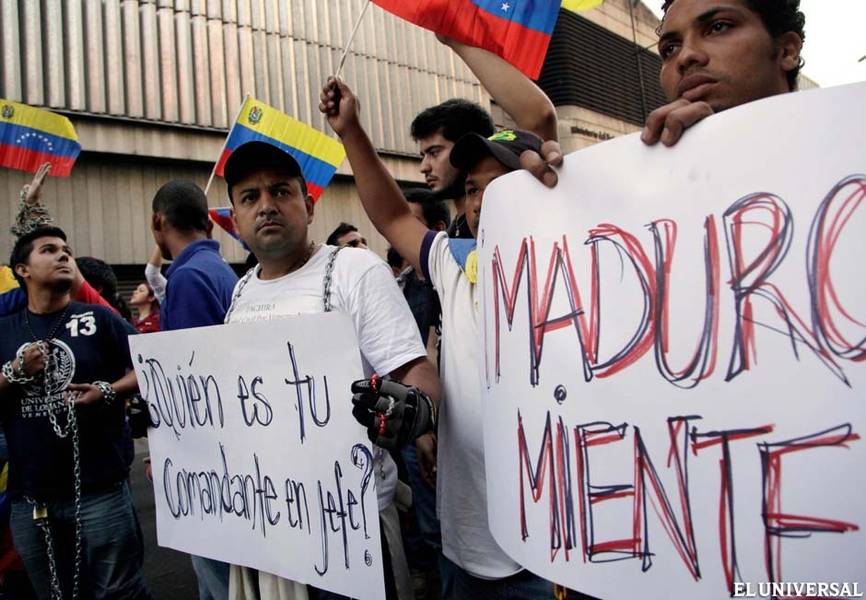
This week: Since his secretive return to Venezuela, confusion and uncertainty have surrounded Chávez’s health; while Chávez remains hidden from the public eye, the possibility of a new presidential election looms; members of the opposition march to demand answers on the president’s health; and vice president Nicolás Maduro admits on national television that Chávez is “is fighting for his health, for his life.” Price and currency controls cause pharmacy drug shortages to reach 40 percent; an electricity crisis and constant power cuts stir anger towards the Venezuelan government; price hikes continue in Venezuela, with the black market price of the dollar now at four times its official value; reports surface that 27.5 percent of Venezuelan imports reported by the government in 2012 in fact never happened; and Venezuela’s comptroller finds multiple administrative irregularities in two state-owned TV networks. Lastly, the Inter-American Commission on Human Rights urges Venezuela to reconsider its withdrawal from the respected human rights commission; authorities violently disperse student demonstrations demanding answers on Chavez’s health; US officials believe the US will have to play a role in any forthcoming transition of power in Venezuela; and opposition leader Leopoldo López is arrested as part of what he calls a “political persecution” by  the Chávez government.

Confusion reigns over Chávez’s condition, Financial Times

There has been no sign of Hugo Chávez since the stealthy pre-dawn return to Caracas of Venezuela’s ailing leader a week ago, but at least one person is confident of his wellbeing.

As Chávez’s silence persists, Venezuela mulls new elections, Miami Herald

President Hugo Chávez spent his first week back in Venezuela too frail to be seen in public and too weak to receive well wishers. But despite his precarious health, few doubt Chávez’s prowess at the ballot box.

Opponents to Hugo Chavez Continue to Demand Answers, Fox News Latino

Hundreds of opponents to the government of Hugo Chávez demonstrated Saturday to demand answers about the condition of the Venezuelan president while he remains out of the public eye.

Venezuela’s Chavez clings to life, vice president says, NBC News

Venezuelan President Hugo Chavez is clinging to life, according to the country’s vice president. “The commander is fighting for his health, for his life,” Nicolas Maduro said on national TV Thursday.

Drugs shortage in Venezuela accounts for 40%, El Universal

Through letters and conversations with the Government, the Venezuelan pharmaceutical sector has warned it is “choking” as medicine shortage is reaching a critical level.

Venezuela: power cuts stir resentment, Financial Times

The problem may have gone largely unnoticed in Caracas, where everyone is fixated by the ongoing Hugo Chávez drama, but Venezuelans living in the provinces are getting fed up with blackouts that inconvenience their everyday life.

Price hikes in Venezuela, Al Jazeera

Scores of Venezuelans descended from the hillside slums of Caracas 24 years ago on this day, burning cars and looting to protest a hike in gasoline prices, the last straw in a series of austerity measures.

An estimated 27.4% of Venezuelan gov’t imports never happened, El Universal

Ten years after forex restrictions were put in place in Venezuela, distortion accentuates. Imports at a low exchange rate seem to be increasingly encouraging overbilling and other procedural practices.

Venezuela’s comptroller finds irregularities in state-run TV networks, El Universal

Lack of internal controls and supervision of budget and assets, absence of personnel management manuals and award of no-bid contracts without justification whatsoever are just some of the administrative irregularities found by the Controller’s Office of Venezuela in state-owned TV networks Ávila TV and Vive TV.

IACHR hopes Venezuela to rethink withdrawal, El Universal

The president of the Inter-American Commission on Human Rights (IACHR), José de Jesús Orozco Henríquez, said he hoped “respectfully” that the Venezuelan state reconsiders its intention to leave the American Convention on Human Rights.

Student demonstration dispersed by authorities in Venezuela, El Universal

One more time, the student opposition movement Operation Sovereignty took the streets, a week after a protest at the Cuban Embassy in Caracas.

Venezuela Charges Opposition Leader With Misuse of Funds in 1998, Bloomberg

Venezuelan opposition politician Leopoldo Lopez faces as much as four years in prison for alleged misuse of public funds more than a decade ago as President Hugo Chavez’s health prompts speculation about new elections.

US says it has a role to play in transition in Venezuela, El Universal

Roberta Jacobson said the aim is to convey to “Venezuelans of all political stripes” the message that it is important to hold elections on an equal footing.