Mar
4
2013
Posted by
admin
Comments

In Chávez’s Absence, the Government Seeks to Dissipate Opposition with Fear

iX2qiGY5WWjk e1362422860756 In Chávez’s Absence, the Government Seeks to Dissipate Opposition with Fear

Courtesy of: Agence France Presse

As is well documented, the Venezuelan government’s record on human rights has been substandard at best. For years, human rights watchdogs have criticized the government for consolidating power in the executive branch and using that power to intimidate, censor and prosecute those who criticize the president or his regime. During Hugo Chávez’s prolonged absence, these problems have only gotten worse.

Fears that Chávez’s declining health will force a new presidential election in the coming months has the United Socialist Party of Venezuela (PSUV) party concerned. Both of Chávez’s likeliest successors lack the charisma and deep popular support the president enjoys, prompting many within the government to wonder whether the movement will survive without its strong leader. A slumping economy has further exposed the government’s failures, and the PSUV has continually sought to change the subject.

Knowing of this – and of the PSUV’s penchant for strongman tactics – it is hardly surprising that there has been significant harassment of Venezuela’s opposition in the past month.

For example, the government has stepped up accusations that three opposition lawmakers were involved in corruption, in a clear attempt to demoralize, fracture and damage the reputation of the opposition. Leaders of the ruling PSUV have threatened to jail those involved and have pledged to pursue further investigations into the alleged financial irregularities.

The attacks weren’t limited to these lesser known lawmakers. Just this week, Chávez’s chosen successor, Vice President Nicolás Maduro, launched a scathing assault on the opposition’s charismatic leader, Henrique Capriles. Capriles was in the United States visiting his sister and her family, who live in New York. Maduro alleged – without any evidence – that Capriles himself owns a lavish high-rise in New York City, and accused Capriles of engaging with Venezuelan expatriates in a plot to destabilize the country. He boasted to a friendly audience that he was “tracking the movements” of Capriles. Capriles called the accusations false, and suggested that Maduro was trying to distract Venezuelans from the damage wrought by a currency devaluation, rampant violence and escalating shortages – not to mention the continuing secrecy surrounding Chávez’s battle with cancer.

“It seems ridiculous to me, with all the problems that there are in Venezuela, that this is what the government is talking about,” Capriles told the New York Times.

Last week, Venezuelan prosecutors brought influence peddling charges against Leopoldo López, a prominent opposition leader, economist and former mayor of the Chacao Municipality of Caracas. He is accused of accepting donations from Venezuela’s state-run oil company in 1998, donations that were purportedly authorized by his mother, Antonietta Mendoza de Lopez, who was a PDVSA administrative employee at the time. Government officials allege the funds were used to form the now popular First Justice Party. Arguing the charges are politically motivated, López denies any wrongdoing.

Of course, if it’s corruption they are after, the PSUV need look no further than itself: under their rule, Venezuela is considered the most corrupt nation in Latin America by Transparency International.

According to Luis Vicente León, analyst and head of the renowned Datanálisis polling firm, the point of these measures is to make the country believe there is a strong government in place despite Chávez’s absence. He expects a series of symbolic actions against key players of the opposition, to instill fear in society and dissuade others from speaking out against Chavismo.

Attacks against the media have become a clear example of this intimidation strategy. Globovisión, the last television network in Venezuela openly critical of the government, was not among the list of stations to be included when the country transitions to a new digital TV signal. The decision will likely drive the station off the air at that time. The government has refused to offer an explanation for the exclusion. Similarly, the website analisis24.com and its Twitter account have been blocked in Venezuela after publishing a series of pictures of Chávez and his daughters in Cuba.

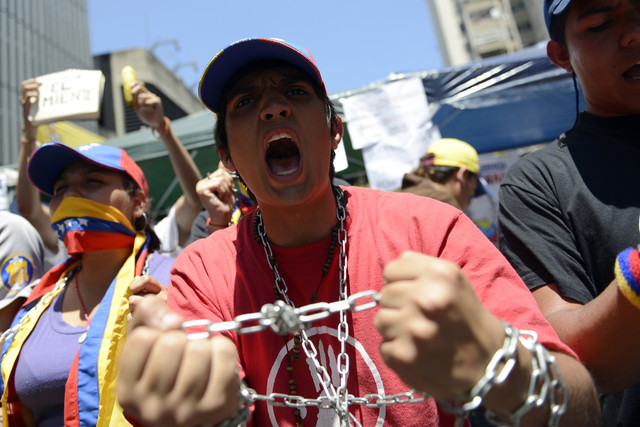
Most troubling thus far, however, were the attacks against students during a peaceful demonstration. Frustrated after not hearing from President Chávez for 80 days, about 120 students gathered in front of the Executive Directorate of the Judiciary to demand answers from the government about the true health of their president. They were received instead by members of the military, who wielded ​​ batons and fired pellets, injuring four of them. Once again, the government has offered no justification for these attacks on its own citizens.

Though there has been no word on whether Chávez will ever return to power, it is clear that the regime fears the uncertainty that would follow if he passes. After 14 years under the strong leadership of Hugo Chávez, PSUV faces the difficult task of convincing Venezuela it is capable of governing without him. The dire economic situation in the country shows that they have much to prove on that front. Yet thus far, fear, intimidation and the suppression of free speech appear to be their only solutions.
 
Mar
1
2013
Posted by
admin
Comments

In Case You Missed It…Articles Roundup Week of 3/1/13

protestaap123.jpg.940.600.thumb  e1362172682790 In Case You Missed It...Articles Roundup Week of 3/1/13

Courtesy of: Associated Press

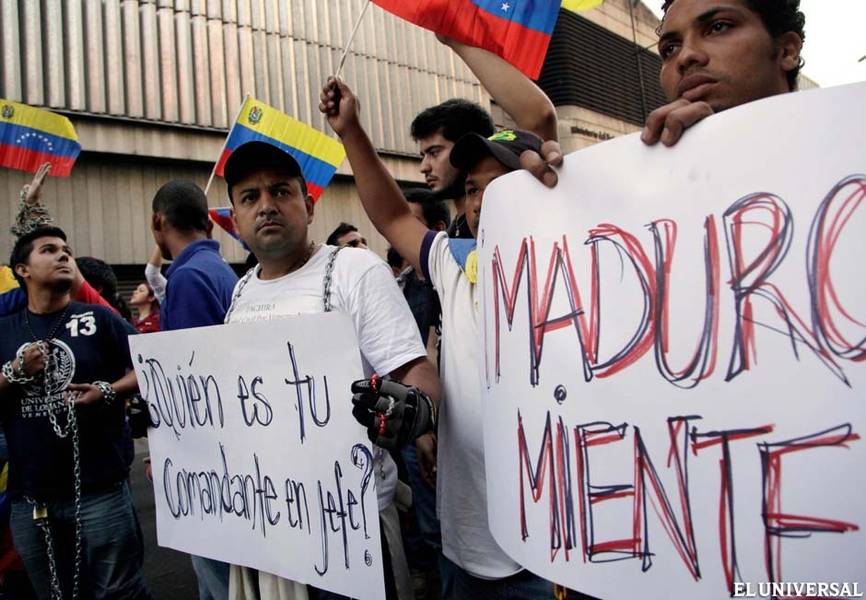
This week: Since his secretive return to Venezuela, confusion and uncertainty have surrounded Chávez’s health; while Chávez remains hidden from the public eye, the possibility of a new presidential election looms; members of the opposition march to demand answers on the president’s health; and vice president Nicolás Maduro admits on national television that Chávez is “is fighting for his health, for his life.” Price and currency controls cause pharmacy drug shortages to reach 40 percent; an electricity crisis and constant power cuts stir anger towards the Venezuelan government; price hikes continue in Venezuela, with the black market price of the dollar now at four times its official value; reports surface that 27.5 percent of Venezuelan imports reported by the government in 2012 in fact never happened; and Venezuela’s comptroller finds multiple administrative irregularities in two state-owned TV networks. Lastly, the Inter-American Commission on Human Rights urges Venezuela to reconsider its withdrawal from the respected human rights commission; authorities violently disperse student demonstrations demanding answers on Chavez’s health; US officials believe the US will have to play a role in any forthcoming transition of power in Venezuela; and opposition leader Leopoldo López is arrested as part of what he calls a “political persecution” by  the Chávez government.

Confusion reigns over Chávez’s condition, Financial Times

There has been no sign of Hugo Chávez since the stealthy pre-dawn return to Caracas of Venezuela’s ailing leader a week ago, but at least one person is confident of his wellbeing.

As Chávez’s silence persists, Venezuela mulls new elections, Miami Herald

President Hugo Chávez spent his first week back in Venezuela too frail to be seen in public and too weak to receive well wishers. But despite his precarious health, few doubt Chávez’s prowess at the ballot box.

Opponents to Hugo Chavez Continue to Demand Answers, Fox News Latino

Hundreds of opponents to the government of Hugo Chávez demonstrated Saturday to demand answers about the condition of the Venezuelan president while he remains out of the public eye.

Venezuela’s Chavez clings to life, vice president says, NBC News

Venezuelan President Hugo Chavez is clinging to life, according to the country’s vice president. “The commander is fighting for his health, for his life,” Nicolas Maduro said on national TV Thursday.

Drugs shortage in Venezuela accounts for 40%, El Universal

Through letters and conversations with the Government, the Venezuelan pharmaceutical sector has warned it is “choking” as medicine shortage is reaching a critical level.

Venezuela: power cuts stir resentment, Financial Times

The problem may have gone largely unnoticed in Caracas, where everyone is fixated by the ongoing Hugo Chávez drama, but Venezuelans living in the provinces are getting fed up with blackouts that inconvenience their everyday life.

Price hikes in Venezuela, Al Jazeera

Scores of Venezuelans descended from the hillside slums of Caracas 24 years ago on this day, burning cars and looting to protest a hike in gasoline prices, the last straw in a series of austerity measures.

An estimated 27.4% of Venezuelan gov’t imports never happened, El Universal

Ten years after forex restrictions were put in place in Venezuela, distortion accentuates. Imports at a low exchange rate seem to be increasingly encouraging overbilling and other procedural practices.

Venezuela’s comptroller finds irregularities in state-run TV networks, El Universal

Lack of internal controls and supervision of budget and assets, absence of personnel management manuals and award of no-bid contracts without justification whatsoever are just some of the administrative irregularities found by the Controller’s Office of Venezuela in state-owned TV networks Ávila TV and Vive TV.

IACHR hopes Venezuela to rethink withdrawal, El Universal

The president of the Inter-American Commission on Human Rights (IACHR), José de Jesús Orozco Henríquez, said he hoped “respectfully” that the Venezuelan state reconsiders its intention to leave the American Convention on Human Rights.

Student demonstration dispersed by authorities in Venezuela, El Universal

One more time, the student opposition movement Operation Sovereignty took the streets, a week after a protest at the Cuban Embassy in Caracas.

Venezuela Charges Opposition Leader With Misuse of Funds in 1998, Bloomberg

Venezuelan opposition politician Leopoldo Lopez faces as much as four years in prison for alleged misuse of public funds more than a decade ago as President Hugo Chavez’s health prompts speculation about new elections.

US says it has a role to play in transition in Venezuela, El Universal

Roberta Jacobson said the aim is to convey to “Venezuelans of all political stripes” the message that it is important to hold elections on an equal footing.

 
Feb
3
2012
Posted by
admin
Comments

In Case You Missed It… Articles Roundup Week of 2/3/12

In this week’s roundup… President Chávez threatens to nationalize the country’s banks and companies if they fail to comply with his orders; Venezuela’s currency has inflated by 528 percent since 2003; the kidnapping of a Mexican envoy to Venezuela underscores the country’s deteriorating security situation; a new anti-terrorism law generates concern that it could be used to target dissidents. Among other news, Henrique Capriles Radonski gains Leopoldo López’s support as he heads into the opposition primaries on February 12, 2012.

Venezuela’s Hugo Chávez warns banks of nationalisation, BBC News
Venezuelan President Hugo Chávez has warned that he could nationalise banks that refuse to finance agricultural projects backed by his government.

Chavez Says He’ll Nationalize Companies That Don’t Limit Prices, Bloomberg
Venezuelan President Hugo Chávez said he will nationalize companies failing to comply with new price controls for consumer goods that the government is preparing to unveil. The price regulations may affect companies including Procter & Gamble Co., Colgate-Palmolive Co. (CL) and Johnson & Johnson.

Venezuela’s accumulated inflation hits 528% in nine years, El Universal
Between February 2003 (when price controls were first implemented) and December 2011, Venezuela’s accumulated inflation has skyrocketed 528 percent. This has hit the worker’s purchasing power, as they can buy 15 percent less than in 1998.

Fear grips Venezuela after kidnapping, The Financial Times
It almost became an international incident when thugs kidnapped the Mexican ambassador and his wife this week in Caracas, shocking the country’s diplomatic community and embarrassing President Hugo Chávez as Venezuelan crime rates continue to soar before October’s presidential election.

Venezuela passes anti-terrorism law; critics warn it could be used for crackdown on dissent, The Washington Post via the Associated Press
Venezuela’s congress has approved a law aimed at fighting organized crime and terrorism, though opposition lawmakers say they fear it could be used to crack down on dissent.

Venezuela’s new chance, The Washington Post
Polls show Mr. Capriles in a dead heat with Mr. Chávez, even though the president has benefited from a wave of public sympathy since revealing seven months ago that he had been treated in Cuba for cancer.

The man who would defeat Hugo Chávez, The Christian Science Monitor
Living with 30 percent inflation, regular power outages, and one of the highest murder rates in the world, however, the middle class has since tired of Chávez. A tough fight lies ahead. The candidate who will take on Chávez in Venezeula’s October Presidential election will be chosen in primaries held on Feb. 12. Young state governor Henrique Capriles Radonski is likely to take that mantle.

Henrique Capriles Radonski, Venezuela Presidential Candidate, Challenges Hugo Chavez, The Huffington Post
Time points out that the Venezuelan president has faced little competition in prior elections — but that changed when opposition frontrunner Leopoldo López threw his support behind fellow challenger Henrique Capriles Radonski, according to The Christian Science Monitor.