Capriles Prepares for a Tough Fight Against the Memory of Chávez
Courtesy of: Associated Press
On Monday, interim president Nicolás Maduro and opposition leader Governor Henrique Capriles formally registered as candidates for Venezuela’s special presidential election, to determine who will succeed the late Hugo Chávez. The former vice president Maduro was sworn in just three days earlier – merely three days after the government announced Chávez’s death.
Even by the standards of an electoral system already skewed to the PSUV’s benefit, April’s special election is hardly a fair fight. The candidates are only permitted to campaign during an official 10-day campaign period from April 2-11, but the timing of the April 14 election already sets the opposition at a distinct disadvantage. While both candidates are prohibited from campaigning until April 2, Maduro has been riding the wave of grief over Chávez’s death to bolster his own image. Currently, state-run TV is saturated with 24/7 coverage of Chávez’s life and legacy, and the government has bused in thousands of supporters to wait in hour-long lines to view his casket. In addition, like Chávez, Maduro has not been timid about using his “cadena” powers, which require mandatory national broadcasts at the discretion of the president. Similar to Chávez, Maduro has made these a daily occurrence; even using one to take the oath of office in front of Chávez’s casket. While the official campaign will not begin for weeks, Maduro’s presence on the airwaves is virtually ubiquitous.
Although the campaign period officially ends on April 11, the days in between are fraught with symbolism that is sure to benefit Maduro. April 13 – the day before the election – is the anniversary of Chávez’s return to power after the April 11, 2002 coup that briefly ousted him from power. In the years following, the anniversary has been marked with widespread celebration by Chavistas – led by Chávez himself. This year will likely see that celebration further intensified – allowing Maduro to carry out de facto campaign events through official government celebrations of Chávez’s memory.
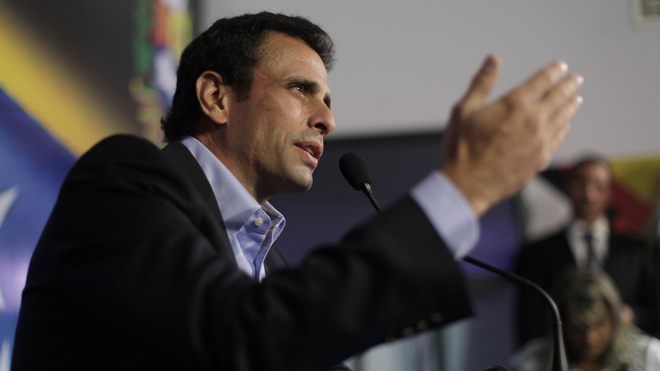
Capriles has spent much of his political career criticizing the Chávez administration for its expropriations, centralization of power, and corruption. He is currently serving as the Governor of Miranda, one of the largest states in Venezuela—the latest stage in his fast political rise. At the age of 26, he became the youngest elected member of the National Congress before winning two consecutive mayoral elections in Baruta, a division of the Greater Caracas municipality. Last year, he became the first candidate in 14 years to unite the opposition parties and seriously challenge Chávez in the October presidential election. Capriles traversed Venezuela for months, seeking to rally Venezuelan’s behind his vision for the country’s future. Although he lost the election, his quest was hardly unsuccessful: Capriles won an unprecedented 44 percent of the vote (over 6 million people).
Meanwhile, Maduro has risen far from his origins as a bus driver, becoming Chávez’s Vice President and handpicked successor. As a former Foreign Minister, he strengthened the Venezuelan government’s ties with Cuba and with the Castros. During Chávez’s absence in June 2011 and last winter, he worked to shore up his power as acting president and his political clout within the PSUV. Maduro lacks Chávez’s charisma and popularity, a weakness he has sought to counteract by currying favor with the late president and the Cuban government through a fierce commitment to PSUV’s principles of socialism.
The presidential campaign has not even officially begun, but Capriles has already been subjected by his rival to a malicious smear campaign. In a speech responding to Capriles’ candidacy, Maduro called him a “fascist” and used racist and homophobic slurs against the governor, a descendant of Polish Jews who escaped the Holocaust. The Venezuelan government is also threatening the opposition candidate with legal action for the defamation of Chávez and his family after Capriles raised questions about the government’s lack of transparency regarding the circumstances of the former president’s death.
Capriles has taken a tougher tone against Maduro than he did against Chávez in last year’s presidential election. Capriles has accused Maduro of exploiting Chávez’s memory for political gain. Indeed, Capriles’ chance at victory will likely hinge on his ability to demonstrate to Venezuelans that Maduro is not Chávez’s “second coming,” but is instead a lifelong political operative and puppet of the Castros, wholly complicit in the PSUV government’s economic mismanagement.
With only 10 days to campaign, Capriles will be fighting an uphill battle. Maduro will leverage every facet of Chávez’s finely-tuned political machine to secure a victory: at his disposal are a formidable (and corrupt) voter turnout program, unobstructed access to government resources, and the hysterical grief of Chávez’s devoted followers. It is little surprise that Maduro has already christened his campaign the “Comando de Campaña Hugo Chávez Frías” (Hugo Chávez Campaign Command). The month ahead will combine elements of a political rally and funeral march, as Maduro looks to ride a wave of Chávez sympathy and nostalgia into power.
Nevertheless, Capriles has defeated Chávez’s top deputies before. Just two months after his strong showing against Chávez in the presidential elections, Capriles held on to his Miranda governorship against Chávez’s close friend and former Vice President, Elías Jaua. He originally defeated Diosdado Cabello, the current head of the National Assembly, to first assume the governorship of Miranda in 2008. Capriles will capitalize on his youthful energy and the strong support of his base to do everything possible to obtain a victory.