Forbes
September 21, 2012
By Doug Schoen
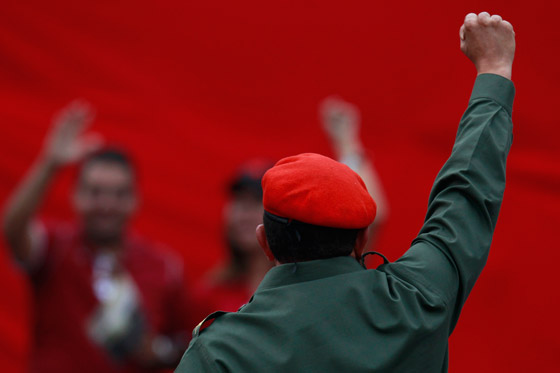
Courtesy of: AP
There is a crucial election about to take place in Venezuela. Basic issues of freedom and economic liberty are at stake for the Venezuelan people. And with Venezuela being both our largest oil provider and a chief anti-American aggressor with alliances in Iran, Syria and Russia amongst others, this election is not only critical for us but much more so than policymakers in DC have acknowledged or realized.
Democratic challenger Henrique Capriles could surely change the direction of the Venezuela. He is poised to serve as a much-needed positive force in shaping Venezuela’s future as a cooperative member of the international community if he is elected on October 7th.
The head of Venezuela’s oil workers union, the United Federation of Oil Workers, said just yesterday that his members are not even entertaining the idea of a Chavez defeat. “It is impossible for Capriles to win this year…We the working class will not allow it.”
But while some in the state run oil industry look to Chavez as a savior of their industry, he has been involved in a number of dangerous and unsavory pursuits over the years that bring a black cloud over his administration and its business. Chavez has been linked to major narcoterrorists, including Walid Makled who was designated a major drug kingpin by the Obama administration in 2009 and is a financial stalwart of Chavez’s administration. In fact, dozens of top-level figures in the Chavez government including ministers, judges and generals were on Makled’s payroll.
Roger Noriega, former US Ambassador to the Organization of American States, delivered chilling testimony to the Congressional Subcommittee on Counterterrorism wherein he detailed Venezuela’s support of Hezbollah in Latin America. And it is well known that Chavez is actively working against American interests in Latin America while he bankrupts his country in pursuit of a radical socialist agenda.
In contrast, challenger Capriles is a true democrat. A successful governor of the state of Miranda, he is a capitalist who is focused on de-politicizing Venezuela, a much needed change.
He represents a new generation of the Venezuelan political class that supports America and wants to work in genuine partnership. As a practicing Roman Catholic and a child of the Holocaust, he is acutely aware of and concerned with issues of freedom and equity, both crucial areas for the future of Venezuela.
To be sure, Capriles faces an uphill battle. Chavez has proven he will do anything, say anything, or undermine the integrity and independence of any institution to stay in power. It is therefore imperative that there be international recognition that Chavez has cheated in past elections and that he very well may cheat again. The polls are currently showing a wide range of results from a two-point advantage for Capriles to as much as a 20-point advantage for Chavez. The reality is that the two candidates are probably very close.
Chavez is convinced that he will win the election. Two weeks ago he said, “Capriles will no longer be able to surmount [the lead], even if he gets on a missile, or two, or 10…it is impossible for them to win this election. It is absolutely impossible, mathematically impossible.”
I’ve written in the past about how Chavez cheated in the 2004 referendum, which has been verified by outside, independent auditors. And indeed, there have occasionally been times that he has stood down, acknowledged defeat and moved to change the constitution like the 2007 referendum.
But the instances of Chavez circumventing the democratic process for his own personal gain far outnumber the cases where he has accepted defeat. It follows that the world must focus on this election so he cannot cheat again, a reality that has been widely predicted.
One of the keys to ensuring a free and fair election in Venezuela next month is Ambassador Diego Arria. Ambassador Arria has long pursued a lonely mission of trying to make the case of Venezuela’s importance on the world stage.
As the Permanent Representative of Venezuela to the United Nations, he predicted the Bosnian genocide in Srebrenica before it happened. And he created the “Arria Formula”, an informal consultation process that affords members of the UN Security Council the opportunity to hear persons in a confidential, informal setting which has become integral to the Security Council process.
It is critically important that Ambassador Arria continues to do his work in order to prevent Chavez from stealing yet another election and, again, consigning the Venezuelan people to further years of deprivation and poverty.
Ambassador Arria is a towering intellect and a world-class figure, a true supporter of democracy. He is playing the role of key liaison to the US and other governments around the world for Capriles and the forces of democracy in Venezuela. He is one of those genuine heroes who has effectively worked to make peace in the world and has dedicated himself to this cause for decades.
An unapologetic democrat, Ambassador Arria is working to make sure the world knows what is at stake in Venezuela. To be sure, the stakes couldn’t be higher and it is high time that the international community took notice.
To read this article on Forbes, please click here.
