Sep
20
2013
Posted by
admin
Comments

ICYMI: Venezuela keeps rooting for Syrian dictator

Miami Herald

September 18, 2013

By Andres Oppenheimer
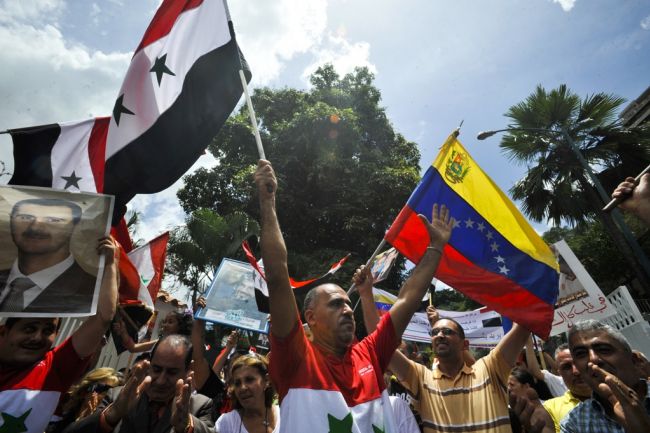
venezuela syria 2012 12 06 e1379694480735 ICYMI: Venezuela keeps rooting for Syrian dictator

Courtesy of: AFP

Much of the world is demanding greater pressure on Syria following a United Nations inspectors’ report hinting that Syrian strongman Bashar al-Assad used chemical weapons in his country’s civil war, but — amazingly — Venezuela and some of its Latin American allies are still passionately defending Syria’s dictator.

Earlier this week, after U.N. Secretary General Ban Ki-moon presented the U.N. inspectors’ report concluding that there is “clear and convincing” evidence that chemical weapons were used in an Aug. 21 incident on the outskirts of Damascus, Venezuelan President Nicolás Maduro lashed out against the U.N. chief for allegedly siding with the enemies of the Syrian people.

“Why is the U.N. secretary general lending himself (to plans to attack Syria,) as if he were a prosecutor and judge of the world’s people, putting himself at the service of the strategy of war, instead of being at the service of peace?” Maduro asked in a speech Monday in the state of Miranda.

In a speech last month more than a week after the Aug. 21 attack with chemical weapons, Maduro said, “Venezuela is with Syria, and with President Bashar al-Assad, and with the Syrian people.”

A day later, on Aug. 31, Maduro issued an official statement stating that Venezuela stands by “the Syrian people” in their fight against “unjustified war-mongering aggressions.”

Venezuela’s government-run media, meantime, has turned Assad into a hero and is blaming the United States and Israel for allegedly trying to invade Syria.

A cartoon in Venezuela’s state-run daily Correo del Orinoco this week shows a plane dropping hearts over Syria with the legend “to the Syrian people from the people of ALBA.” ALBA, which stands for the Bolivarian Alliance for the Peoples of Our Americas, is an organization formed by Venezuela that is it made up of nine Latin American and Caribbean countries.

Venezuela’s daily Vea, which like other government-backed newspapers often publishes anti-Semitic cartoons, ran a cartoon on May 9 showing a black-robed skeleton representing death, with a star of David and this legend: “Since we got tired of killing Palestinians, we are now going to finish with the Syrians.”

What’s most amazing about the pro-Assad statements in Venezuela’s official media is that they are still appearing after the U.N. inspectors’ report — which clearly suggests, without saying so explicitly, that Assad’s forces were responsible for the Aug. 21 chemical gas attack.

While it doesn’t officially take sides, because that wasn’t within the inspectors’ scope, the U.N. report shows that the rockets that carried Sarin gas are weapons that are not in the hands of Syria’s rebels, and that they were launched from several government-controlled points.

Although less strenuously, Venezuelan allies such as Cuba and Bolivia also have come out in support of Assad even after the U.N. findings. Most other Latin American countries have supported the Geneva agreement between the United States and Russia to demand that Syria destroy its chemical weapons.

But U.S. officials say major Latin American countries such as Mexico and Brazil have been late in joining the international community’s demands that Syria comply with the Geneva agreement.

Roberta Jacobson, the top U.S. State Department official in charge of Latin American affairs, told me Wednesday that “there is disappointment that more countries (in the region) would not have put out stronger statements condemning the Assad government’s use of Sarin gas, and supporting the Geneva U.S.-Russia agreements.”

Jacobson added that “countries in the Western Hemisphere want to be, and increasingly are, global actors. (But) If countries want to be global players, they should step up and confront challenges to the international community.”

My opinion: It’s entirely legitimate for Latin American countries to oppose a unilateral U.S. intervention in Syria, or even a U.S. intervention with dozens of allied countries but without the blessing of the United Nations. I myself have serious doubts about the wisdom of an intervention to stop Syria’s war crimes without some sort of U.N. cover.

But defending a dictator who has massacred a sizable part of the 100,000 people who have died in Syria’s civil war, and who according to all available evidence is responsible for the Aug. 21 attack with chemical weapons, is outrageous.

Maduro may be over-reacting on Syria because he needs to keep his Chavista radical base behind him after his dubious and narrow election victory April 14. His almost daily blunders, alongside Venezuela’s steep economic decline, are seriously weakening his government. And his adoration for dictators may explain his natural sympathy for Assad.

Still, Venezuela’s enthusiastic support for the Syrian regime after the Aug. 21 attack with chemical weapons should be denounced by everybody for what it is: an open defense of crimes against humanity.

To read this article at the Miami Herald, please click here.
 
Jul
22
2013
Posted by
admin
Comments

ICYMI: Venezuela Stops Efforts to Improve U.S. Relations

The New York Times
July 20, 2013
By William Neuman

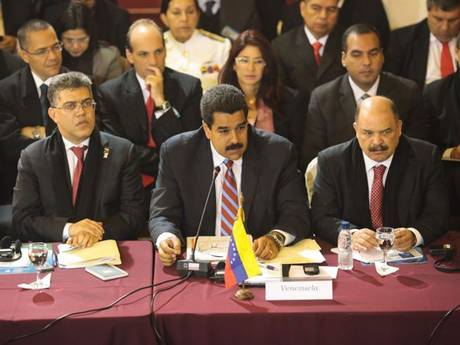
Nicolas Maduro ICYMI: Venezuela Stops Efforts to Improve U.S. Relations

Courtesy of: The Independent

CARACAS, Venezuela — Venezuela announced late Friday that it was stopping the latest round of off-again-on-again efforts to improve relations with the United States in reaction to comments by the Obama administration’s nominee for United Nations ambassador.

The nominee, Samantha Power, speaking before a Senate committee on Wednesday, said part of her role as ambassador would be to challenge a “crackdown on civil society” in several countries, including Venezuela. President Nicolás Maduro had already lashed out on Thursday at Ms. Power for her remarks, and late on Friday the Foreign Ministry said it was terminating efforts to improve relations with the United States.

Those efforts had inched forward just last month after Secretary of State John Kerry publicly shook hands with the Venezuelan foreign minister, Elías Jaua, during an international meeting in Guatemala — one of the highest-level meetings between officials of the two countries in years.

Venezuela “will never accept interference of any kind in its internal affairs,” the Foreign Ministry said in a statement, adding that it “considered terminated the process begun in the conversations in Guatemala that had as their goal the regularization of our diplomatic relations.”

Relations with Venezuela have long been troubled, although the country has remained a major supplier of oil to the United States. Under the previous president, Hugo Chávez, a longtime nemesis of the United States, relations were bumpy, especially after the Bush administration tacitly supported a coup that briefly ousted him.

Mr. Maduro, Mr. Chávez’s handpicked successor, has given mixed messages about relations with the United States.

In March, when Mr. Maduro was vice president, he kicked out two American military attachés, accusing them of seeking to undermine the government. After he was elected in April, he ordered the arrest of an American documentary filmmaker whom officials accused of trying to start a civil war. The filmmaker, Tim Tracy, was later expelled from the country.

And in recent days, in a sharp escalation of the war of words with Washington, Mr. Maduro has said he would give asylum to Edward J. Snowden, the former American intelligence contractor who leaked secrets about American intelligence programs and is staying at a Moscow airport.

The United States and Venezuela have not had ambassadors in each other’s capitals since 2008, when Mr. Chávez expelled the American envoy, accusing the United States of backing a group of military officers he said were plotting against him. The United States responded at the time by expelling Venezuela’s ambassador.

In the Guatemala meeting, Mr. Kerry said he hoped the two countries could rapidly move toward exchanging ambassadors again. But those talks never had time to gain traction. On July 12, Mr. Kerry telephoned Mr. Jaua to express concern over the asylum offer to Mr. Snowden.

This is not the first time that Venezuela has backed off the idea of renewed relations with the United States. The two countries quietly began talks late last year aimed at improving relations, although those ground to a halt after the health of Mr. Chávez, who had cancer, deteriorated in December.

After Mr. Chávez’s death in March, a State Department official said the United States hoped that the election to replace him would meet democratic standards — prompting Mr. Jaua to angrily announce that Venezuela was halting the talks between the two countries. Venezuelan officials have repeatedly said relations with the United States should be conducted on a basis of respect.

To read this article at The New York Times, please click here.

 
Jun
21
2013
Posted by
admin
Comments

In Case You Missed It… Articles Roundup Week of 6/21/13

UNI VenezuelaHunger wg e1371848667693 In Case You Missed It… Articles Roundup Week of 6/21/13

Courtesy of: La Prensa

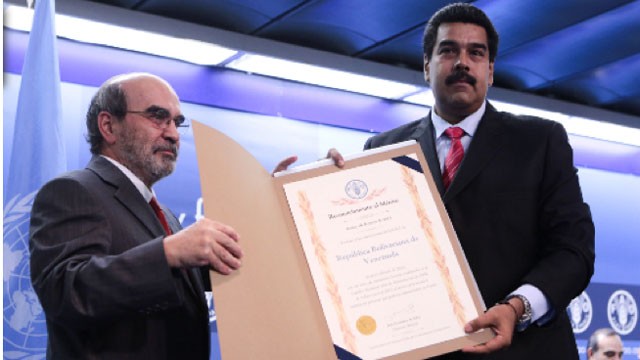
This Week: The Venezuelan constitutional court is expected to rule on Henrique Capriles’ lawsuits challenging the April 14 elections; in an attempt to improve his international image, President Maduro tours Europe, meeting with Pope Francis to discuss poverty, the fight against organized crime and regional disputes; ahead of his meeting with the Maduro, Capriles warns the Pope of basic democratic and human rights violations in Venezuela; in a survey of presidents, Venezuela’s Maduro receives worst ratings of all national leaders; and attackers torch buses and damage the rectory building at a leading Venezuelan university. Venezuela experiences soaring inflation, reporting a 6.1 percent spike last month alone; S&P expects “next to no growth” in the Venezuelan economy this year and downgrades its sovereign debt rating from “B+” to “B”; amid severe food shortages, the United Nations ironically congratulates Venezuela for reducing hunger; and Capriles maintains that Venezuela has not beaten hunger or poverty, questioning the FAO award.  In an attempt to alleviate goods shortages, Venezuela will supply more U.S. dollars to importers; in response to rationing rumors, Venezuela will allegedly import 760.000 tons of food; Venezuela’s non-oil exports hit the lowest level since 2009; and Venezuela’s Congress will discuss legislation that would prohibit baby bottles.

Top Constitutional Court to take up actions contesting April 14 election, El Universal

The Constitutional Court of the Supreme Tribunal of Justice (TSJ) is to hear and rule on all the seven laswsuits filed by former opposition presidential candidate Henrique Capriles and the opposition alliance Unified Democratic Panel (MUD) challenging the April 14 presidential vote.

Pope Francis meets Venezuelan President Maduro, Reuters

Maduro meets Pope Francis in the Vatican City and discussed poverty, the fight against organized crime and drug trafficking, and regional issues including a dispute between Venezuela and Colombia.

Capriles warns pope of rights violations in Venezuela, Global Post

Venezuela’s opposition leader told Pope Francis on Saturday that the government was violating basic democratic and human rights, just two days before President Nicolas Maduro visits the Vatican.

Venezuelan president pulls off the lowest score in Spanish survey, El Universal

Polls conducted by Spanish firm Real Instituto Elcano, after the controversial results of the presidential election held on April 14 in Venezuela, show Venezuelan President Nicolás Maduro’s ratings are the lowest, scoring 2.5 out of 10 points, behind his Argentinean counterpart rated with 2.7 points.

Attackers torch buses at Venezuela university, Miami Herald

A group of masked assailants has attacked a leading university in the Venezuelan capital, torching two buses and seriously damaging its rectory building.

Soaring inflation adds even more stress to the Venezuelan economic model, El Universal

Venezuelan economy reported a 6.1% spike in May which led to an accumulated inflation of 19.4%, thus crushing any possibility of meeting the 14% to 16% target set by the government for 2012.

Citing Governability, S&P Cuts Venezuela’s Debt. Bondholders, Look Out Below, Wall Street Journal

Standard & Poor’s cut its sovereign rating on Venezuela from “B+” to “B” another step deeper into junk territory, reflecting the government’s diminishing ability to implement measures to reverse declining GDP growth, rising inflation, and weakening external liquidity in the context of growing political disagreements within the administration.

UN Congratulates Venezuela for Reducing Hunger, ABC News

The FAO, the UN organization that specializes in nutrition, included Venezuela in a group of 18 nations that that have cut their number of hungry people by half over the past 20 years.

Capriles: hunger is addressed with investment and production, El Universal

Following the recent award given to the Venezuelan Government by the FAO, Capriles claimed on Tuesday that the country has not overcome hunger and poverty and stressed that the award was not in line with both the true food shortage Venezuela was going through and the more than 3,000 households living under severe poverty.

Venezuela Plans Expanded Dollar Auctions to Fight Shortages, Bloomberg Businessweek

Venezuela will boost supplies of dollars, through auctions that will begin early in the second half of the year,  to importers as it seeks to alleviate a shortage of goods that is fueling the fastest inflation in the region.

To silence rationing rumours, Venezuela announces 760.000 tons of imported food is on the way, MercoPress

A 760.000 tons of different food items were imported into several cities in Venezuela that were suffering serious shortages, including  staples and other items such as coffee, sugar, cooking oil, butter, milk, flour and most recently toilet paper, but the situation instead of improving has worsened.

Venezuela’s non-oil exports hit lowest level since 2009, Reuters
Venezuela’s non-oil exports fell in March to their lowest level since early 2009 in another sign of the economic problems accruing for President Nicolas Maduro’s fledgling government.

Venezuela considers taking bottles from babies’ mouths, Reuters

Venezuela’s Congress will discuss legislation next week that would prohibit bottle feeding of infants to try to encourage breast feeding and reduce the use of baby formula, said a lawmaker of the ruling Socialist Party.