The Washington Post
July 8, 2013
By Juan Forero and Will Englund

Courtesy of: AFP
BOGOTA, Colombia —American fugitive Edward Snowden’s diminishing possibilities of remaining free to continue releasing information about secret U.S. surveillance programs increasingly appear to hinge on Venezuela, which awaited word Monday on whether the former National Security Agency contractor would accept its offer of asylum and fly to the oil-rich country.
Bolivia and Nicaragua also say they could give refuge to Snowden, who is on the run from American officials and is thought to be marooned in the vast transit zone of Moscow’s Sheremetyevo International Airport. And the president of communist Cuba, Raúl Castro, on Sunday expressed support for Latin American allies that might take in the 30-year-old computer expert, opening the possibility that Snowden could fly through Havana as a first leg on his flight to asylum.
Among those offering sanctuary to Snowden, anti-imperialist Venezuela stands out: a country with an intense antipathy toward the United States and just enough muscle to make his escape from American law enforcement a possibility. It also appears that Russian officials, eager to end the diplomatic fallout of having Snowden in Moscow, see their close ally, Venezuela, as offering the clearest solution.
“The situation with Snowden is creating additional tension in relations with Washington that are complex as they are,” Alexei Pushkov, head of the foreign affairs committee of the lower house of the Russian parliament, told the newspaper Kommersant on Monday.
Pushkov, whose comments dependably reflect the Kremlin’s position on foreign affairs, said the Snowden saga needed to be settled before President Obama arrives in September to meet with his Russian counterpart, Vladimir Putin. “And judging by the way things are unfolding,” Pushkov told the newspaper, “this is how it’s going to be.”
Over the weekend, Pushkov had also said that giving asylum to Snowden in Venezuela could not damage Venezuelan President Nicolás Maduro, because his government’s relations with Washington are already in tatters. “It can’t get worse,” Pushkov said in a Twitter message.
Late Tuesday afternoon, Pushkov said on Twitter that Snowden, “as expected,” had accepted Maduro’s offer of asylum, but he didn’t address the question of how Snowden might get to Caracas. Shortly afterward, the tweet was deleted.
Pushkov then tweeted again, claiming he had heard the news about Snowden on Russian television. “Direct all your questions to them,” he wrote.
By Tuesday evening, Pushkov had issued yet a third tweet: “According to News 24 [a TV news program], with reference to Maduro, Snowden accepted his offer of asylum. If so, he has found that to be the safest option.”
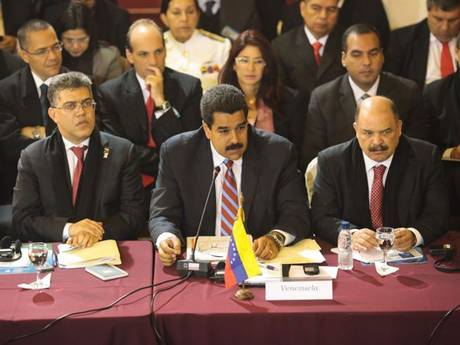
Newly elected and facing staggering economic problems at home despite the country’s oil wealth, Maduro appears to have made a high-pitched, openly hostile position against the Obama administration a cornerstone of his government’s foreign policy. He took his most provocative stand Friday in announcing that Venezuela would take in Snowden. On Monday, Maduro said that a letter from Snowden requesting asylum had been received and that the young American would simply have to decide when to fly to Caracas.
Maduro has accused the United States of fomenting protests against his government after his disputed April 14 election victory, which gave him the presidency his predecessor, Hugo Chávez, had held for 14 turbulent years until his death from cancer.
The Snowden saga — a young American revealing secrets the U.S. government wants to contain — provided the perfect opportunity for Maduro to take on the Obama administration, said Eduardo Semtei, a former Venezuelan government official.
“To figure internationally, to show that he is a player among big powers, he offered asylum to Snowden,” said Semtei, who had been close to Chávez’s brother, Adán, a leading ideologue in the late president’s radical movement. “This grabs headlines, and it shows that he’s a strong president, one with character, and that he’s capable of challenging the United States.”
Maduro and Venezuela came late to the Snowden saga, as tiny Ecuador, an ally also committed to opposing American initiatives, heaped praise on Snowden and expressed a willingness to help him after he had flown from Hong Kong to Moscow on June 23 to avoid American justice. When
Ecuador backed away from its initial enthusiasm over Snowden, Venezuela stepped in last week as Maduro arrived in Moscow for an energy summit.
The 50-year-old Maduro, who found his political calling as a socialist activist with close ties to Cuba, took a sharply anti-
imperialist stand in embracing Snowden. He said the United States had “created an evil system, half Orwellian, that intends to control the communications of the world,” and characterized Snowden as an antiwar activist and hero who had unmasked the dastardly plans of America’s ruling elite.
Political analysts say the opportunity to take sides against Washington was simply irresistible for a government that has for years characterized itself as a moral force speaking out for the weak against “the empire,” as the United States is known in Caracas. And the fact that the secrets Snowden divulged were embarrassing to the Obama administration only gave more fuel to Venezuela, former Venezuelan diplomats and political analysts in Caracas said.
“Edward Snowden became the symbol for the anti-imperialist rhetoric, for progressivism, for international radicalism,” said Carlos Romero, an analyst and author who closely tracks Venezuela’s international diplomacy.
Venezuela helped channel the fury of Argentina, Bolivia, Ecuador, Uruguay and Suriname after Bolivian President Evo Morales’s plane was apparently refused entry into the airspace of as many as four European countries last Tuesday because of the belief that Snowden was hiding aboard. And on Monday, Venezuela’s state media apparatus seemed to take more offense than the Brazilian government over revelations that the NSA had collected data on countless telephone and e-mail conversations in Brazil.
But former diplomats familiar with Venezuela say that there are other aspects to consider in deciphering Maduro’s support for Snowden.
Ignacio Arcaya, a diplomat who served the Chávez government in the United States in the early part of his presidency, said Maduro has had the challenge of trying to ease the concerns of radicalized sectors in his movement that have been worried about a resumption of relations with Washington now that Chávez is gone. Indeed, until recently, Maduro was spearheading an effort at rapprochement, as shown by a meeting in Guatemala on June 5 between Secretary of State John F. Kerry and his Venezuelan counterpart, Elías Jaua.
“What Maduro is doing is aimed at quieting the radical sectors of his party who think he is negotiating with the United States and think that he’s talking to private industry,” Arcaya said.
Maduro also has to consider his own unstable political position after the April 14 election, which is being contested by his challenger, Henrique Capriles, who says the vote was stolen from him. At the same time, Maduro faces millions of Venezuelans tired of the country’s sky-high inflation, rampant homicide rate and serious shortages of everything from chicken to toilet paper.
Myles R.R. Frechette, a retired American diplomat who served in Venezuela and other Latin American countries, said Maduro is using a tried-and-true strategy: loudly oppose the United States to distract from domestic problems.
“It plays very well,” said Frechette. “It’s the card to play. It’s what you’ve always got in your drawer. You open your drawer and play to your most radical elements.”
To read this article at The Washington Post, please click here.