Jun
21
2013
Posted by
admin
Comments

In Case You Missed It… Articles Roundup Week of 6/21/13

UNI VenezuelaHunger wg e1371848667693 In Case You Missed It… Articles Roundup Week of 6/21/13

Courtesy of: La Prensa

This Week: The Venezuelan constitutional court is expected to rule on Henrique Capriles’ lawsuits challenging the April 14 elections; in an attempt to improve his international image, President Maduro tours Europe, meeting with Pope Francis to discuss poverty, the fight against organized crime and regional disputes; ahead of his meeting with the Maduro, Capriles warns the Pope of basic democratic and human rights violations in Venezuela; in a survey of presidents, Venezuela’s Maduro receives worst ratings of all national leaders; and attackers torch buses and damage the rectory building at a leading Venezuelan university. Venezuela experiences soaring inflation, reporting a 6.1 percent spike last month alone; S&P expects “next to no growth” in the Venezuelan economy this year and downgrades its sovereign debt rating from “B+” to “B”; amid severe food shortages, the United Nations ironically congratulates Venezuela for reducing hunger; and Capriles maintains that Venezuela has not beaten hunger or poverty, questioning the FAO award.  In an attempt to alleviate goods shortages, Venezuela will supply more U.S. dollars to importers; in response to rationing rumors, Venezuela will allegedly import 760.000 tons of food; Venezuela’s non-oil exports hit the lowest level since 2009; and Venezuela’s Congress will discuss legislation that would prohibit baby bottles.

Top Constitutional Court to take up actions contesting April 14 election, El Universal

The Constitutional Court of the Supreme Tribunal of Justice (TSJ) is to hear and rule on all the seven laswsuits filed by former opposition presidential candidate Henrique Capriles and the opposition alliance Unified Democratic Panel (MUD) challenging the April 14 presidential vote.

Pope Francis meets Venezuelan President Maduro, Reuters

Maduro meets Pope Francis in the Vatican City and discussed poverty, the fight against organized crime and drug trafficking, and regional issues including a dispute between Venezuela and Colombia.

Capriles warns pope of rights violations in Venezuela, Global Post

Venezuela’s opposition leader told Pope Francis on Saturday that the government was violating basic democratic and human rights, just two days before President Nicolas Maduro visits the Vatican.

Venezuelan president pulls off the lowest score in Spanish survey, El Universal

Polls conducted by Spanish firm Real Instituto Elcano, after the controversial results of the presidential election held on April 14 in Venezuela, show Venezuelan President Nicolás Maduro’s ratings are the lowest, scoring 2.5 out of 10 points, behind his Argentinean counterpart rated with 2.7 points.

Attackers torch buses at Venezuela university, Miami Herald

A group of masked assailants has attacked a leading university in the Venezuelan capital, torching two buses and seriously damaging its rectory building.

Soaring inflation adds even more stress to the Venezuelan economic model, El Universal

Venezuelan economy reported a 6.1% spike in May which led to an accumulated inflation of 19.4%, thus crushing any possibility of meeting the 14% to 16% target set by the government for 2012.

Citing Governability, S&P Cuts Venezuela’s Debt. Bondholders, Look Out Below, Wall Street Journal

Standard & Poor’s cut its sovereign rating on Venezuela from “B+” to “B” another step deeper into junk territory, reflecting the government’s diminishing ability to implement measures to reverse declining GDP growth, rising inflation, and weakening external liquidity in the context of growing political disagreements within the administration.

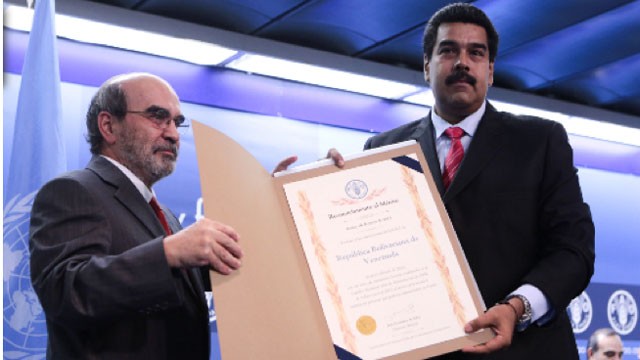
UN Congratulates Venezuela for Reducing Hunger, ABC News

The FAO, the UN organization that specializes in nutrition, included Venezuela in a group of 18 nations that that have cut their number of hungry people by half over the past 20 years.

Capriles: hunger is addressed with investment and production, El Universal

Following the recent award given to the Venezuelan Government by the FAO, Capriles claimed on Tuesday that the country has not overcome hunger and poverty and stressed that the award was not in line with both the true food shortage Venezuela was going through and the more than 3,000 households living under severe poverty.

Venezuela Plans Expanded Dollar Auctions to Fight Shortages, Bloomberg Businessweek

Venezuela will boost supplies of dollars, through auctions that will begin early in the second half of the year,  to importers as it seeks to alleviate a shortage of goods that is fueling the fastest inflation in the region.

To silence rationing rumours, Venezuela announces 760.000 tons of imported food is on the way, MercoPress

A 760.000 tons of different food items were imported into several cities in Venezuela that were suffering serious shortages, including  staples and other items such as coffee, sugar, cooking oil, butter, milk, flour and most recently toilet paper, but the situation instead of improving has worsened.

Venezuela’s non-oil exports hit lowest level since 2009, Reuters
Venezuela’s non-oil exports fell in March to their lowest level since early 2009 in another sign of the economic problems accruing for President Nicolas Maduro’s fledgling government.

Venezuela considers taking bottles from babies’ mouths, Reuters

Venezuela’s Congress will discuss legislation next week that would prohibit bottle feeding of infants to try to encourage breast feeding and reduce the use of baby formula, said a lawmaker of the ruling Socialist Party.
 
Feb
19
2013
Posted by
admin
Comments

ICYMI: Chavez’s return to Venezuela raises questions

Associated Press
February 19, 2013
By Fabiola Sanchez and Ian James

38026estudiantes cub1 e1361304532483 ICYMI: Chavezs return to Venezuela raises questions

Courtesy of: TalCual

CARACAS, Venezuela — The announcement of President Hugo Chavez’s return to Venezuela after a 10-week silence in Cuba is raising questions about his cancer treatments, his delicate health, and the political purposes that motivated his homecoming.

Three messages appeared on Chavez’s Twitter account early Monday saying he was back, and the government announced that he had arrived at 2:30 a.m. and was taken to Caracas’ military hospital to continue with his treatments. The government released no images of the president, though, and while his supporters threw street celebrations to welcome him, some also said they wanted to see him to get a better idea of how he is doing.

The government has said Chavez is undergoing “complex and tough” treatments for his illness but hasn’t specified what sort of treatment. The government has said he is breathing through a tube inserted into his windpipe and therefore has difficulty talking, but officials haven’t given a detailed medical report despite demands by the opposition.

Even as Vice President Nicolas Maduro has increasingly stood in for Chavez since the president’s Dec. 11 surgery, he and other leading officials have insisted that Chavez remains in charge and has been signing off on government decisions.

Chavez’s announced return to Caracas came less than three days after the government released the first photos of the president in more than two months, showing him in a bed looking bloated and smiling alongside his daughters. The lack of any images of Chavez on Monday underlined the many unanswered questions about where he stands in his prolonged struggle with an undisclosed type of pelvic cancer.

Information Minister Ernesto Villegas broke into song on television early Monday, exclaiming: “He’s back, he’s back!”

“Bravo,” Villegas said, before state television employees joined him in the studio clapping and celebrating.

A giant inflated Chavez doll was placed beside a corner of the National Assembly building.

Villegas reiterated in an interview with Venezuelan radio station Union Radio that Chavez is going through a “difficult, hard and complex” recovery process, and that his return doesn’t change the “difficult circumstances he has been in.”

The vice president later presided over a televised Cabinet meeting at the presidential palace, though he didn’t offer additional details about Chavez. “He will live and he will triumph,” Maduro said at the end of the meeting, while on television an image of Chavez’s face was superimposed on the oval-shaped table.

Hundreds of Chavez supporters celebrated his return in downtown Caracas, chanting his name and holding photos of the president in Bolivar Plaza. Supporters also gathered outside the hospital, wearing the red T-shirts of Chavez’s socialist movement and chanting: “He’s back!”

“I want to see my president,” said Alicia Morroy, a seamstress who stood outside the hospital on the verge of tears. “I’ve missed him a lot because Chavez is the spirit of the poor.”

Six hospital employees who were asked about the president said they hadn’t seen him. Yusmeli Teran, a waitress who serves food to patients, told The Associated Press that the area where Chavez was being treated on the 9th floor is a restricted area guarded by police and soldiers. “No one has seen him at all,” she said.

Chavez’s precise condition and the sort of cancer treatments he is undergoing remain a mystery, and speculation has grown recently that he may not be able to stay on as president.

Dr. Carlos Castro, scientific director of the Colombian League Against Cancer in Bogota, Colombia, said that given the government’s accounts that Chavez is undergoing “complex” treatment, he thinks he likely will have to step down.

“Unfortunately, the cancer he has isn’t going to go away, and he’s returning to continue his battle. But I think he’s conscious that he isn’t going to win his fight against cancer, as much as he’d like to win it,” Castro told the AP in a telephone interview.

The Venezuelan Constitution says that if a president dies or steps down, a new vote must be called and held within 30 days. Chavez raised that possibility before he left for Cuba in December by saying that if necessary, Maduro should run in a new election to replace him.

Chavez’s return could be used to give a boost to his would-be successor and gain time to “consolidate his alternative leader” ahead of a possible new presidential vote this year, said Luis Vicente Leon, a Venezuelan pollster and political analyst.

Leon said that even if Chavez isn’t seen in public, his presence will allow the government to keep up his emotional connection to his followers and rally support.

Even the state newspaper Correo del Orinoco referred to the possibility of a new election in its Monday edition. The top headline, published before Chavez’s announced return, said a poll found Maduro would win a possible election.

Maduro and other Cabinet ministers held hands and prayed in a televised gathering on Monday night in which a priest and a minister offered words of thanks for Chavez’s return.

Venezuela’s opposition responded to the news by saying that it’s natural for the president to be back in his own country and that creating a “spectacle” with his return serves no useful purpose.

“The government should tell the truth and dedicate itself to working to confront Venezuelans’ serious problems,” the opposition coalition said in a statement, citing problems such as violent crime, soaring inflation and worsening shortages of some foods.

The 58-year-old Chavez was re-elected to a new six-year term in October, and his inauguration, originally scheduled for Jan. 10, was indefinitely postponed by lawmakers in a decision that the Supreme Court upheld despite complaints by the opposition.

Some speculated that with Chavez back, he could finally be sworn in. But government officials haven’t yet addressed that possibility.

To read this article at the Associated Press, please click here.