Jun
14
2013
Posted by
admin
Comments

As Venezuelans Struggle to Find Food, Maduro to Receive UN Award for Food Production

WO AN794 VENEZU G 20130516180502 e1371227734904 As Venezuelans Struggle to Find Food, Maduro to Receive UN Award for Food Production

Courtesy of: Reuters

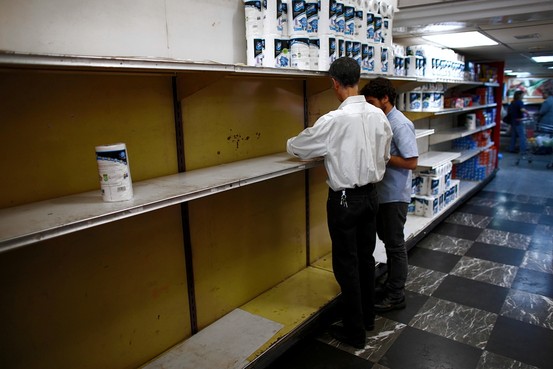
For months, What’s Next Venezuela and other major news outlets have been reporting on the rampant shortages plaguing Venezuela. In light of this reality, we and many others were stunned to learn this week that President Nicolás Maduro is expected to receive an award from the Food and Agriculture Organization of the United Nations (FAO) for the “progress” Venezuela has made in food-related matters. The irony is palpable; shortages in Venezuela are now so severe that Venezuelans have turned to a mobile app that helps them locate basic goods like milk and toilet paper.

Maduro’s troubling two months in office and record shortages have caused many, including Congresswoman Ileana Ros-Lehtinen, to wonder aloud whether the award is indeed justified. While the FAO argues advances have been made with regards to food development and consumption in Venezuela, the facts and figures beg to differ.

The Venezuelan Central Bank reported that shortages in May rose to 21.3 percent, its highest level in 64 months. In other words, two out of 10 products were not in stock in grocery stores and supermarkets. Furthermore, that same month Venezuelan consumer prices increased at a record pace after a devaluation of the currency pushed up the cost of imports. Prices climbed 6.1 percent from April, accelerating the annual inflation rate to a record-high 35.2 percent.

Price controls and foreign exchange restrictions in the import-dependent nation have triggered shortages in every sector of the Venezuelan economy. Basic food products such as chicken, milk, sugar and toilet paper have become an ordeal to find. Not even the Catholic Church has been exempt of the country’s growing scarcities. Wheat flour used for the sacramental wafers is scarce, while the supply of altar wine used for Holy Communion is threatened, likely forcing the Church to ration supplies.

Maduro’s only solution to the problem has been to blame Venezuelans for “overconsumption.” Such a charge stands in utter contrast to the scenes of hungry Venezuelans swarming a grocery truck when it finally arrived with the food they needed. Maduro, meanwhile, has responded by telling Venezuelans not to “panic” and to “regularize consumption,” accusing the public for the government’s failed policies.

Thus far, the free mobile application – which uses crowdsourcing to pinpoint areas that actually have basic necessities – has been the most successful solution for everyday Venezuelans.  After struggling to find milk, an enterprising 21-year-old Venezuelan student decided to develop the app, which has been downloaded over 12,000 times. In a country where citizens are forced to rely on their smart phones to find basic food products, the rationale behind this award is difficult to understand.

 
Feb
1
2013
Posted by
admin
Comments

In Case You Missed It… Articles Roundup Week of 2/1/13

uribana 2013 01 27 In Case You Missed It… Articles Roundup Week of 2/1/13

Courtesy of: AFP

This week: While President Chávez’s health remains a mystery, Vice President Maduro reads a letter supposedly signed by the president at a summit in Chile; with Chávez still in Cuba, many Venezuelans are uneasy about his ties with the Castro family; and the Venezuelan government announces that Chávez will begin yet another round of medical treatment in Cuba, after battling complications from cancer surgery. A Venezuelan jail in Uribana closes after at least 58 died in one of the deadliest prison clashes in the nation’s history; the government comes under harsh criticism for its handling of the Uribana prison riot; the United Nations Human Rights Office holds the Venezuelan government accountable for the prison clash, arguing that the violence reflects neglectful Venezuelan policies; and the Venezuelan Prisons Observatory announces that 591 prisoners were killed in Venezuelan prisons in 2012 alone, the deadliest year in Chávez’s 14-year reign. Lastly, Human Rights Watch releases its annual report saying that Chávez holds “total” power in Venezuela; the government will channel more resources from its oil exports to the central bank this year with hopes that it will alleviate a shortage of dollars; and delayed economic measures continue to lead to inflation and massive shortage of necessities in Venezuela.

Venezuela VP Reads Typed Chavez Letter at Summit, ABC News

Venezuela’s vice president read a letter from Hugo Chavez at a summit in Chile Monday, exhorting the region’s leaders to show unity while criticizing the U.S. embargo on Cuba.

As Chavez takes his time, Havana rules Venezuela, South Florida Sun-Sentinel

Before undergoing his fourth surgery for an unspecified abdominal cancer, Chávez gave specific instructions on what was to happen if he could not return to power.

Venezuela’s Chavez Undergoes New Medical Treatment in Cuba, Voice of America

A Venezuelan government spokesman says President Hugo Chavez has begun a new round of medical treatment in Cuba, after battling complications from cancer surgery performed more than a month ago.

Venezuela jail closed after more than 60 died in riot, BBC News

Venezuelan prison minister Iris Varela has announced the closure of the jail where more than 60 people died in a riot on Friday. Ms Varela said the female wing of the Uribana prison near the city of Barquisimeto had already been cleared.

Victims, Victims Everywhere, New York Times

Uribana prison was built just this century, supposedly as a model institution that would usher in a rehabilitative approach to the penitentiary system. Instead, it has become a symbol of Venezuela’s history of prison violence.

UN Agency: Venezuela Prison Violence ‘Alarming,’ ABC News

Venezuela’s government is facing mounting criticism from activists and the U.N. human rights office for its handling of the country’s overcrowded and violent prisons following a clash between inmates and troops that left at least 58 dead.

Group: 591 Killed in Venezuela Prisons Last Year, ABC News

Venezuela’s latest bloody prison clash came after a year in which 591 inmates were killed in the country’s troubled prisons, the deadliest toll yet during President Hugo Chavez’s 14-year government, a watchdog group said Thursday.

Chavez-run government holds total power: rights group, The Global Post

Venezuela’s government, headed by ailing and absent President Hugo Chavez, holds “total” power while the country’s Supreme Court lacks all credibility, Human Rights Watch said Thursday.

Venezuela to Pump More Dollars Into Economy With Oil Tax, Bloomberg

Venezuela will channel more resources from its oil exports to the central bank this year as it seeks to alleviate a shortage of dollars that has crimped imports, Oil Minister Rafael Ramirez said yesterday.

Delayed economic steps lead to inflation, shortage in Venezuela, El Universal

After two months of uncertainty concerning the economic actions to be taken by the Venezuelan Government, Vice-President Nicolás Maduro informed that President Hugo Chávez had approved several memorandum accounts in connection with economic decisions that will be fully explained by the relevant ministers.

 
Dec
4
2012
Posted by
admin
Comments

Outrage erupts as imprisoned judge details abuses

Maria Lourdes Afiuni  Outrage erupts as imprisoned judge details abuses

Courtesy of: Maria Corina Machado / Globovisión

The case of a Venezuelan judge imprisoned almost three years ago has recently surged back into the headlines, drawing scrutiny from human rights advocates in and outside of Venezuela. Judge María Lourdes Afiuni was arrested in December 2009, after issuing a ruling that displeased President Hugo Chávez. At the time, the president went on national television to affirm that in earlier times, she would have been put before a firing squad. Soon after, she was arrested. Afiuni says that she was raped while in prison and later underwent an abortion behind bars after becoming pregnant. Controversy surrounding the case has outraged human rights activists who consider her jailing proof of the lack of judicial independence in Venezuela.

President Chávez sent his secret intelligence police to arrest Afiuni after she granted bail to businessman Eligio Cedeño, who had ties to the Venezuelan opposition and was accused of evading currency controls. Cedeño’s detention was declared arbitrary by the United Nations Working Group on Arbitrary Detention, which decried Chávez for jailing an officer of the government without a fair trial. Despite the UN’s demands, Afiuni was held for more than a year in an overcrowded women’s prison near Caracas. She was incarcerated only cells away from more than 20 inmates whom the judge had sentenced for murder, drug smuggling and other serious charges. “I’m in this hell because I had the temerity to do my job as a judge in a way that didn’t please Chávez,” Afiuni told the New York Times from her prison cell.

Now that Afiuni has made the abuses she suffered known, the outrage has begun to grow. And now, nearly three years after her arrest, her trial has finally begun. Afiuni refused to enter the courtroom, however, claiming her rights had been violated and the case mishandled. However, due to a recent change in Venezuela’s penal code, the government has claimed the right to try her in absentia, setting a new precedent in Venezuela’s legal history. The particular change in the penal code was approved in June under the auspices of the controversial Enabling Act, which essentially gives President Chávez the right to rule Venezuela by edict.

Afiuni, who suffers from cancer, is now under strict house arrest in Caracas. Human rights groups such as Amnesty International and Human Rights Watch have repeatedly called for Afiuni’s release, as has the American linguist Noam Chomsky, a commentator who often supports Chávez’s socialist goals. In an open letter to the Venezuelan president, Chomsky exhorted Chávez to “correct an injustice” by releasing Afiuni. Chomsky noted with outrage that the sick Afiuni “experienced grave abuses that led to a severe deterioration of her physical and psychological condition.” Unfortunately, these appeals have all been ignored by the Chávez administration.

This three year old case is another example of the government’s efforts to tighten its control over institutions like the judiciary. Earlier this year, former Venezuelan Supreme Court judge Eladio Aponte Aponte made startling claims about the Chávez administration’s control over the court system. Aponte has said Chávez and other government officials contacted judges with instructions on sensitive cases, while vice president Elías Jaua held weekly meetings with members of the judiciary. In fact, the World Justice Project released on Wednesday its 2012 Rule of Law Index Report, ranking Venezuela last in criminal justice. According to the report, “the government institutions are not transparent, and the criminal justice system is ineffective and subject to political influence.”

Examples like Afiuni’s are unfortunately common in Venezuela, but this one in particular has caught the eye of international activists, who will remain attentive as this unprecedented case proceeds. Afiuni’s next court hearing is scheduled for December 19.