Jul
1
2010
Posted by
editor
Comments

Chavez formalizes seizure of US-owned oil rigs

Article originally posted on BusinessWeek

Chavez government took control of 11 oil rigs owned by U.S. driller Helmerich & Payne on Thursday after the company shut them down because the state oil company was behind on payments.

The government’s “forced acquisition” of the rigs took effect with publication of President Hugo Chavez’s decree in the Official Gazette. Red-clad Chavez supporters celebrated the takeover in an outdoor rally in the town of Anaco, where some of the rigs are located.

The government has said it decided to seize the oil rigs because Helmerich & Payne had left them idle for about a year.

Oil Minister Rafael Ramirez defended the expropriation on Wednesday, telling state television the Tulsa, Oklahoma-based company had refused to discuss rates for its drilling services. He said the state oil company Petroleos de Venezuela SA, or PDVSA, is willing to discuss a fair price for the drills and if no agreement is reached, the matter will go to arbitration.

Helmerich & Payne has said it halted operation of some rigs because it simply wanted to be paid for its work.

The U.S. company announced in January 2009 that it was halting about four of its drilling rigs because PDVSA owed the company close to $100 million. Several months later it said more of its rigs were out of operation due to the unpaid debts.

The company said in a statement last week that PDVSA still owed it about $43 million as of June 14.

Other oil services companies have complained about delayed payments. Dallas-based Ensco International Inc. said last year that it had suspended oil drilling off Venezuela’s Caribbean coast because Venezuela owed it $35 million — prompting the state oil company to take over the its operations.

Starting in 2008, PDVSA accumulated unpaid debts of about $7.5 billion to oil industry service contractors. The state oil company paid off more than $5 billion of those debts in 2009, partly relying on bonds to cover its obligations.

 
Jul
1
2010
Posted by
editor
Comments

Caracas Archbishop says that Venezuela is on its way to downfall

Interview with Caracas ArchbishopGreat interview published by El Universal to Jorge Cardinal Urosa Savino, Caracas Archbishop about the current situation in Venezuela:

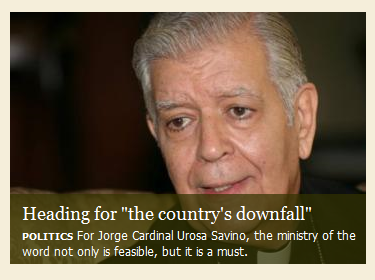
For Jorge Cardinal Urosa Savino, the ministry of the word not only is feasible, but it is a must, mostly nowadays, when, in his view, “the intended way to take us is dictatorship and the country’s downfall.” He noted his dislike of permanent exposure to the media, yet feels the need to speak to the country.

The communiqué from the presidency of the Venezuelan Bishops’ Conference on the spoiled food is noteworthy because it refuels the controversy under which the boundaries between the spiritual mission of the Catholic Church and its interference in politics are so blurry, to such an extent that it is accused of dealing with matters which are not their business.

Politicians say so whenever what one says is not appropriate for them. Bishops’ remarks on social and political life always are in line with supreme principles. We do not go into circumstantial details, except for the result of a government wrongful behavior. The statement referred by you is in accordance with our mission as shepherds of the people of God. In addition, we, bishops, are fully entitled, as citizens, to give our opinion, particularly when the common good, freedom, justice and peace are at stake.

Therefore, the Church is worried not only about a breaking point, such as spoiled food.

It is a breaking point, but a heavy one. Not only hundred thousand tons of food has been lost, but also what does this mean. Firstly, there is likely administrative corruption; further, inefficient management of activities which should correspond to individuals. All of this happens because the government, which tries to cover all areas, is in a totalitarian fashion and going beyond its own tasks, such as ensuring personal and material security of citizens, good working order of public utilities, sovereignty and the country’s independence. Thus, the government has embarked upon production, distribution and marketing of every kind of goods. It attempts to take part in all aspects of Venezuelans’ lives by imposing a Marxist-communist line.

Should the government be efficient and honest in management of the property taken over, would the Venezuelan Church have the same reporting position?

No matter what efficient and honest, it would be fulfilling functions that should correspond to individuals, who, according to the Constitution have the right to engage in economic activities. Such intervention in all the fields of economy, going beyond necessary controls, is an expression of the Marxist-communist line intended to be imposed by the president (Hugo Chávez), which, incidentally, was refused by the people on December 2, 2007 (in a referendum on the constitutional reform). Marxist totalitarianism allows those who occupy top government positions absolute control over the rest of people and this is something questioned by the Church social doctrine, because it leads to gross injustice and people’s submission to the government.

While totalitarianism fills the political, economic and social life, it also enters family life and individual intimacy. Are we reaching such extreme cases in Venezuela? Is it time to chase the Catholic religion?

I hope not, but we are on that way. There is surely the attempt at taking hold of people consciousness, but they have not made it because there is a strong democratic spirit in most Venezuelans.

Was Jesus Christ, as President Chávez claims, the first socialist in the history?

There is a big mistake here. Jesus Christ was not a socialist or monarchist or republican or liberal or a political leader. He was a religious leader; more precisely, the son of God becoming a man. He is above any system, ideology or regime. Such remarks aim at misleading people’s religious feelings. Jesus Christ promotes fraternal love, justice, the human being’s magnanimity. The values proposed, forcefully, by this socialism put power not in the people’s hands, but in their leaders’; remove pluralism, any dissent and different opinions not necessarily opposed to the government thinking.

 
Jul
1
2010
Posted by
admin
Comments

Caracas Archbishop says that Venezuela is on its way to downfall

Interview with Caracas ArchbishopGreat interview published by El Universal to Jorge Cardinal Urosa Savino, Caracas Archbishop about the current situation in Venezuela:

For Jorge Cardinal Urosa Savino, the ministry of the word not only is feasible, but it is a must, mostly nowadays, when, in his view, “the intended way to take us is dictatorship and the country’s downfall.” He noted his dislike of permanent exposure to the media, yet feels the need to speak to the country.

The communiqué from the presidency of the Venezuelan Bishops’ Conference on the spoiled food is noteworthy because it refuels the controversy under which the boundaries between the spiritual mission of the Catholic Church and its interference in politics are so blurry, to such an extent that it is accused of dealing with matters which are not their business.

Politicians say so whenever what one says is not appropriate for them. Bishops’ remarks on social and political life always are in line with supreme principles. We do not go into circumstantial details, except for the result of a government wrongful behavior. The statement referred by you is in accordance with our mission as shepherds of the people of God. In addition, we, bishops, are fully entitled, as citizens, to give our opinion, particularly when the common good, freedom, justice and peace are at stake.

Therefore, the Church is worried not only about a breaking point, such as spoiled food.

It is a breaking point, but a heavy one. Not only hundred thousand tons of food has been lost, but also what does this mean. Firstly, there is likely administrative corruption; further, inefficient management of activities which should correspond to individuals. All of this happens because the government, which tries to cover all areas, is in a totalitarian fashion and going beyond its own tasks, such as ensuring personal and material security of citizens, good working order of public utilities, sovereignty and the country’s independence. Thus, the government has embarked upon production, distribution and marketing of every kind of goods. It attempts to take part in all aspects of Venezuelans’ lives by imposing a Marxist-communist line.

Should the government be efficient and honest in management of the property taken over, would the Venezuelan Church have the same reporting position?

No matter what efficient and honest, it would be fulfilling functions that should correspond to individuals, who, according to the Constitution have the right to engage in economic activities. Such intervention in all the fields of economy, going beyond necessary controls, is an expression of the Marxist-communist line intended to be imposed by the president (Hugo Chávez), which, incidentally, was refused by the people on December 2, 2007 (in a referendum on the constitutional reform). Marxist totalitarianism allows those who occupy top government positions absolute control over the rest of people and this is something questioned by the Church social doctrine, because it leads to gross injustice and people’s submission to the government.

While totalitarianism fills the political, economic and social life, it also enters family life and individual intimacy. Are we reaching such extreme cases in Venezuela? Is it time to chase the Catholic religion?

I hope not, but we are on that way. There is surely the attempt at taking hold of people consciousness, but they have not made it because there is a strong democratic spirit in most Venezuelans.

Was Jesus Christ, as President Chávez claims, the first socialist in the history?

There is a big mistake here. Jesus Christ was not a socialist or monarchist or republican or liberal or a political leader. He was a religious leader; more precisely, the son of God becoming a man. He is above any system, ideology or regime. Such remarks aim at misleading people’s religious feelings. Jesus Christ promotes fraternal love, justice, the human being’s magnanimity. The values proposed, forcefully, by this socialism put power not in the people’s hands, but in their leaders’; remove pluralism, any dissent and different opinions not necessarily opposed to the government thinking.