Dec
13
2012
Posted by
admin
Comments

Post Chávez Surgery, Venezuela Warns of ‘Difficult’ Days

The Wall Street Journal
December 12, 2012
By Ezequiel Minaya and Kejal Vyas

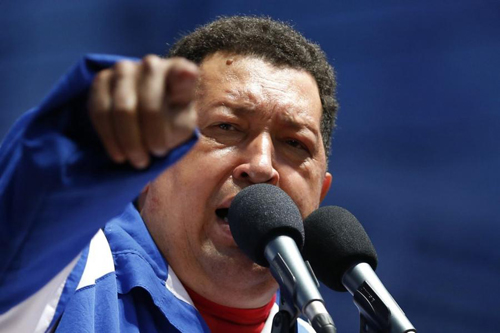
91C59A26 AD14 466B 83A3 488762D71B4A w640 r1 s cx0 cy4 cw0 Post Chávez Surgery, Venezuela Warns of Difficult Days

Courtesy of: Voice of America

Concerns about President Hugo Chávez’s health deepened Wednesday after his government told Venezuelans to prepare for “difficult” days ahead and the possibility that he doesn’t return from his cancer treatment in Cuba before his inauguration for a new term next month.

A day after Mr. Chávez underwent a six-hour operation in Cuba, the details of which weren’t disclosed, his government’s information minister, Ernesto Villegas, described the operation as “difficult, complex, and delicate,” and described Mr. Chávez’s recovery from the surgery in the same words.

Later in the day, Mr. Villegas said doctors reported that Mr. Chávez was in stable condition.

Mr. Chávez handily won a new six-year term in October and is set to be inaugurated on Jan. 10.

“We trust that, with the love of millions, the Comandante will get well soon and return to the helm before Jan. 10. But if that isn’t the case, the people should understand that. It would be irresponsible to hide the gravity of the current moment and the days to come,” Mr. Villegas said in a statement earlier in the day.

The return of Mr. Chávez’s illness has stirred political uncertainty in the oil-rich country of 29 million people. If he dies or has to resign, the constitution calls for new elections within 30 days, raising the chance of a new direction for the nation with the world’s largest oil reserves.

The constitution is less clear, however, about what happens when a president or president-elect is alive, but unable to attend his swearing-in ceremony. Some legal experts said they believed the head of the national legislature, Diosdado Cabello, would temporarily assume the presidency until the president-elect could be sworn in.

Other top members of Mr. Chávez’s government sounded equally dire. With a grim face and a trembling voice, Vice President Nicolas Maduro asked Venezuelans in a televised address to pray for Mr. Chávez, who underwent surgery his fourth procedure in the year and a half since he revealed that he had cancer in June 2011.

The country should be “prepared to face these difficult days, complex and hard that we will be living,” Mr. Maduro said, flanked by Energy Minister Rafael Ramírez and Mr. Cabello—close aides of the man who has run Venezuela virtually as a one-man government for the past 14 years.

Before departing for Cuba on Monday, Mr. Chávez tapped Mr. Maduro as the steward for the self-styled leftist movement popularly called “Chavismo.” Mr. Chávez encouraged Venezuelans to vote for Mr. Maduro if a presidential election is called.

Ecuador’s President Rafael Correa, a Chávez ally who visited the president Monday before his surgery, told reporters he had been told the operation went well. He said if Mr. Chávez was “unable to recover due to the gravity of his illness, the revolutionary process should continue.”

Officials haven’t publicly identified the type of cancer that has stricken Mr. Chávez and have spoken only in vague terms about his medical prognosis. Mr. Chávez has received most of his medical treatment in Cuba, away from the public eye.

Venezuelan opposition politicians have complained that the government is treating Mr. Chávez’s health like a state secret.

Caracas Mayor Antonio Ledezma sent his best wishes to the president for a speedy recovery on Wednesday, but said his government is acting with almost “total secrecy.” Mr. Chávez’s supporters “have a right to inquire about their president, but also the broader Venezuelan public has the right to be told every detail of this issue,” he said.

Meanwhile, unity among the ruling socialist party, as well as Venezuela’s often fractious opposition, will be tested on Sunday in gubernatorial elections.

A version of this article appeared Dec. 13, 2012, on page A18 in some U.S. editions of The Wall Street Journal, with the headline: Post Chávez Surgery, Venezuela Warns of ‘Difficult’ Days.

To read this article on the Wall Street Journal, please click here.
 
Dec
10
2012
Posted by
admin
Comments

ICYMI: Venezuela’s Hugo Chavez, facing a 4th cancer surgery, anoints successor in case he has to leave office

The Washington Post
December 9, 2012
By Juan Forero

hugo chavez ICYMI: Venezuelas Hugo Chavez, facing a 4th cancer surgery, anoints successor in case he has to leave office

Courtesy of: Miraflores Press

Venezuelan President Hugo Chavez will undergo his fourth cancer surgery in Cuba in the coming days, the fiery leader said over the weekend, explaining that he had decided to designate a successor in case the illness forces him to resign from the office he has held for nearly 14 years.

The announcement was the clearest sign yet that Chavez’s battle with cancer could abruptly end his self-described socialist revolution. It prompted his followers to flock to churches and public squares Sunday to pray and chant slogans supporting him.

Saturday night, in a dour address on television, the president said “some malignant cells” had been detected in his pelvic region that would necessitate surgery in Havana’s Cimeq hospital, where he has been treated before. Chavez said he would fly to Cuba on Sunday, although the government did not confirm his departure.

Chavez, 58, said his vice president and confidant, Nicolas Maduro, would assume control if he has to step down. The populist leader urged supporters to vote for Maduro, who made his mark as Chavez’s foreign minister, should there be a need for a presidential election.

“If something happens that sidelines me, which under the constitution requires a new presidential election, you should elect Nicolas Maduro as president,” Chavez said, sitting at a table with Maduro at his side. “I ask that of you from my heart.”

Moises Naim, a former Venezuelan government official who is an analyst at the Carnegie Endowment for International Peace in Washington, called the announcement “basically a farewell speech.”

“He said goodbye to power,” Naim said. “It’s a statement full of resignation and appeals to God. There is no plan. The only talk of the future is that there will be elections and he asks for people to vote for Maduro.”

Chavez’s departure would mark the end of a tumultuous rule in which the leftist former army officer harnessed Venezuela’s considerable oil wealth to shower the poor with social programs while engineering a sharp diplomatic shift away from the country’s historical ally, the United States.

Chavez’s government forged alliances with some of Washington’s most intransigent adversaries, including Cuba, Iran and Syrian President Bashar al-Assad. He has used his lock on practically all levers of power, from the courts to the congress, to push forward the nationalization of hundreds of private companies and the seizure of wide swaths of farmland.

For Venezuela’s opposition, the possible scenarios that Chavez discussed in Saturday’s address amount to the first time the president has publicly acknowledged the severity of his illness and the impact it could have on the future of the country.

No one in the government is authorized to discuss Chavez’s medical condition except Chavez himself, who astonished his countrymen in June 2011 by telling them he had gone under the knife twice to remove a malignant growth. A third surgery followed in February.

Chavez has never disclosed what kind of cancer he has or where it is located. He has twice pronounced himself cured, without providing details.

“It was time to tell the truth to the country,” said Maria Corina Machado, an opposition member of the National Assembly. “Venezuela has been living with a lot of uncertainty. In a democratic country where the constitution is obeyed, the president must talk about his health when it is compromised.”

Should Chavez die or have to resign, the constitution calls for Venezuela to stage presidential elections within 30 days. Maduro, a 50-year-old former union organizer and bus driver who has risen through the ranks of Chavez’s movement, would become the candidate of the president’s United Socialist Party.

The constitution also requires that the vice president fill in for the president should he be temporarily absent. Chavez has spent many weeks in Cuba in the past 18 months, undergoing chemotherapy and radiation treatments. But he has remained in charge of the government, signing decrees and bills from Havana.

Machado said the opposition will call for a strict interpretation of the constitution now that Chavez has suggested the possibility of stepping aside.

“Article 233 of the constitution is clear about the only mechanism, an election within 30 days,” she said. “He can’t name a successor. It’s the Venezuelan people who decide.”

An election would mean a contest between Maduro and the opposition’s leader, Henrique Capriles.

Capriles lost to Chavez in the presidential election held Oct. 7, with the incumbent winning 55 percent of the vote to the challenger’s 44 percent. Polls, though, have shown that Capriles is more popular in Venezuela than all of Chavez’s closest associates, including Maduro.

The president’s swearing-in for another six-year term is scheduled for Jan. 10, but his announcement, following weeks in which he remained out of public view, raised questions about whether the inauguration will take place.

“This is how life goes,” Chavez said in his televised address. “God willing, I hope to be able to give you good news in the coming days.”

To read this article on The Washington Post, please click here.

 
Dec
7
2012
Posted by
admin
Comments

In Case You Missed It… Articles Roundup Week of 12/7/12

yv 1003 5 300x199 In Case You Missed It… Articles Roundup Week of 12/7/12

Courtesy of: AFP

This week: a likely devaluation and spending cuts look set to decrease Venezuelans purchasing power; the Venezuelan Central Bank reports November’s inflation rate was the nation’s highest in 16 months; despite the oil boom in Venezuela, Chávez has failed to alleviate poverty, which has only dropped 4.1 percent over a five year period; the Chávez administration named 15 new ambassadors via twitter; violence remains rampant as 45 bodies were taken to the Caracas morgue over the weekend; the state-run Venezuelan airline, Conviasa has been banned from flying in the European Union due to safety reasons. Meanwhile, Norway will close its Venezuelan embassy after 45 years in Caracas, citing rampant crime; according to a recent Transparency International study, Venezuela is the most corrupt nation in Latin America and one of the most corrupt nations in the world; Chávez’s continued absence causes more speculation over his health. Finally, after a canceled appearance at the Mercosur summit this week, Chávez returns to Venezuela after a ten day medical trip to Cuba.

Likely devaluation and spending cuts are to curb consumption in Venezuela, El Universal

In the third quarter, Venezuelan households’ consumption hit its highest level ever since 1998, as well as a 7.8% leap over the same period in 2011, according to the numbers disclosed by the Central Bank of Venezuela (BCV).

Venezuela Names 15 New Ambassadors, Via Twitter, The Wall Street Journal

CARACAS—Venezuela President Hugo Chávez, who will be in Cuba for an undetermined period receiving follow-up treatment after his battle with cancer, named 15 new ambassadors to countries in the region, the Middle East and Africa, Information Minister Ernesto Villegas announced Monday.

A total of 45 bodies are taken to Caracas morgue in the weekend, El Universal

As many as 45 bodies had been taken to Bello Monte morgue in Caracas from Friday morning through Monday morning, according to unofficial sources. The body of Roberto José Pinto, 29, a detective of the Scientific, Criminal and Forensic Investigation Agency (Cicpc), was added to the weekend account.

Venezuela is headed for economic adjustments despite oil boom, El Universal

The last thing one expects from people who have won the lottery is that after six years their debts are higher, they are having difficulties to meet daily expenses, and they have slightly reduced poverty.

Venezuela’s Conviasa blacklisted by the European Commission, El Universal

The European Commission on Thursday updated the blacklist of airlines that have been banned from flying on the European Union due to safety reasons. Venezuelan state-run airline Conviasa has been included in the list.

UPDATE 2-Venezuela’s November inflation was highest in 16 months, Reuters

CARACAS, Dec 4 (Reuters) – Venezuela’s monthly inflation accelerated to 2.3 percent in November, the central bank said on Tuesday, the highest rate in more than a year.

Citing Crime, Norway to Close Venezuela Embassy, ABC News

Norway will close its embassy in Venezuela because of rampant crime in the South American country and move the diplomatic mission to neighboring Colombia, its ambassador said Wednesday.

Corruption Perception Index Ranks Venezuela as One of World’s Most Crooked Countries, Fox News Latino

Venezuela is the most corrupt nation in Latin America and one of the most crooked countries in the world, according to an NGO annual report. The Andean nation ranked 165 out of 174 nations on Transparency International’s 2012 Corruption Perception Index.

Chavez’s Longest Silence Since Cancer Fuels Health Rumors, Bloomberg Businessweek

Venezuelan President Hugo Chavez’s longest absence from public view since he first underwent cancer surgery 18 months ago is fueling speculation that his health is worse than he’s letting on.

Chavez back in Venezuela after Cuba treatment, USA Today

Venezuela (AP) — Venezuelan President Hugo Chavez arrived back home in Caracas early Friday after 10 days of medical treatment in Cuba. State television showed images of Chavez arriving at Caracas’ airport and walking down the steps of the presidential jet wearing a track suit.