Feb
22
2013
Posted by
admin
Comments

In Case You Missed It…Articles Roundup Week of 2/22/13

 In Case You Missed It...Articles Roundup Week of 2/22/13

Courtesy of: Associated Press

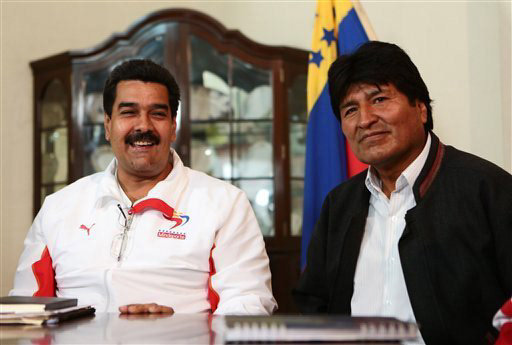
This week: Hugo Chávez returns home to Venezuela, fueling speculation he will soon retire due to his declining health; the military hospital in Caracas housing Chávez remains the center of attention, though there have been no physical signs of the president; as the president remains hidden, Venezuela faces political uncertainty and an impending constitutional crisis; and the Venezuelan government remains discouraged about Chávez’s condition as his breathing difficulties persist. Chávez’s return to Venezuela prompts discussion of succession and a new election; the president’s declining health prevents a visit from his ally President Evo Morales of Bolivia; and Cuba continues to play an outsized role in Venezuelan politics. Lastly, Globovisión, the sole remaining Venezuelan TV channel that criticizes the Chávez regime, accuses the government of excluding it from a new digital television system; Harvest Natural’s deal to sell Venezuelan assets falls through after the devaluation causes the company’s shares to plunge; and companies from the U.S., China and Canada question the lawfulness of the Venezuelan government.

Chavez Return to Venezuela Fuels Speculation He’ll Quit, Bloomberg Businessweek

Venezuelan President Hugo Chavez was rushed to a military hospital early this morning after returning home from two months of cancer treatment in Cuba.

Venezuela hospital at center of attention in Chavez’s cancer fight, but no sign of leader, The Washington Post

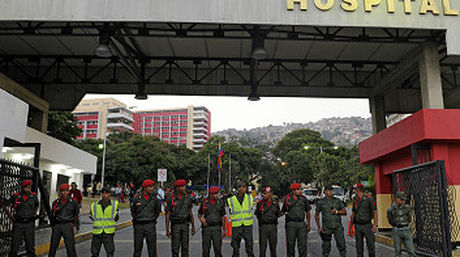
At Caracas’ military hospital, the only outward signs that President Hugo Chavez is a patient inside are the motorcades that come and go and the soldiers standing guard, some of them wearing red berets.

Venezuela: Constitutional Crisis and a Barely Visible President, The Huffington Post

“Now that the president is back, there can be no doubt about the democratic institutions working in Venezuela,” said communication and information minister Ernesto Villegas on the return to Caracas of the Venezuelan president.

Venezuela Downcast on Chávez’s Condition, The Wall Street Journal

Venezuelan President Hugo Chávez, who is recovering from cancer surgery at a military hospital, is still suffering respiratory problems and hasn’t responded favorably to treatment, a government spokesman said late Thursday.

Chavez Back in Venezuela, Stirs Succession Talk, ABC News

Hugo Chavez’s sudden return to Venezuela after more than two months of cancer treatments in Cuba has fanned speculation that the president could be preparing to relinquish power and make way for a successor and a new election.

Chavez’s Health Prevented Him From Seeing Ally Morales, Bloomberg Businessweek

Venezuelan President Hugo Chavez has endured the “most difficult moments of his life,” according to Bolivian President Evo Morales, who didn’t get to see his close ally during a visit to Caracas.

Cuba has outsized role in Venezuela as Chavez fights cancer, The Washington Post

It’s become a well-worn routine here: A news flash about President Hugo Chavez’s battle with cancer is issued, invariably delivered with great fanfare but scant details.

Venezuela launches digital television, critical TV channel complains it was excluded, The Washington Post

A Venezuelan television channel that takes a critical stance toward President Hugo Chavez accused the government on Wednesday of excluding it from a new digital television system, and it warned that the action could force it off the open airwaves

Harvest Natural’s $725 Million Deal to Sell Venezuela Assets Falls Through, The Wall Street Journal

Harvest Natural Resources Inc. (HNR) said a deal under which Indonesia’s state-owned PT Pertamina had agreed to buy its interests in Venezuela for $725 million has been terminated.

Chinese companies query into Venezuelan governance lawfulness, El Universal

Companies from China, United States and Canada have a big question mark as to lawfulness of governance in Venezuela. For this reason, they hesitate to invest in the country, said Adolfo Salgueiro, an expert in international law.
 
Feb
21
2013
Posted by
admin
Comments

ICYMI: The homecoming

The Economist
February 23, 2013
By Fabiola Sanchez and Ian James

hospital chavistas celebraban presidente AFP NACIMA20130221 0259 19 ICYMI: The homecoming

Courtesy of: AFP

Ten weeks after flying to Cuba for his fourth cancer operation since June 2011, President Hugo Chávez returned to Venezuela in the early hours of February 18th. But the manner of his arrival suggested that he remains far too ill to govern. Only his closest aides, including a medical team, were on hand. Even senior cabinet members and leaders of the ruling United Socialist Party of Venezuela (PSUV) were kept in the dark. The president was taken to a military hospital, and installed in a tightly guarded ninth-floor ward reserved for senior officers. No images of his return were made available, but the party organised “spontaneous” demonstrations of joy on the part of his supporters once the news had been announced on the president’s Twitter account.

Since leaving Caracas for Havana on December 10th Mr Chávez, who has ruled his country in a hyperactive fashion for 14 years, has been neither seen nor heard. In a series of vaguely worded official communiqués, the government admitted that a severe post-operative lung infection left him with breathing difficulties. On February 15th it belatedly presented a “proof of life”, in the form of several photographs of the president with his eldest daughters, holding a copy of the Cuban government newspaper Granma from the previous day. But the photos (one of them is above) raised more questions than they answered. An accompanying statement said Mr Chávez is barely able to speak, thanks to a tracheotomy to ease his breathing (no tube was visible in the photos).

Despite all this, officials continue to insist that the president is in day-to-day control of the administration. They said, for example, that he had authorised a 32% devaluation of the currency, the bolívar, announced on February 8th, the eve of the Carnival holiday, when most Venezuelans are thinking about the beach. The president’s return has also served to distract attention temporarily from the deteriorating economy.

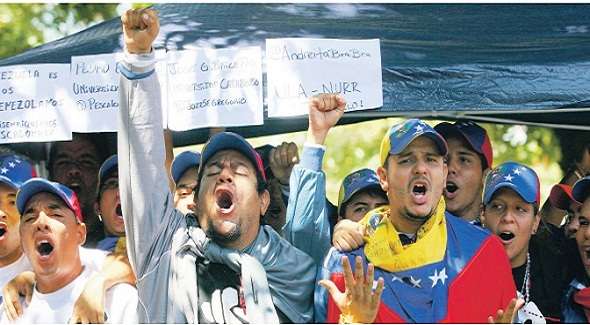
Nicolás Maduro, the vice-president, is to all intents and purposes running the country, but vehemently denies that he is the acting president. Mr Chávez’s return will at least obviate the need for ministers to make frequent visits to Havana for bedside consultations. Those visits fuelled speculation that instructions were being imparted by Cuba’s communist leaders, rather than by Mr Chávez. The homecoming cut short a growing protest against Cuban interference staged by students outside the island’s embassy in Caracas.

But in other ways Venezuela remains in the constitutional limbo that began on January 10th. That was the date on which Mr Chávez should have been sworn in for his fourth consecutive term after an election on October 7th. The supreme court, which Mr Chávez has turned into an appendage of the executive, ruled that as a re-elected president he could be sworn in whenever his doctors deemed him fit enough. More controversially still, they extended indefinitely the tenure of the existing cabinet, including the unelected Mr Maduro, whom Mr Chávez before his operation had anointed as his chosen successor. The court thus brushed aside constitutional stipulations concerning the president-elect’s incapacitation, which include the appointment of a medical board to determine his fitness for office.

Nevertheless, Mr Chávez’s return to Caracas makes possible his swearing-in, which is likely to be administered by a delegation from the court in private, rather than before the National Assembly. That in turn would give constitutional legitimacy to Mr Maduro’s role as vice-president (which technically lapsed on January 10th). But the government seems in no immediate hurry to take this step, perhaps because of the gravity of the president’s condition, including his speech impairment. Mr Chávez “will be sworn in when he’s good and healthy,” said Aristóbulo Istúriz, a state governor and leading PSUV member. The opposition Democratic Unity alliance is wondering aloud whether a man who is not fit enough to be sworn in can be considered fit enough to run the country.

Few but the president’s most fervent supporters believe he will recover sufficiently to serve his six-year term of office. Mr Chávez’s son-in-law, Jorge Arreaza, who is also the science minister, referred last week to “palliative treatments”, which suggested that the president has come home to die.

Foreign diplomats in close touch with the regime expect a fresh presidential election by June at the latest. This would almost certainly pit Mr Maduro against the opposition’s Henrique Capriles, who lost to Mr Chávez in October. The president’s death, his resignation or other “permanent absence” would, according to the constitution, trigger an election within 30 days. But the supreme court is skilled in creative interpretation of the constitution so as to suit the government’s cause.

Some analysts suggested that the devaluation, which is bound to spark an increase in inflation (already at 20% a year), was a sign that the regime had ruled out an early election. Rather, it may be an indication of the gravity of Venezuela’s economic plight. Wild spending ahead of the October election and the economy’s mismanagement pushed the fiscal deficit to 8.5% of GDP last year. Several staple goods are in short supply and the Central Bank’s liquid reserves are down to about $4.5 billion. In the illegal black market, the dollar buys 23 bolívares, compared with the new official rate of 6.3.

One indication that an election may come soon is that government newspapers have begun to publicise polls which suggest that Mr Maduro would easily beat Mr Capriles in a vote. Mr Maduro himself has been engaged in an undeclared campaign for some time: he blamed the devaluation and shortages on speculation and sabotage by what remains of Venezuela’s battered private sector. Some in the opposition coalition want to name their candidate so as to be ready for a snap election. Barring a miraculous recovery by Mr Chávez, Venezuelans may soon be going to the polls again.

To read this article at The Economist, please click here.

 
Feb
19
2013
Posted by
admin
Comments

ICYMI: Chavez’s return to Venezuela raises questions

Associated Press
February 19, 2013
By Fabiola Sanchez and Ian James

38026estudiantes cub1 e1361304532483 ICYMI: Chavezs return to Venezuela raises questions

Courtesy of: TalCual

CARACAS, Venezuela — The announcement of President Hugo Chavez’s return to Venezuela after a 10-week silence in Cuba is raising questions about his cancer treatments, his delicate health, and the political purposes that motivated his homecoming.

Three messages appeared on Chavez’s Twitter account early Monday saying he was back, and the government announced that he had arrived at 2:30 a.m. and was taken to Caracas’ military hospital to continue with his treatments. The government released no images of the president, though, and while his supporters threw street celebrations to welcome him, some also said they wanted to see him to get a better idea of how he is doing.

The government has said Chavez is undergoing “complex and tough” treatments for his illness but hasn’t specified what sort of treatment. The government has said he is breathing through a tube inserted into his windpipe and therefore has difficulty talking, but officials haven’t given a detailed medical report despite demands by the opposition.

Even as Vice President Nicolas Maduro has increasingly stood in for Chavez since the president’s Dec. 11 surgery, he and other leading officials have insisted that Chavez remains in charge and has been signing off on government decisions.

Chavez’s announced return to Caracas came less than three days after the government released the first photos of the president in more than two months, showing him in a bed looking bloated and smiling alongside his daughters. The lack of any images of Chavez on Monday underlined the many unanswered questions about where he stands in his prolonged struggle with an undisclosed type of pelvic cancer.

Information Minister Ernesto Villegas broke into song on television early Monday, exclaiming: “He’s back, he’s back!”

“Bravo,” Villegas said, before state television employees joined him in the studio clapping and celebrating.

A giant inflated Chavez doll was placed beside a corner of the National Assembly building.

Villegas reiterated in an interview with Venezuelan radio station Union Radio that Chavez is going through a “difficult, hard and complex” recovery process, and that his return doesn’t change the “difficult circumstances he has been in.”

The vice president later presided over a televised Cabinet meeting at the presidential palace, though he didn’t offer additional details about Chavez. “He will live and he will triumph,” Maduro said at the end of the meeting, while on television an image of Chavez’s face was superimposed on the oval-shaped table.

Hundreds of Chavez supporters celebrated his return in downtown Caracas, chanting his name and holding photos of the president in Bolivar Plaza. Supporters also gathered outside the hospital, wearing the red T-shirts of Chavez’s socialist movement and chanting: “He’s back!”

“I want to see my president,” said Alicia Morroy, a seamstress who stood outside the hospital on the verge of tears. “I’ve missed him a lot because Chavez is the spirit of the poor.”

Six hospital employees who were asked about the president said they hadn’t seen him. Yusmeli Teran, a waitress who serves food to patients, told The Associated Press that the area where Chavez was being treated on the 9th floor is a restricted area guarded by police and soldiers. “No one has seen him at all,” she said.

Chavez’s precise condition and the sort of cancer treatments he is undergoing remain a mystery, and speculation has grown recently that he may not be able to stay on as president.

Dr. Carlos Castro, scientific director of the Colombian League Against Cancer in Bogota, Colombia, said that given the government’s accounts that Chavez is undergoing “complex” treatment, he thinks he likely will have to step down.

“Unfortunately, the cancer he has isn’t going to go away, and he’s returning to continue his battle. But I think he’s conscious that he isn’t going to win his fight against cancer, as much as he’d like to win it,” Castro told the AP in a telephone interview.

The Venezuelan Constitution says that if a president dies or steps down, a new vote must be called and held within 30 days. Chavez raised that possibility before he left for Cuba in December by saying that if necessary, Maduro should run in a new election to replace him.

Chavez’s return could be used to give a boost to his would-be successor and gain time to “consolidate his alternative leader” ahead of a possible new presidential vote this year, said Luis Vicente Leon, a Venezuelan pollster and political analyst.

Leon said that even if Chavez isn’t seen in public, his presence will allow the government to keep up his emotional connection to his followers and rally support.

Even the state newspaper Correo del Orinoco referred to the possibility of a new election in its Monday edition. The top headline, published before Chavez’s announced return, said a poll found Maduro would win a possible election.

Maduro and other Cabinet ministers held hands and prayed in a televised gathering on Monday night in which a priest and a minister offered words of thanks for Chavez’s return.

Venezuela’s opposition responded to the news by saying that it’s natural for the president to be back in his own country and that creating a “spectacle” with his return serves no useful purpose.

“The government should tell the truth and dedicate itself to working to confront Venezuelans’ serious problems,” the opposition coalition said in a statement, citing problems such as violent crime, soaring inflation and worsening shortages of some foods.

The 58-year-old Chavez was re-elected to a new six-year term in October, and his inauguration, originally scheduled for Jan. 10, was indefinitely postponed by lawmakers in a decision that the Supreme Court upheld despite complaints by the opposition.

Some speculated that with Chavez back, he could finally be sworn in. But government officials haven’t yet addressed that possibility.

To read this article at the Associated Press, please click here.