Jan
18
2013
Posted by
admin
Comments

ICYMI: 5 Ways Hugo Chavez has Destroyed the Venezuelan Economy

ABC News
January 17, 2013
By Stephen Keppel
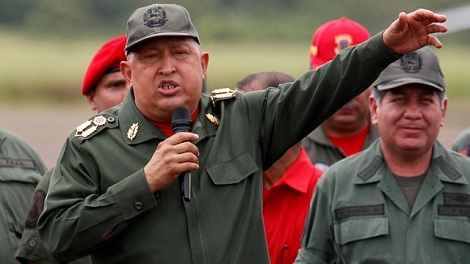
ap chavez military uniform wg ICYMI: 5 Ways Hugo Chavez has Destroyed the Venezuelan Economy

Courtesy of: Associated Press

It is unclear if Venezuelan president Hugo Chavez will make a full recovery from his most recent surgery in Cuba. Whatever happens, he always stirs a lot of passions. Certainly that is the case when thinking of what his lasting legacy in Venezuela will be.

On the left he is seen as a socialist hero who broke the Venezuelan “oligarchy” and defended the country against the “American Empire.” On the right he is the socialist anti-Christ who “brought Afghanistan to South America.” But perhaps one of the simplest ways to judge his reign, is to remove the politics and look closely at his economic record.

Take gross domestic product, or GDP. In that case the record is certainly mixed. There was strong economic growth from 2004 to 2008 but GDP fell in 1999, 2002, 2003, 2009 and 2010. From the time Chávez took office in 1999 to 2011 Venezuela’s economy grew by an average of 2.8% per year. During this same period Latin America as a whole grew by 3.3% per year and Brazil grew by 3.4% per year.

Others will argue that we must judge Chavez on his record of reducing poverty and inequality. According to the UN’s Economic Commission for Latin America, the percentage of the population living under the poverty line in Venezuela fell from 49.4% in 1999 to 27.8% in 2010. That is a pretty good record but there were similar trends across Latin America. In the region as a whole poverty dropped from 43.8% in 1999 to 31.8% in 2010. A few countries, like Peru, Brazil and Panama, faired even better than Venezuela. Poverty rates in Peru dropped sharply from 54.7% in 2000 to 31.3% in 2010—all three have solidly capitalistic economies.

Inequality has declined in Venezuela but it has across other parts of Latin America as well particularly in Brazil, Chile and Colombia.

When you take a closer look at the entire economy, and where Venezuela is headed, the record is not a good one. Here are five major ways that Chavez has really undone the Venezuelan economy:

1. Venezuela has gone from being dependent on oil to being extremely dependent on oil.

Former minister Gerver Torres points out that in 1998 oil represented 77 percent of Venezuela’s exports but by 2011 oil represented 96 percent of exports. That means today only around 4 percent of the goods that Venezuela exports are non-oil products! The Venezuelan economy relies almost exclusively on the price of oil and the ability of the government to spend oil revenues. This will take years to reverse because of item two below.

2. The Chavez government has crippled private businesses and national industry through expropriations and nationalizations.

The Chavez government has expropriated or nationalized numerous companies (no one seems to be able to count them all) involved in various sectors including aluminum, cement, gold, iron, steel, farming, transportation, electricity, food production, banking, paper and the media. The number of private companies in industry has dropped from 14,000 in 1998 to only 9,000 in 2011, according to Torres.

Companies need investment to grow and hire new workers. One of the biggest failures of the Chavez government has been to drive away both domestic and foreign investors. In 2011 Latin America enjoyed a record of more than $150 billion in foreign investment with Brazil receiving $67 billion. Venezuela’s neighbor Colombia received $13 billion while Venezuela received only $5 billion. To avoid expropriation and find investment a number of Venezuelan companies have moved to Colombia, Panama and the United States.

3. The Venezuelan currency is a mess.

The new currency, the Bolivar fuerte, is anything but strong. The Bolivar fuerte has lost nearly two-thirds of its value since it was launched in 2008. Many analysts expect Venezuela will have to go through a painful devaluation sometime this year or next. This will further reduce the value of wages and sharply increase the costs of imports of basic staple goods. Life will get tougher for most Venezuelans but Chavez probably won’t be around to see it.

4. Prices in Venezuela have gone up by 23 percent a year for more than ten years.

Inflation in Venezuela has averaged 23 percent during 1999-2011 compared to a Latin American average of 4.6 percent. Imagine what life would be like if the price of groceries went up 23 percent every year. This craziness combined with stringent price controls has completely distorted the economy, creating black markets and shortages. In 2012 Venezuela will again have one of the highest inflation rates in the world.

5.Under Chavez Venezuela has become one of the most violent countries on the planet.

The murder rate per 100,000 citizens has risen from 25 in 1999 to 45.1 in 2011. This is not an economic stat per se but violence has an economic impact. It is more challenging and dangerous than ever to do business and go to work in Venezuela. When you consider these points, it’s hard to call the economic legacy of Chavez and his band of 21st Century Socialists a good one.

To read this article on ABC News, please click here.


Sep
24
2012
Posted by
admin
Comments

What’s Next Venezuela Election Update: September 24, 2012

caprilesychavez445a What’s Next Venezuela Election Update: September 24, 2012

Courtesy of: BBC Mundo

The Venezuelan elections are only two weeks away, and opposition candidate Henrique Capriles’ campaign has put himself in a good position to hand President Hugo Chavez his first electoral defeat. The two candidates have run very different campaigns, with Chávez running a populist campaign based on grandiose promises and Capriles a more granular, issue-oriented campaign, directing his rhetoric toward fixing the basic problems of the country. Chávez’s declining popularity, meanwhile, is partially the president’s own doing, as Venezuela’s crime rate has become one of the highest in his world since he came to power. Despite its successful campaign, the opposition is worried about violence and has voiced concerns that pro-government armed groups could seek to intimidate voters at the polls. Chávez has already shown that dirty tactics are not beneath him, having just last week blocked a Capriles event from the airwaves by calling a mandatory national broadcast of his own. Meanwhile, the possibility of a change in government is exciting investors, although Chávez’s increased election-year spending is taking Venezuela’s international reserves to record lows, making a post-election currency devaluation very likely.

An Emboldened Opposition Challenges One of Latin America’s Most Skilled Politicians, The Huffington Post

There is no doubt that the Oct. 7 presidential vote will be Hugo Chávez’s most difficult election to date.

Venezuela’s Capriles says he’ll fix country’s problems, not world peace, Reuters

Venezuela’s opposition standard bearer Henrique Capriles mocked President Hugo Chavez’s grandiose campaign pledges two weeks before the election, and vowed to fix voters’ daily problems if he wins.

Insight: Chavez plays populist card for Venezuela election, The Chicago Tribune

To understand why President Hugo Chavez may win yet another election in Venezuela next month, go and sit under the mango trees of Los Rastrojos or Sabaneta.

Venezuela crime out of control, imperiling Chavez re-election, USA Today

Margarita Hernandez has been waiting more than a year for someone to pay for the murder of her 18-year-old son, killed by thugs a few blocks from his home.

Venezuela Opposition Concerned About Armed Groups, ABC News

The campaign of Venezuelan presidential candidate Henrique Capriles said Tuesday that it has detected risks of trouble at dozens of polling centers in areas where Colombian rebels or other armed groups are known to operate.

Venezuela’s Capriles slams Chavez for blocking broadcast, Reuters

Shortly after Capriles began speaking to thousands of supporters in a Caracas park, Chavez launched a “chain broadcast” across all public access television in which he celebrated his government’s achievements and extolled the virtues of socialism.

Investors Turn Gaze to Venezuela Election, The Wall Street Journal

The approach of next month’s national elections has created a fervor among investors in the country’s bonds but is ringing alarm bells for some.

Venezuela’s Reserves Fall to Five-Year Low Before Vote, Bloomberg Businessweek

Venezuela’s international reserves last week fell to their lowest level in more than five years as the government boosts spending ahead of next month’s presidential election.

 
Sep
24
2012
Posted by
admin
Comments

What’s Next Venezuela Election Update: September 24, 2012

caprilesychavez445a What’s Next Venezuela Election Update: September 24, 2012

Courtesy of: BBC Mundo

The Venezuelan elections are only two weeks away, and opposition candidate Henrique Capriles’ campaign has put himself in a good position to hand President Hugo Chávez his first electoral defeat. The two candidates have run very different campaigns, with Chávez running a populist campaign based on grandiose promises and Capriles a more granular, issue-oriented campaign, directing his rhetoric toward fixing the basic problems of the country. Chávez’s declining popularity, meanwhile, is partially the president’s own doing, as Venezuela’s crime rate has become one of the highest in his world since he came to power. Despite its successful campaign, the opposition is worried about violence and has voiced concerns that pro-government armed groups could seek to intimidate voters at the polls. Chávez has already shown that dirty tactics are not beneath him, having just last week blocked a Capriles event from the airwaves by calling a mandatory national broadcast of his own. Meanwhile, the possibility of a change in government is exciting investors, although Chávez’s increased election-year spending is taking Venezuela’s international reserves to record lows, making a post-election currency devaluation very likely.

An Emboldened Opposition Challenges One of Latin America’s Most Skilled Politicians, The Huffington Post

There is no doubt that the Oct. 7 presidential vote will be Hugo Chávez’s most difficult election to date.

Venezuela’s Capriles says he’ll fix country’s problems, not world peace, Reuters

Venezuela’s opposition standard bearer Henrique Capriles mocked President Hugo Chavez’s grandiose campaign pledges two weeks before the election, and vowed to fix voters’ daily problems if he wins.

Insight: Chavez plays populist card for Venezuela election, The Chicago Tribune

To understand why President Hugo Chavez may win yet another election in Venezuela next month, go and sit under the mango trees of Los Rastrojos or Sabaneta.

Venezuela crime out of control, imperiling Chavez re-election, USA Today

Margarita Hernandez has been waiting more than a year for someone to pay for the murder of her 18-year-old son, killed by thugs a few blocks from his home.

Venezuela Opposition Concerned About Armed Groups, ABC News

The campaign of Venezuelan presidential candidate Henrique Capriles said Tuesday that it has detected risks of trouble at dozens of polling centers in areas where Colombian rebels or other armed groups are known to operate.

Venezuela’s Capriles slams Chavez for blocking broadcast, Reuters

Shortly after Capriles began speaking to thousands of supporters in a Caracas park, Chavez launched a “chain broadcast” across all public access television in which he celebrated his government’s achievements and extolled the virtues of socialism.

Investors Turn Gaze to Venezuela Election, The Wall Street Journal

The approach of next month’s national elections has created a fervor among investors in the country’s bonds but is ringing alarm bells for some.

Venezuela’s Reserves Fall to Five-Year Low Before Vote, Bloomberg Businessweek

Venezuela’s international reserves last week fell to their lowest level in more than five years as the government boosts spending ahead of next month’s presidential election.