May
17
2013
Posted by
admin
Comments

In Case You Missed It…Articles Roundup Week of 5/13/13

This week: Shortages prevent Venezuelans from buying basic foodstuffs, from milk to flour to cooking oil. Foreign direct investment plummets The widespread shortages caused by Maduro’s socialist policies have now choked off the supply of a new household item: toilet paper; To address rampant crime, Maduro sends Venezuela’s military into high-violence areas. Analysts worry that Venezuela, entirely dependent on oil revenues, may turn into a failed state when oil prices inevitably drop. Desperate for a scapegoat on which to blame Venezuela’s economic woes, Maduro accuses Venezuela’s largest food company, Polar, of hoarding.  Polar’s CEO convincingly rebuts these allegations and offers advice on how the government might work with the private sector to combat shortages. A conciliatory Maduro begins to show signs of extending an olive branch to the private sector.


Eclac reports 15% drop in foreign investment in Venezuela in 2012, El Universal

Foreign investment in Venezuela fell 15% in 2012, said the Economic Commission for Latin America and the Caribbean (Eclac) of the United Nations in its report “Foreign Direct Investment in Latin America,” released on Tuesday. The regional agency report highlighted that in 2012, Venezuela received USD 3.21 billion versus 3.77 billion a year earlier. In this way, Ecuador joined Venezuela, Nicaragua, Mexico, Bahamas, Granada, Saint Kitts and Saint Lucia as the only countries in the region where foreign investment has dropped. Thanks to the positive performance of other countries, on average, Latin America and the Caribbean in 2012 hit a new record amount of direct foreign investment of  USD 173.36 billion (6.7% higher than in 2011), despite the external context of declining capital flows, Eclac reported in a press release.

How food shortages are dividing Venezuela, BBC News

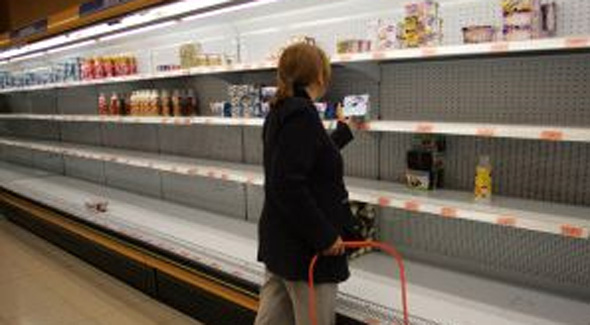
Some 30 people are queuing outside a state-run supermarket in the 23 de Enero neighbourhood in Caracas. A woman walks out with a bag in her hands. “There is milk!” she says enthusiastically, much to the delight of the other customers. Milk is one of the products that are not easily available in Venezuela. Others include toilet paper, sugar, cooking oil and the cornflour used to make arepas, Venezuela’s national dish. According to data from Venezuela’s Central Bank, the scarcity index rose to 21% last month, the highest since the bank started tracking the measure in 2009. This means that out of 100 goods, 21 are not available.

Roiled over rolls: No toilet paper has Venezuelans fuming, USA Today

Gil, a 43-year-old Venezuelan housewife, spent two days looking for toilet paper in this city of 150,000 in the central state of Aragua. She found paper towels and napkins but no toilet paper. Gil, a 43-year-old Venezuelan housewife, spent two days looking for toilet paper in this city of 150,000 in the central state of Aragua. She found paper towels and napkins but no toilet paper.”Call me a counterrevolutionary but there are certain things that are essential and toilet paper is one of them,” she says, staring at the bare shelves where toilet tissue used to be stocked at the Morichal supermarket, one of the city’s largest. “What do they expect us to use? Banana leaves?”


Venezuela’s military enters high-crime slums, Miami Herald

Stern-looking soldiers clutching assault rifles wave down the beat-up Chevy Caprice entering this sprawling slum on the outskirts of Caracas. Flashlights in his face, the driver steps out and places his hands on the roof while the soldiers frisk him for drugs and weapons. He’s clean, and a hand gesture from the commanding officer sends him off into the maze of ramshackle homes that is Petare, one of the most dangerous parts of Venezuela’s notoriously crime-infested capital.

The People of Venezuela Are in Dire Need of Toilet Paper, New York

The AP brings us news that Venezuela is having a serious humanitarian crisis, one with which anyone who’s ever made a frantic late-night run to the corner bodega can sympathize. Namely, the entire country is running out of toilet paper. Venezuela’s socialist government has promised to import 50 million rolls of toilet paper (or maybe 25 million double-rolls?) and 760,000 pounds of food to make sure all citizens can eat and poop in comfort once more. “The revolution will bring the country the equivalent of 50 million rolls of toilet paper,” the country’s commerce minister said. “We are going to

Venezuela remains mired in a political and economic crisis that shows no signs of letting up. But while street protests, soaring inflation, scarcity, and skyrocketing crime are massive headaches, the government can count on still-high oil prices to soothe the pain a bit. The question that begs asking is: How will Venezuela maintain stability if oil prices drop?

Venezuelan food firm tells Maduro government to boost output, Reuters

Venezuela’s top food producer, Empresas Polar, on Monday challenged the country’s socialist government to boost output of basic staples and ease nagging product shortages, rejecting accusations it is hoarding products to destabilize the economy. Food supplies have become increasingly unsteady since late last year. Shoppers struggle to find corn, wheat flour and basic medicines – a constant complaint that could become a political liability for President Nicolas Maduro. The president over the weekend said Polar, which makes products from beer to detergent, was intentionally cutting output to leave supermarket shelves bare and weaken his government through “economic war.” Polar President Lorenzo Mendoza, in a combative press conference, said the product shortages have been partly spurred by inefficiency of state-run companies nationalized during the 14-year-rule of late socialist leader Hugo Chavez.

Caracas Offers Peace to Private Sector, Wall Street Journal

New President Nicolás Maduro, trying to shore up Venezuela’s economy amid growing shortages of everything from corn flour to toilet paper, has extended an olive branch to the country’s private sector, in particular the country’s largest food maker. It is a surprising turnaround given the antics of his predecessor, the late populist Hugo Chávez, who regularly threatened to nationalize the food maker, Empresas Polar SA, and accused it of hoarding products in order to sabotage his self-styled revolution.
 
Feb
28
2013
Posted by
admin
Comments

ICYMI: Venezuela’s Economic Troubles Continue

Joel Hirst is a democracy activist and a Principal at Cordoba Group International. He is a regular What’s Next Venezuela contributor.

35176escasez22 e1362071656126 ICYMI: Venezuelas Economic Troubles Continue

Courtesy of: TalCual

Huffington Post
February 28, 2013
By Joel D. Hirst

For the past few months, the eyes of Latin America have been fixed on the ailing Venezuelan President Hugo Chávez. As news regarding his health does not improve, speculation has swirled about whether the three-term president will ever recover. For average Venezuelans, however, the more important debate concerns not whether the man himself will live out his fourth term in office, but whether the economic malpractice he has subjected on Venezuela — and which has wrought so much economic pain on the country — will be allowed to endure.

Chávez, first elected in 1999, proclaimed that his new political/economic doctrine of “21st Century Socialism” would provide a more equitable distribution of wealth for Venezuela’s poorest. After fourteen years of economic experiments; the economic model has been demonstrated as self-defeating. More than a decade of expropriations, government harassment of the private sector, and price and currency controls in fact proved disastrous for Venezuela’s economy and its people. Venezuelans have spent that decade struggling under the yoke of high unemployment, rampant inflation and crippling shortages of everything from rice to flour to coffee. It has left Chávez in the awkward position of blaming Venezuela’s hobbled private sector for the failure of his own socialist policies.

As the situation in Venezuela has deteriorated, Chávez has used private enterprise as a scapegoat — reinforced by Chavez’s near-total control of the country’s media — to maintain his hold on power. Yet there is no escaping the fact that the private sector in Venezuela is in a bad way, and it is only getting worse.

Expropriations have long been Chávez’s favorite tool to suppress the private sector. The government has seized almost a thousand companies over the past decade, in industries as varied as agriculture to tourism. Most of them are now state-owned and unproductive. Since Chávez was first elected, the number of private companies in Venezuela has dropped from 14,000 to 9,000 in 2011.

Chávez insisted such measures were necessary because private companies were “hoarding” their products to intentionally reduce supply. He claimed that seizures would boost productivity and reduce Venezuela’s dependence on imports. Not surprisingly, as has become evident in other countries that decide to nationalize large swaths their economy, the opposite has happened. Dramatic declines in productivity, shortages and inflation have ensued. With general shortages at an alarming 16.3 percent — the highest level in five years — the government’s excuses are simply no longer credible.

Those businesses that have escaped expropriation are subject to government threats and an ever-tighter regulatory environment. Widespread and arbitrary price controls govern nearly all goods and services sold to the public, including imports. The government has no methodology when determining whether a company’s earning is, according to them, “excessive,” giving them the power to subjectively decide prices.

Pharmaceuticals will soon become the latest target of price regulations. The government has ordered the country’s price controls agency to establish maximum prices for all medications. As the agency finalizes its decision, pharmacies will have to report their current selling prices to the authorities. The reports issued by pharmaceutical companies and laboratories illustrate the troubling fact that drug shortages in January stood at 40 percent. Once the new price controls come into force, that number will likely continue to rise.

Such stringent controls force many companies to operate at a loss, discouraging investment and bankrupting more of Venezuela’s remaining businesses. Companies that reduce their inventories in order to remain in business are threatened with expropriation or may see their wares confiscated on charges of “boycotting”, exacerbating the shortages of goods. Indeed, Venezuelan authorities seized 3,088 metric tons of food in January alone. According to AP, “Over the weekend, National Guard troops entered one market in downtown Caracas and confiscated 20 tons of beef, 15 tons of corn and four tons of garlic that allegedly violated price controls.”

Compounding the impact of price controls are equally stringent restrictions on foreign currency. As Chávez’s domestic policies crippled purchasing power and caused inflation to skyrocket, businesses turned to foreign reserve currencies, like U.S. dollars, to remain viable. But the Venezuelan government severely limits the supply of dollars, depreciating the value of private currency reserves and preventing companies from importing the goods that Venezuelans need. It typically takes between 180 and 250 days for foreign currency to be delivered, putting an additional strain on the balance sheets of both Venezuelan businesses and private citizens.

Add in the effects of a recent labor law, which forbids employers from laying off any worker who does not agree to resign, and the situation for business in Venezuela is indeed bleak. Chávez has succeeded in marginalizing the free market in Venezuela. The socialist utopia that he promised would follow, however, has failed to materialize.

Even as the rest of the world slowly emerged from the global recession of 2008, Venezuela’s economy decelerated. Unemployment tops eight percent (even after counting informal workers such as street venders). Inflation, currently at 22 percent, has soared. Venezuela sits atop the world’s largest proven oil reserves, yet the state-owned oil company PDVSA continually operates under capacity and in the red. An election-year spending binge has left the government drowning in debt, and without adequate resources to update Venezuela’s crumbling infrastructure.

In a tacit acknowledgement of its own failure, the government recently announced that it would devalue Venezuela’s national currency, the Bolivar, by nearly a third. After hearing the news, regular citizens raced to the streets to purchase anything they could find before the devaluation crippled their purchasing power still further. Private businesses quickly did the numbers as well, predicting even more losses in 2013. For example, Colgate-Palmolive expects an after-tax loss of approximately $120 million, while Halliburton anticipates a $30 million related charge.

The government announced the devaluation without warning, clearly hoping it would go unnoticed by a nation still fixated upon their president’s illness. Try as they may to scapegoat the private sector, the fact remains that this is precisely the society that the revolutionaries betted on. Their top lieutenants can no more ignore the consequences of their own actions than wish their ailing president back to health.

Recent reports indicate that Chávez has now returned to Venezuela, where his condition has not improved. No one knows for sure what will become of Chávez. His country, however, stands at a crossroads. And the eyes of the world will be watching.

To read this article at the Huffington Post, please click here.