Sep
17
2012
Posted by
admin
Comments

Venezuela’s Capriles slams Chavez for blocking broadcast

Reuters
September 17, 2012
Girish Gupta and Brian Ellsworth
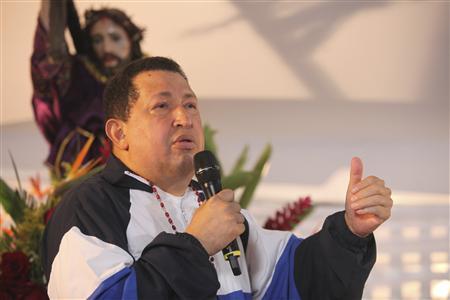
download 300x200 Venezuelas Capriles slams Chavez for blocking broadcast

Courtesy of: Reuters

Venezuela’s opposition candidate Henrique Capriles slammed President Hugo Chavez on Monday for blocking a live broadcast of an opposition rally, highlighting criticism the leftist leader abuses state resources to guarantee his re-election.

Shortly after Capriles began speaking to thousands of supporters in a Caracas park, Chavez launched a “chain broadcast” across all public access television in which he celebrated his government’s achievements and extolled the virtues of socialism.

“Another radio and television chain broadcast to continue lying to Venezuelans just 20 days before the election,” Capriles said via his Twitter account.

Capriles has accused Chavez of using state institutions to tilt the October 7 election in his own favor, from giving supporters cash and apartments, to using state media to glorify his image.

Government officials dismiss those charges, saying the social programs are aimed at helping the poorest, not buying votes.

Chavez says he only uses “chain” broadcasts for state business, not to boost his re-election campaign, but they often last for hours, during which he usually berates his opponents.

Local broadcasters in the South American nation are forced to halt their programming to carry the speeches, although the system was originally designed for brief emergency messages.

After Capriles was told his rally had been taken off the air, he told the crowd: “My friends, people are allowed to be afraid if they want.”

Supporters responded with thunderous applause. The rest of Capriles’ speech was screened by opposition TV station Globovision after Chavez finished talking.

The election campaign was already drowning in a flood of accusations and insults. Just days earlier, Capriles fired a top aide who had been seen accepting an envelope of cash in a video made public by Chavez’s allies.

Chavez remains popular in the OPEC nation after 14 years in power, thanks largely to his self-styled revolution’s liberal spending of oil revenue on social programs ranging from free health clinics to subsidized supermarkets.

‘MY REVOLUTION’

He leads the election race in most of the best-known polls, which are notoriously controversial and divergent in Venezuela. One major polling firm has Capriles ahead and his numbers have been edging up.

Chavez spoke for almost two hours on Monday at a school inauguration about how education has improved under his government. During the broadcast, several children thanked him for giving them laptops and ensuring access to education.

“Chavez, you are the heart of the people,” said one toddler, echoing the government’s principal campaign slogan.

Chavez, who won fame through a failed 1992 coup, has built up a strong emotional connection with the country’s poor that has made him a formidable candidate.

On Saturday, he tugged at supporters’ heart-strings by weeping during a speech at a campaign rally in which he lamented that he could no longer roam the country as in years past.

That may have been a reference to his cancer diagnosed last year. He says he is cured, but it has apparently limited his ability to campaign in the streets.

Opposition leaders described the scene as histrionic crocodile tears, saying he should have cried for the victims of delinquent violence rather than for himself.

On Monday, Capriles mocked Chavez’s triumphalist rhetoric in a swipe at the government’s struggle to control blackouts, rampant crime and deterioration of public services.

“My revolution is that the people will have water, power and good jobs,” Capriles told supporters. A day earlier, he led a rally through the Petare slum that was for years a bastion of Chavez support but in 2008 backed an opposition mayor.

Chavez has spent more than 70 hours in “chain” broadcasts since the start of the campaign on July 1, according to opposition activists that track the broadcasts.

The head of the National Electoral Authority has said that such broadcasts cannot be regulated by elections officials because they are used to inform the public about government projects and do not constitute campaign activity.

To read this article in Reuters, please click here.

 
Sep
15
2012
Posted by
admin
Comments

Cancer or no Cancer, Venezuela President Hugo Chavez Won’t Pick Running Mate

Fox News Latino
September 15, 2012

Venezuela No Running  Garc Cancer or no Cancer, Venezuela President Hugo Chavez Won’t Pick Running Mate

Courtesy of: AP / Ariana Cubillos

CARACAS, Venezuela – Even with his deteriorating health, Hugo Chavez is not afraid to stand alone.

While it is normal in Venezuela’s election system for presidential candidates to not choose a running mate, this year’s situation has voters concerned.

President Chavez has been fighting a mysterious cancer that, along with a lack of a prospective No. 2, has left some Venezuelans wondering who in fact would take over were Chavez to win next month’s elections but be forced to leave office prematurely.

Nearly alone among South American nations, Venezuelan law leaves designation of a vice president until after the new leader is sworn in. The country did not even have a vice president until 1999, when the office was created in a new constitution promoted by Chavez.

Campaigning against youthful challenger Henrique Capriles, Chavez seldom mentions his health problems, which over the past 15 months have required frequent trips to Cuba for three surgeries, chemotherapy and radiation treatments. When asked about his health last week, Chavez said his last checkup in June showed he was cancer-free and “everything will be fine.”

Still, even some loyal Chavez supporters who plan to vote for him on Oct. 7 acknowledge feeling uneasy about the uncertainty.

“Who would take his place? Nobody knows, and that’s makes me worry,” said Maria Lovera, a street vendor selling household cleaning supplies on a street corner.

“I love Chavez and I want him to remain in power for many more years, but I must confess that some people like me have suspicions that he hasn’t told us the whole truth about his cancer,” Lovera said.

“The possibility of him getting sick again and having to step down exists.”

Some say identifying a vice president now could cause divisions within Chavez’s movement by favoring one faction over another.

And because none of Chavez’s possible vice presidential candidates have anywhere near his popularity, choosing one might alienate some sectors within his movement or prove less appealing to voters still on the fence.

“He is aware that if he appoints the VP (ahead of the vote), that would trigger divisions and increase uncertainties,” said Diego Moya-Ocampos, an analyst with the consulting firm IHS Global Insight in London.

Capriles has not named a likely vice president either, though the issue is less pressing because there are no questions about the 40-year-old’s health.

“Capriles, like Chavez wants to make this a contest between the two figures,” said Miguel Tinker Salas, a Latin American studies professor at Pomona College in Claremont, California. For both candidates, he said, to name a vice president now “would detract from this strategy.”

Under Chavez, the vice presidency has been an office of limited authority. In fact, the country’s constitution doesn’t even specify how soon a president must name a vice president after winning office.

Chavez has delegated little to his vice presidents over the years, instead using his deputy as one in a team of aides who largely carry out his instructions. Even when he was forced to scale back his work due to taxingcancer treatments in Cuba, Chavez delegated only minimal administrative duties to current Vice President Elias Jaua, whom he appointed in 2010, the seventh man to hold that post during the socialist leader’s 13 years in office.

Venezuela’s Constitution says that if a president-elect dies before taking office, new elections would be called. If a president dies during the first four years of the term, the vice president would temporarily take over, but a new election would be held. If a president dies during the last two years of the six-year term, the vice president would finish the term and the next election would be held as planned.

In most South American countries vice presidents are elected at the same time as the top of the ticket. In Chile, however, presidential candidates run for office alone, but once in office name an interior minister who serves as vice president when necessary.

As for which ally Chavez might pick as his deputy if re-elected, speculation in recent months has ranged widely across figures such as Foreign Minister Nicolas Maduro and National Assembly President Diosdado Cabello.

Throughout his presidency, Chavez’s closest confidants have been characterized by their lack of an independent following, a relative lack of charisma and military-like allegiance to their leader, a former army paratroop commander.

Moya-Ocampos said the vice-presidential mystery is by design. By saving any talk of his choice for later, he said, Chavez aims to send a simple message, “that there is no clear successor.”

To read this article in the Fox News Latino, please click here.

 
Sep
10
2012
Posted by
admin
Comments

Election rival ridicules idea that Venezuelan leader Hugo Chavez pursues socialist policies

Washington Post via Associated Press
September 10, 2012

Venezuela Politics.JPEG 021f2 Election rival ridicules idea that Venezuelan leader Hugo Chavez pursues socialist policies

Courtesy of: Associated Press

CARACAS, Venezuela — The Venezuelan opposition’s candidate in next month’s presidential election ridiculed President Hugo Chavez on Monday for claiming to pursue socialist policies, and pledged to use the country’s oil wealth more effectively if elected.

Henrique Capriles told supporters that nearly 14 years under the fiercely anti-capitalist Chavez have resulted in Venezuela having violence-plagued prisons, crumbling hospitals and one of the world’s highest murder rates.

“If they’re socialists, I’m Marxist-Leninist, because I invite them to compare who is doing more on the social front and who is using resources to solve the problems of our people, not to save other countries,” Capriles said during a speech in which he laid out his plans if he wins the Oct. 7 vote.

“This government imports gasoline from the United States and says it fights against imperialism. It imports rice from the U.S. and it says that it has gained its independence,” he told a cheering crowd.

Capriles pledged to improve police forces to combat crime, which according to polls is a top concern for Venezuelans. He also said he would provide people with more job opportunities as well as better electricity and water services after years of decaying infrastructure.

The opposition candidate accused Chavez of wasting Venezuela’s oil riches through fuel supply deals with allied nations such as Cuba and Nicaragua that involve long-term, low-interest financing. “We aren’t going to give away a single drop more of our oil,” he said.

Chavez disputes that characterization of his foreign oil deals and says Venezuela has reached mutually beneficial oil deals with its allies during his presidency.

Speaking on state television Monday, the 58-year-old president called the 40-year-old Capriles “a rich kid disguising himself as poor, as a boy from the barrio.”

The leftist Chavez has regularly accused his rival of representing the interests of the wealthy, but Capriles describes his views as center-left and says he would maintain social programs for the poor while also working with the private sector to create jobs.

Capriles has strongly criticized government seizures of private businesses during Chavez’s presidency.

The president has maintained a lead in most recent polls, but one survey last month put the two candidates roughly even in a race that is expected to be the toughest challenge of Chavez’s career. After battling cancer in the past year, Chavez says he is free of the illness as he seeks another six-year term.

Trying to shore up support among poor Venezuelans, Chavez has also increased spending on public housing and other social programs.

Chavez has accused Capriles of having a hidden agenda to impose right-wing policies, and reiterated claims on Sunday that such policies could lead to “a civil war.” He said that even the wealthy, who are regular targets of his criticism, ought to have an interest in supporting him.

“To the families that have their riches, that own their nice homes, their good cars, with their great apartments on the beach, who like to travel abroad on holidays: Is a civil war convenient for them? Not at all. It’s only convenient for the extreme fascist right,” the president told supporters. “Even the rich guys, the wealthy families who want tranquility … Chavez guarantees you peace, stability.”

Capriles has sought to counter such claims by saying that his proposals would bring stability and that he has no plans to take away the government’s social programs for the poor.

Among his pledges on Monday, Capriles said he would strive to bring down Venezuela’s inflation rate, which at 18.1 percent is the highest in Latin America.

He also said he would raise the minimum wage to the equivalent of $581 a month from the current $476.

As for the country’s key oil industry, Capriles pledged to take steps to ensure better maintenance and safety measures. He referred to the powerful Aug. 25 explosion at Venezuela’s Amuay oil refinery, which killed at least 42 people.

“Venezuelans still don’t know the causes of this accident,” Capriles said. “The question all of us are asking is: Under this government, will we ever know what happened there?”

___

Luis Andres Henao on Twitter: https://twitter.com/LuisAndresHenao

To read this article on The Washington Post, please click here.