Feb
29
2012
Posted by
admin
Comments

Venezuela’s Chavez: I’m recovering like a condor

Reuters
By Andrew Cawthorne
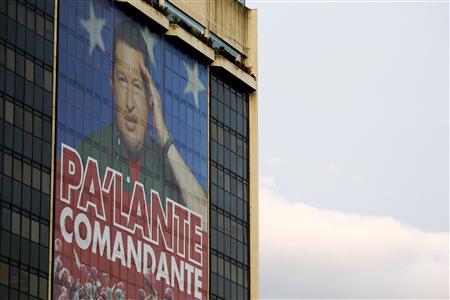
download5 300x200 Venezuelas Chavez: Im recovering like a condor

Courtesy of: Reuters / Jorge Silva

Venezuela’s President Hugo Chavez broke his silence on Wednesday after surgery in Cuba for a suspected recurrence of cancer to insist he was recovering well and “soaring like the condor”.

“I send you all my supreme love. We will live and we will recover!” the 57-year-old socialist leader enthused via Twitter from Havana where he was operated on earlier in the week.

“Here I go, soaring like the condor.”

Despite an upbeat official assessment of the latest procedure in Cuba, some sources including a prominent pro-opposition Venezuelan journalist suggested Chavez may face a life-threatening spread of the disease discovered last year.

The health saga has raised questions over Chavez’s ability to campaign for re-election in October and to rule the South American OPEC member afterward should he win.

His condition also has huge implications around a region where Cuba and other leftist governments in the Caribbean and Central America count on his oil-financed largesse.

The government blames Venezuela’s “ultra-right” for fomenting malicious speculation. “Our people should not pay attention to these rumors. We are going through a very emotional time,” said Isis Ochoa, the minister for social protection.

Having exuded strength since storming to power as an election outsider in 1998, Chavez’s public image and personal ebullience suffered a big blow last year when doctors discovered a cancerous tumor in his pelvis.

MEDIA HATE FIGURES

Although he said he was fully recovered toward the end of 2011, the president returned to Cuba for new surgery last weekend on a probably malignant “lesion” in the same area.

The government said the lesion was completely removed, with test results due soon on the extracted tissue.

Vice President Elias Jaua told state television Chavez was in good spirits when he spoke to him by telephone on Wednesday evening. “He is in a full process of recovery,” he said.

“With a firm, energetic and victorious voice, he sent a fraternal greeting to the people, his love and thanks.”

There has been no word on when Chavez will return, prompting opposition calls for a replacement to be named.

Nelson Bocaranda, an anti-Chavez Venezuelan journalist who broke the news of his return to Cuba, and Merval Pereira, a well-known commentator for Brazil’s O Globo network, have been quoting medical sources to suggest the Venezuelan leader’s situation is much more serious than the official version.

The pair have been heavily criticized by Chavez allies.

In an increasingly vitriolic atmosphere, state TV was crammed with mockery of foreign and opposition media, while anti-Chavez activists have sarcastically dubbed Bocaranda the country’s only reliable “information minister”.

Experts say the pathology results from Chavez’s operation on Monday may take up to five days, while a normal recuperation period from that type of surgery would be a week to 10 days.

Former Cuban President Fidel Castro has long been Chavez’s mentor, and the Venezuelan leader prefers receiving treatment in Havana where there is high security and a lower chance of his medical details being leaked on the tightly controlled island.

In his latest online posting, Bocaranda said on Wednesday there was an atmosphere of “great paranoia” at the Cimeq hospital in Havana where Chavez was presumably being treated.

A Brazilian doctor helping assess Chavez had concluded the use of steroids to give him strength since last year’s operation had hastened the recurrence of a new tumor, he said.

“If the decision is to give him more chemotherapy from April, as we said last week, the use of steroids will be forbidden,” Bocaranda added on his closely watched www.runrun.es site.

“That is a big worry for the patient because his physical deterioration, with such a strong cocktail of chemicals, would become evident very quickly.”

VOTE LOOMS

Cuba has a lot at stake in Chavez’s future.

It receives about 100,000 barrels per day of cheap oil from Caracas in return for supplying doctors, nurses, teachers and others to work in Venezuelan social projects.

Chavez’s rival for the October 7 poll is Henrique Capriles, a 39-year-old state governor who hopes to woo former Chavez voters with a promise of a Brazilian-style “modern left” government.

He repeatedly wishes Chavez a speedy recovery “so he can see the changes coming to Venezuela.”

Before the announcement that he would need more surgery, opinion polls showed Venezuelans broadly split – a third pro-Chavez, a third pro-opposition and a third undecided.

But the polls indicate Chavez has the edge in voter enthusiasm due to his popularity among Venezuela’s poor and a big increase in welfare spending for the most needy.

While the president may get a “sympathy bump” in opinion polls from his latest health setback, analysts say perceptions of weakness – particularly in contrast with Capriles’ youthful image – could offset that.

The OPEC nation’s widely traded bonds have jumped on investor perceptions of a more market-friendly opposition’s enhanced chance of winning the presidential poll in October.

Chavez has avoided grooming a successor, so rumors abound as to who could take over if he were incapacitated.

Two heavyweight allies, vice president Jaua and Congress head Diosdado Cabello, are widely rumored to be at odds. Yet they made a public show of friendship in parliament on Tuesday, smiling and pledging unity.

Neither man, nor any other of Chavez’s closest allies, have his man-of-the-people charisma or the political talents that have enabled him to thwart the opposition for 13 years.

(Additional reporting by Daniel Wallis in Caracas and Nelson Acosta in Havana. Editing by Christopher Wilson)

To read the original article on Reuters, please click here.
 
Feb
26
2012
Posted by
admin
Comments

Chavez Surgery Opens Venezuela Election Chances For Candidate Henrique Capriles

The Huffington Post

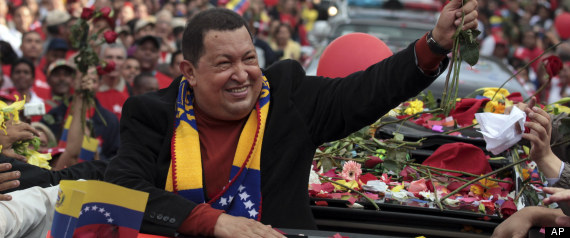
r CHAVEZ SURGERY VENEZUELA large570 300x125 Chavez Surgery Opens Venezuela Election Chances For Candidate Henrique Capriles

Courtesy of: AP / Fernando Llano

Throughout his presidency, Hugo Chavez has relied on his vigor and endurance: playing baseball, speaking for hours at a stretch and making decisions on the fly while bounding around Venezuela exuding energy.

Now, just as he may need it most, Chavez finds himself ailing heading into a re-election campaign.

It’s the rival, Henrique Capriles, who tossed a baseball with Little Leaguers and embraced admirers as Chavez, 18 years older, disappeared over the weekend into a Cuban hospital to have a potentially cancerous tumor surgically removed.

Capriles “represents a contrasting young and energetic option,” said Diego Moya-Ocampos, an analyst with the London-based consulting firm IHS Global Insight.

The 39-year-old state governor has also, perhaps inadvertently, blunted some of the sympathy vote that might go to Chavez by shunning direct attacks on the president. He has cast himself as a polite, non-confrontational politician, a sharp contrast to the venom-tongued president, who recently referred to Capriles as “a pig” and has accused rivals of wanting him dead.

But Capriles didn’t rise to the bait.

“I wish the head of state a long life,” Capriles said. “I want him to see the changes that are going to come about in our country, for him to see a Venezuela of progress, a united country, a country where Venezuelans have many opportunities.”

He added a little dart though: “It’s important that people who have an illness tone down the confrontation a bit. It’s not good for one’s health.”

History has shown that those who underestimate the socialist president do so at their own peril.

“For now (Chavez’s) illness represents a political weakness, unless and until he can put it behind him,” said John Walsh, an analyst at the Washington Office on Latin America, an independent think tank. “If he can eventually convince people that he has overcome cancer, then the narrative changes to one of Chavez conquering adversity, and the advantage could shift to Chavez.”

“Chavez is a masterful politician,” Walsh added. “His resourcefulness in setting the agenda and defining the terms of debate should not be underestimated.”

Chavez had seemed to be rebounding from last year’s cancer surgery, when he was in Cuba for weeks to have a malignant tumor removed from his pelvic region. At the time, he was often out of sight and was slow to give details of what was going on, leaving Venezuelans guessing about his health. But the hair he lost during chemotherapy has been growing back and Chavez was again back to making extensive, and extended, public appearances. He spoke for about four hours on Thursday as he discussed his illness before departing for Cuba, insisting, “I will live!”

Chavez’s refusal to say exactly what type of cancer he had, as well as earlier assurances he had been completely freed of cancer, have led to uncertainly among Venezuelans regarding his chance for full recovery.

Chavez revealed last week that his Cuban doctors had discovered a one-inch (two-centimeter) lesion near where the larger tumor was removed last year and he has conceded he could be out of action for a while. If he is forced to undergo radiation treatment following the surgery, he could be sidelined for several months.

That could leave Capriles free to hog the spotlight back home, making personal appearances at school openings and giving speeches as the campaign builds toward the October vote.

If Chavez is unable to personally lead his re-election bid, that opens him to questions about whether he is still capable of running the government and illness tarnishes his long-standing image as an unbeatable politician just as the long-fractious opposition has finally united behind a single candidate.

Capriles, meanwhile, has been busy inaugurating schools and sports facilities in his central state of Miranda. At the inauguration of a baseball diamond on Saturday, he joined dozens of Little League players for warm-up exercises and tossed a ball around with them before a game.

Neighbors see him go on daily jogs through his middle-class Caracas neighborhood, and he even runs the occasional marathon.

That’s the sort of athleticism long displayed by Chavez, a former paratrooper and a pretty good amateur baseball player.

A day before he left for Cuba, Chavez acknowledged that cancer’s apparent comeback has obliged him to move beyond his usual politics of personality and lean on others.

“This situation forces me to move forward the appointment of the campaign organizers,” he said to loud applause at a packed rally in Caracas. “I swear that I’ll live and I’ll accompany you to new victories. No cancer will stop us.”

While the president’s social programs are popular among the country’s poor, he is vulnerable to criticism about economic and social problems that have persisted or grown during his more than 13 years in office. Those include annual inflation of 26 percent, the highest rate in Latin America, and soaring murder rates.

While Chavez has insisted that Capriles would eliminate many benefits for the poor, the governor has so far promoted welfare programs similiar to those of Chavez in his own state.

“The race is already shaping up to be close, and a physically weakened Chavez, less potent as a campaigner, would make it even closer,” Walsh said. “At this stage it will be difficult for Chavez to recover his aura of invincibility and inevitability, meaning it will be a hard-fought campaign.”

Luis Vicente Leon, director of the Datanalisis polling firm, said he expects the tightest presidential race Venezuelans have seen since Chavez’s first election victory in 1998.

“It’s the first time the opposition kicks off a campaign so close to Chavez,” Leon said.

Before Capriles won a Feb. 12 primary, polls by Datanalisis showed a difference of less than 5 percentage points between Chavez and the still undetermined winner of the opposition vote, Leon said. Datanalisis, widely considered one of Venezuela’s most accurate pollsters, has not carried out any surveys since the primary.

Emilio Mijares is one of the many Venezuelans known as “ni-nis,” or “neither-nors,” who have never backed Chavez or his opponents. He said he might vote this October for the first time in more than a decade because he fears instability if Chavez wins a fourth term.

“I don’t believe the president is going to get better. His health could deteriorate following re-election, and that would certainly lead to problems,” said Mijares, a 48-year-old taxi driver. By contrast, he said he considers Capriles to be an efficient administrator.

Others fear political upheaval looms no matter who wins.

“If (Chavez) recovers and wins, the opposition is going to protest. On the other hand, if Capriles wins the election, the Chavistas will fill the streets and there will be violence,” said 58-year-old retiree Maria Guzman. “Whatever happens, we’ll have trouble.”

Associated Press Writer Peter Orsi contributed to this report.

To read the original article on The Huffington Post, please click here.

 
Feb
24
2012
Posted by
admin
Comments

In Case You Missed It… Articles Roundup Week of 2/24/12

In this week’s roundup…  The Chávez administration hurled insults at opposition candidate Henrique Capriles following his landslide victory in the primaries; several Jewish groups publicly condemned Chávez’s anti-Semitic remarks against Capriles. Meanwhile, Venezuela’s Hugo Chávez heads to Cuba to undergo a third operation after doctors found another lesion where his last tumor was removed, stoking speculations about who will succeed Chávez if he is forced to step down.  A new report found that private construction in Venezuela is down 70 percent in the last two years, contributing to the critical housing shortage; Chinese loans drive PDVSA toward bankruptcy; Gold Reserve Inc. concludes oral hearings in ICSID arbitration against Venezuela; and Chávez continues to foster relationships with controversial governments, including Iran and Syria.

Venezuela’s Hugo Chavez faces an uprising at the ballot box, The Washington Post

Henrique Capriles Radonski, a 39-year-old Venezuelan state governor, won a primary election to become the opposition’s candidate against Hugo Chavez in October’s presidential election.

Chavez Media Say Rival Capriles Backs Plots Ranging From Nazis to Zionists, Bloomberg

Venezuela’s state media has accused opposition presidential nominee Henrique Capriles Radonski of offenses ranging from participating in a Zionist conspiracy to joining a Nazi-inspired effort to wipe out blacks and the poor.

El loco’s new foe, The New York Post

The reign of Venezuelan strongman Hugo Chávez faces its worst trouble in years. The normally fractured opposition has suddenly united behind one man, Henrique Capriles Radonski, in the Oct. 7 presidential election.      

Jewish groups decry ‘anti-Semitic’ Venezuelan state media article, CNN

A Venezuelan state media article about Chavez’s chief political challenger drew criticism from the New York-based Anti-Defamation League and the Los Angeles-based Simon Wiesenthal Center last week. 

AJC Decries Anti-Semitic Assaults in Venezuela Presidential Campaign, Market Watch

“If President Chavez wants to convince the world that Venezuela is a democracy, he needs to act now to show that there is no room for willful hate,” said AJC Executive Director David Harris.

Chávez Health Struggle Stokes Political Uncertainties, The Wall Street Journal

New uncertainties about Venezuelan President Hugo Chávez’s health are threatening to spur a power struggle to succeed him among the factions that make up his political movement, and boosting the hopes of a rejuvenated opposition planning for the presidential election this fall.

What Happens Next in Venezuela?, Foreign Policy

What happens if an incapacitated Chávez wins? Or, will a dying Chávez’s anointing of a successor succeed in overcoming a unified and energized opposition for the first time in a decade? Or, will voters, burdened by declining economic conditions and rising crime, opt for a new direction in the face of the uncertainty surrounding Chávez and the lack of a legitimate standard-bearer for his movement?

The republic vs. Chávez, The Miami Herald

You multiply it by 2.5 or 3 — depending on whom you ask. That’s how you usually translate the votes from the primaries into the final election results. Electoral experts insist that the three million votes obtained by Henrique Capriles in the Venezuelan primaries could bring him between 7.5 and nine million votes in the balloting against Hugo Chávez. Enough to remove him from power.

Private construction drops 70% in the past two years, El Universal

The president of the Venezuelan Construction Chamber, Juan Francisco Jiménez, stated that private construction has dropped 70% in the last two years. The situation was described as serious by the businessman leader, who said that the construction industry is necessary for the country’s development.

Thousands Of Homeless An Election Issue For Chavez, NPR

Oil-rich Venezuela is awash in hundreds of thousands of homeless. Many find places to live where they can — in half-finished shopping malls or under the grandstand at a race track. The huge number of homeless has become an election issue for President Hugo Chavez, who is seeking his fourth, six-year term.

Chinese loans put Venezuela over barrel, The Washington Times

Opposition groups in Venezuela are warning that billions of dollars in Chinese loans are driving the state oil company toward bankruptcy.

Gold Reserve Announces Conclusion of Oral Hearings in ICSID Arbitration Against Venezuela, Business Wire

Gold Reserve Inc. announces that the oral hearings held at the World Bank in Washington, D.C., and presided over by a three-member tribunal in the arbitration conducted under the auspices of the International Centre for the Settlement of Investment Disputes concluded, as scheduled, on February 17, 2012.

As Others Isolate Syria, Chávez Ships Fuel to It, The New York Times

A day before the United Nations General Assembly voted overwhelmingly to condemn President Bashar al-Assad of Syria this month for his bloody crackdown on the uprising in his country, President Hugo Chávez of Venezuela was conducting a very different kind of diplomacy on his own.

Iran and Venezuela, BFF, The NY Daily News

At a time when the world is rightly focused on the Iranian nuclear threat and its intentions against Israel, it is also important to not lose sight of that country’s clandestine dealings in Latin America. Its activities there serve multiple purposes. None of them is benign.