Mar
16
2012
Posted by
admin
Comments

In Case You Missed It… Articles Roundup Week of 3/16/12

In this week’s roundup… Uncertainty about Hugo Chavez’ health begins to create infighting within the PSUV… Price controls and land seizures continues to erode Venezuela’s private industry; the last remaining publicly traded gold miner in Venezuela, Rusoro Mining Ltd., expects its assets to be seized; the government threatens to nationalize water utilities in the state if Monagas. The Venezuelan government refuses to open the door to the UN and IACHR to review potential threats to human rights, and Iran finds ways to elude economic sanctions through its partners in Ecuador and Venezuela.

Venezuela: opposition gathers strength, The Financial Times

As Hugo Chávez continues to languish in Cuba, recovering from an operation to remove a cancerous lesion, things are getting increasingly fraught amongst his followers back home.

PDVSA Oil Spill Exposes Fissures in Chavez’s Socialist Party, Bloomberg

An oil spill at a facility operated by Venezuela’s state oil company has sparked the first public spat in the ruling party since President Hugo Chavez was diagnosed with cancer in June.

Chavez’s ruling party suspends governor in Venezuela after public criticisms, The Washington Post via The Associated Press

A state governor was suspended from President Hugo Chavez’s governing party on Wednesday after making critical remarks about the president of Venezuela’s National Assembly.

Sinister forces at work in Venezuela power struggle, The Miami Herald

Venezuelans are facing a tumultuous year ahead that could bring an end to 13 years of authoritarian populism under cancer-stricken caudillo Hugo Chávez or make matters worse.

Hugo Chávez’s cancer dominates Venezuelan election campaign, The Guardian

Welcome to Venezuela’s presidential election campaign, a swirl of intrigue and conspiracy theories over the health of Hugo Chávez that has thrown the race wide open and stoked hope and dread on both sides.

Price caps pound manufacturers and wholesalers, El Universal

Standard prices, according to industry experts, imply that, as a result of Sundecop’s failure to recognize differences in product presentation, production costs will be greater than the price set by the governing agency for certain products.

Substantial losses out of land seizure, El Universal

Lands rescue announced by Venezuelan Vice-President Elías Jaua on October 12, 2011, encompassing 25 farms in Machiques de Perijá Municipality, western Zulia state, hit the daily production of 26,000 liters of milk.

Rusoro Expects Venezuela Gold Takeover as Talks Fail, Bloomberg Businessweek

Rusoro Mining Ltd. (RML), the last remaining publicly traded gold miner in Venezuela, expects its gold assets in the South American country to be taken over after a deadline to negotiate with the government lapsed, Chief Executive Officer Andre Agapov said. The stock slid 12 percent.

Authorities threaten to nationalize Monagas’ water utility, El Universal

The Venezuelan minister warned that the government will have to nationalize Monagas water supply company (Aguas Monagas) if José Gregorio Briceño, the governor of northeastern state of Monagas, continues refusing to supply water from the Guarapiche River. The water is fit for drinking, Hitcher stressed.

Venezuelan gov’t refuses to open the door to the UN and IACHR, El Universal

Venezuela’s doors will continue to be closed for the United Nations’ and the Inter-American Commission on Human Rights’ (IACHR) Special Rapporteurs, unless the government deems it “appropriate” to invite them.

Iran’s stealth financial partners in Latin America, The Miami Herald

One unconventional mechanism developed by Iran, with the help of Venezuela and Ecuador, is a way to bypass the economic sanctions, as Iran may be using a parallel financial system operated by members of ALBA countries — the Cuba-Venezuela-Bolivia-Ecuador-Nicaragua axis — to elude financial sanctions by the West and engage in money-laundering.
 
Mar
9
2012
Posted by
admin
Comments

In Case You Missed It… Articles Roundup Week of 3/9/12

In this week’s roundup… Hugo Chávez reveals that his recently removed tumor was cancerous; Chávez supporters open fire on a rally for opposition candidate Henrique Capriles; Venezuela’s Jewish community slams the Chávez administration for anti-Semitic attacks against Capriles. Venezuela’s foreign debt rises 90 percent in just three years; the Inter American Press Association (IAPA) condemns Venezuela’s Supreme Court decision to uphold a $2.18 million fine against Globovisión.  Venezuela continues to send aid to embattled Syrian leader Bashar Assad; Chávez’s relationship with Ahmadinejad deepens, as reports surface that Iran will provide Chávez’s army with unmanned drones.

Venezuela’s Hugo Chávez says new tumor was cancerous in 1st TV appearance in 9 days, The Washington Post via the Associated Press

Venezuelan President Hugo Chávez revealed Sunday that a new tumor recently removed from his pelvic region was of the same type of cancer as a baseball-sized growth extracted from that part of his body about eight months ago.

The man who could be Venezuela’s next president — if the Chavistas let him, Foreign Policy

Venezuela President Hugo Chávez’s disclosure that his cancer has recurred raises hard questions about his ability to campaign for re-election in October. If he lacks the stamina or is incapacitated, what happens next — will fair elections proceed, or will his ruling circle frustrate any potential transfer of power?

In Venezuela, Election Won’t Inspire Stability, The Wall Street Journal

In Venezuela’s increasingly unpredictable presidential election, voters face more than a choice between competing ideologies. They must also weigh which candidate represents the best hope of staving off political and social upheaval.

Venezuela Opposition Presidential Candidate Capriles Rally Attacked by Gunmen (VIDEO), Latin American Herald

Red shirted supporters of left-wing Venezuela President Hugo Chávez fired shots at a crowd of opposition supporters gathered for a rally with opposition presidential candidate Henrique Capriles Radonski.

Jews hit out at Venezuelan government, The Jewish Chronicle

The Jewish community in Venezuela has denounced the attack by the state media on Henrique Capriles. An article published on the Venezuelan State Radio website entitled The Enemy is Zionism criticised Mr. Capriles’s Jewish ancestry.

What’s going on at PDVSA? The Financial Times

Do the ends justify the means for PDVSA, Venezuela’s state oil company? The ends at least are clear enough: to keep afloat Hugo Chávez’s revolution, which in turn depends on the well-being of PDVSA, one of the world’s biggest oil companies that doubles up as the Venezuelan president’s piggy bank.

Venezuela’s operating reserves sink to lowest level in 15 years, El Universal

Though rising oil prices drive in petrodollars, Venezuela’s operating reserves, that is, currency deposited with banks for imports and foreign-debt payments, have plummeted to their lowest level in 15 years.

In three years, Venezuela’s foreign debt grew 90%, El Universal

In 2009, drop in oil prices led the Venezuelan government to borrow to cover the oil revenue gap and, although the barrel price recovered in the following years, the government has continued to issue further debt.

WikiLeaks report cites corruption in Venezuela production, The Miami Herald

The destruction of Venezuelan production in favor of imports is worsening the scarcity problem and creating corruption by those who want to obtain bigger contracts, says a report by the private intelligence firm Stratfor released by WikiLeaks.

IAPA condemns high court ratification of fine on Globovisión, El Universal

The Inter American Press Association (IAPA) on Thursday strongly condemned the ratification by Venezuela’s Supreme Tribunal of Justice (TSJ) of a fine meted out to private TV news channel Globovisión, calling the rejection of its appeal “a reprisal and censorship of freedom of information

Venezuela to ship more fuel to Syria as crackdown spreads, Reuters

Venezuela is readying a third shipment of diesel to the government of Syria even as President Bashar al-Assad intensifies a crackdown against protesters, said a Venezuelan lawmaker on Monday.

Southern Exposure: Iran, Terror Groups Setting Up Shop in South America, U.S. News

Iran and Middle East-based extremist groups are stepping up their activities in South America, aiming to make friends and score cash, a senior U.S. military official says. Tehran intends to build military drones in Washington’s backyard for the Venezuelan military led by Hugo Chávez, U.S. Southern Command chief Gen. Douglas Fraser told reporters Wednesday during a breakfast meeting in Washington.

 
Mar
8
2012
Posted by
admin
Comments

ICYMI: Iran, Terror Groups, and South America?

Southern Exposure: Iran, Terror Groups Setting Up Shop in South America
U.S. News & World Report
March 7, 2012

Iran and Middle East-based extremist groups are stepping up their activities in South America, aiming to make friends and score cash, a senior U.S. military official says.

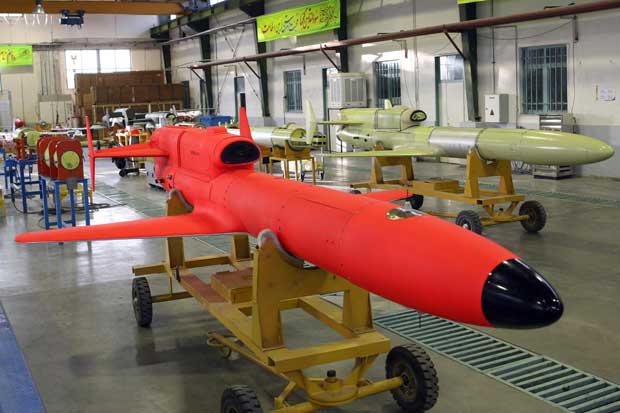
Tehran intends to build military drones in Washington’s backyard for the Venezuelan military led by Hugo Chavez, U.S. Southern Command chief Gen. Douglas Fraser told reporters Wednesday during a breakfast meeting in Washington.

Iran Drones 120307 01 ICYMI: Iran, Terror Groups, and South America?
Source: U.S. News & World Report

Pressed by DOTMIL about the unmanned aerial vehicles’ capabilities, Fraser dubbed it “a fairly limited-capacity UAV.”

“I would put it in the Scan Eagle class of UAV,” Fraser said. “It’s not up into the Predator class.”

The Southern Command chief was referring to two U.S.-made drone aircraft used by the American military. The Scan Eagle is about 10 feet long and is used for surveillance while the MQ-1B Predator drone can be armed with air-to-ground Hellfire missiles and is about 27 feet long.

Fraser said it’s unclear what kinds of missions Venezuelan officials will send the Iranian drones.

His best guess? “I assume it’s for internal defense.”

In, 2006, Israeli officials said they shot down at least three Iran-backed Hezbollah drones during a war in Lebanon.

In December, Tehran said one of its electronic warfare units downed an American military RQ-170 spy drone, known as the “Beast of Kandahar.” It remains unclear whether Iran has fitted that kind of technology on the drones sold to Venezuela.

U.S. officials do know production of the Iranian drones has been delayed due a recent fire at the manufacturing plant, Fraser said.

Teal Group analyst Phillip Finnegan says the drone deal “is one of these intangible signs of the relationship between Iran and Venezuela.”

“If they can get a UAV that appears to be a cutting-edge symbol of that relationship,” they can frame it as a loss for the United States, Finnegan says. “Although it’s likely the end result might not be cutting-edge — generally Iran is not mentioned as being in the forefront of countries developing this capability.”

Tehran also has doubled the number of official embassies it maintains across South America from five to 10. Iran also has erected “cultural centers” in some countries, Fraser said. This is part of a broader increase in diplomatic efforts on the continent, he added.

So what is Tehran up to?

“They are working to build diplomatic relations [and] international support to counter the sanctions” imposed by Washington and Europe as a means toward pressuring Iran to scuttle its nuclear arms program, Fraser said.

U.S. officials are also closely monitoring the activities in South America by two of Iran’s allies, the Hamas and Hezbollah groups. The State Department has long considered both terrorist organizations.

So far, those groups have been involved in the kinds of “illicit activities,” as Fraser put it, that are familiar in South America: the trafficking of drugs, weapons and people. The goal for Hamas and Hezbollah is to use these activities to generate funds to send back to their leaders in the Middle East.

“I’ve seen no indications of al Qaeda” establishing a foothold on the southern continent, Fraser told DOTMIL.

To read this article on U.S. News & World Report please click here.